
Todos los libros

Profesional

Apps Acerca de Coach Iniciar sesión Empezar a leer

Quantitative Finance · Glosario

¿Qué es Economic value of equity, NII sensitivity?

También llamado: economic value of equity · net interest income sensitivity

Definition 24.7 Rates, Credit, XVA and Risk · Capítulo 24 — Liquidity and Funding Risk; Bank Treasury

The economic value of equity (EVE) is the present value of the banking book’s asset cash flows less that of its liability cash flows (deposits slotted by behavioural models). Net interest income sensitivity is the change in the next year’s interest income less interest expense under a rate scenario, on a constant balance sheet.
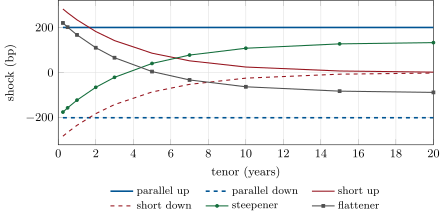
The six supervisory interest rate shocks for the US dollar by tenor: parallel ±200 basis points, short-rate ±300 decaying with tenor, and the two rotations built from the short and long shocks. Data: Basel Committee IRRBB standard (2016); the chapter’s tutorial.
Figure 24.1. The six supervisory interest rate shocks for the US dollar by tenor: parallel ±200\pm200 basis points, short-rate ±300\pm300 decaying with tenor, and the two rotations built from the short and long shocks. Data: Basel Committee IRRBB standard (2016); the chapter’s tutorial.
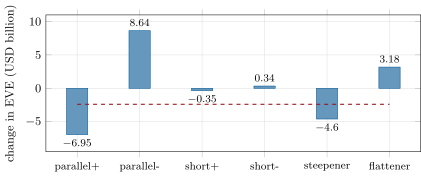
Change in the stylised bank’s economic value of equity under the six supervisory shocks, at a 1% rate. The dashed line is the outlier threshold, a loss of 15% of Tier 1 (2.4); the parallel-up and steepener scenarios cross it. Data: the chapter’s tutorial.
Figure 24.2. Change in the stylised bank’s economic value of equity under the six supervisory shocks, at a 1% rate. The dashed line is the outlier threshold, a loss of 15% of Tier 1 (2.4); the parallel-up and steepener scenarios cross it. Data: the chapter’s tutorial.
Leer en el capítulo →