Todos los libros

Profesional

Apps Acerca de Coach Iniciar sesión Empezar a leer

Quantitative Finance · Glosario

¿Qué es False discovery rate, Benjamini–Hochberg procedure?

También llamado: false discovery rate · Benjamini--Hochberg procedure

Definition 12.11 Quantitative Methods · Capítulo 12 — Testing and Multiple Testing

If a procedure makes RR rejections of which VV are true nulls, its false discovery rate is E[V/max⁡(R,1)]\E[V/\max(R, 1)]. The Benjamini–Hochberg procedure at level qq rejects H(1),…,H(k)H_{(1)}, \dots, H_{(k)} for the largest kk with p(k)≤kq/mp_{(k)} \le kq/m.

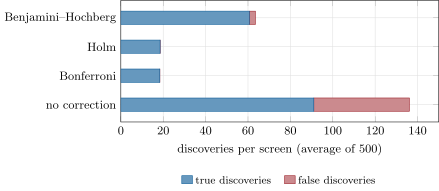
A thousand signals, a hundred of them real: average true and false discoveries of four rules at 5%. No correction: 91 true, 45 false. Bonferroni and Holm: 18 true, 0.05 false. Benjamini–Hochberg: 61 true, 2.9 false (a false discovery rate of 4.4%). Data: the chapter’s tutorial, seeded.
Figure 12.4. A thousand signals, a hundred of them real: average true and false discoveries of four rules at 5%. No correction: 91 true, 45 false. Bonferroni and Holm: 18 true, 0.05 false. Benjamini–Hochberg: 61 true, 2.9 false (a false discovery rate of 4.4%). Data: the chapter’s tutorial, seeded.

Ejemplos

Example 12.13 (Five pp-values)

Take p=(0.005,0.01,0.03,0.04,0.2)p = (0.005, 0.01, 0.03, 0.04, 0.2) and α=q=5%\alpha = q = 5\%. Bonferroni’s threshold 0.010.01 rejects two. Holm compares them in order with 0.05/5,0.05/4,0.05/3,…0.05/5, 0.05/4, 0.05/3, \dots: 0.005≤0.010.005 \le 0.01 and 0.01≤0.01250.01 \le 0.0125, then 0.03>0.01670.03 > 0.0167 stops it at two. Benjamini–Hochberg compares with 0.01,0.02,0.03,0.04,0.050.01, 0.02, 0.03, 0.04, 0.05: the largest kk with p(k)≤0.01kp_{(k)} \le 0.01k is k=4k = 4, so it rejects four. As adjusted pp-values (the smallest level at which each is rejected): Bonferroni (0.025,0.05,0.15,0.2,1)(0.025, 0.05, 0.15, 0.2, 1), Holm (0.025,0.04,0.09,0.09,0.2)(0.025, 0.04, 0.09, 0.09, 0.2), Benjamini–Hochberg (0.025,0.025,0.05,0.05,0.2)(0.025, 0.025, 0.05, 0.05, 0.2).

Leer en el capítulo →