 Coach
CoachA firm’s fixed cost base is the part of its costs that does not move with its revenue within a year: fixed pay, technology and communication, market data, premises, administration and depreciation. Its operating margin is operating profit, net trading revenue less pay less the other fixed costs, as a share of net trading revenue.
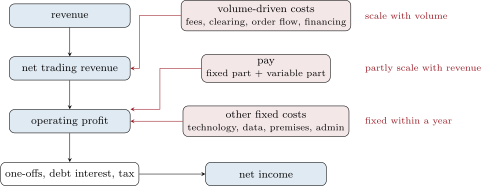
firm.firmecon); the costs on the right are taken off in order, and what each one does when revenue moves is written beside it.Examples
Example 1.3 (The market maker’s 2025 net trading revenue)
Virtu Financial’s 2025 income statement reports trading income of $2 436.7 million, commissions and technology services of $617.0 million, interest and dividends income of $508.8 million, and among its expenses brokerage, exchange, clearance fees and payments for order flow of $769.8 million and interest and dividends expense of $647.4 million. Its net trading revenue is million; the volume-driven costs take of the revenue before other income. Pay ($528.1 million) and the other fixed costs (communication and data $249.2 million, operations and administration $97.9 million, depreciation and amortisation $64.4 million, $411.5 million in all) leave an operating profit of $1 205.7 million, a margin of 56.2% on net trading revenue.