
सभी किताबें

पेशेवर

ऐप्स परिचय Coach लॉग इन पढ़ना शुरू करें

Quantitative Finance · शब्दावली

Gap risk क्या है?

Definition 15.14 Derivatives and Volatility · अध्याय 15 — Barriers and Digitals

Gap risk is the risk that a price moves discontinuously across a level at which a position’s value or hedge changes, a barrier, a strike near expiry, or a stop, so that the hedge planned at that level is executed at a worse price or not at all.
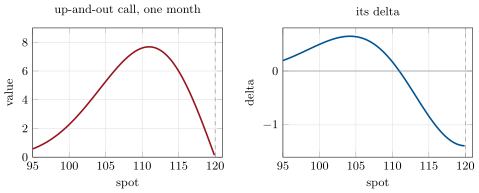
A reverse knock-out near its barrier: strike 100, barrier 120 (dashed), one month left, 20%. Its value peaks well before the barrier and its delta turns strongly negative; a hedger short the option is short the underlying there, and loses on any gap through the barrier. Data: the chapter’s code.
Figure 15.4. A reverse knock-out near its barrier: strike 100, barrier 120 (dashed), one month left, 20%. Its value peaks well before the barrier and its delta turns strongly negative; a hedger short the option is short the underlying there, and loses on any gap through the barrier. Data: the chapter’s code.

उदाहरण

Example 15.15 (A gap through a reverse barrier)

An up-and-out call, strike 100, barrier 120, has one month left, and the spot is 119. It is worth 1.38 and its delta is −1.37-1.37: a rise brings the barrier closer and destroys the payoff (Figure 15.4). The seller hedges by selling 1.37 shares. If the spot moves to 119.5, the hedged position’s P&L is +0.005+0.005. If it gaps to 125, the option dies, and the seller gains its 1.38, but the short shares lose 1.37×6=8.191.37\times6=8.19: a net loss of 6.81, five times the premium.

अध्याय में पढ़ें →