
All books

Professional

Apps About Coach Log in Start reading

Quantitative Finance · Glossary

What is Gilt and liability-driven investment?

Also known as: gilt · liability-driven investment

Definition 7.6 Markets II: Rates, FX and Credit · Chapter 7 — European and Japanese Government Bonds

A gilt is a UK government bond; conventional gilts pay semiannual coupons, index-linked gilts pay coupons and principal indexed to inflation. Liability-driven investment (LDI) is a strategy in which a defined-benefit pension fund hedges the interest-rate and inflation sensitivity of its liabilities with long gilts and swaps, often with leverage from repo and derivatives, so that it can hedge more of its liabilities than it holds in bonds while keeping other, higher-returning assets.
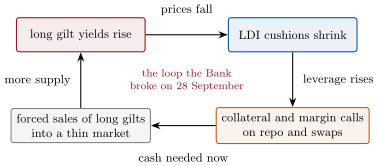
The collateral spiral of September 2022. Pension-fund LDI strategies borrowed against long gilts; rising yields eroded their cushions, calls for collateral could be met fastest by selling gilts, and the selling raised yields further. A buyer that could absorb the sales without needing a return, the central bank, stopped the loop.
Figure 7.3. The collateral spiral of September 2022. Pension-fund LDI strategies borrowed against long gilts; rising yields eroded their cushions, calls for collateral could be met fastest by selling gilts, and the selling raised yields further. A buyer that could absorb the sales without needing a return, the central bank, stopped the loop.
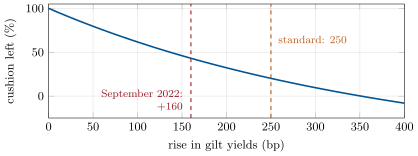
The cushion of an illustrative LDI fund, two-times levered in repo and holding a thirty-year gilt, as gilt yields rise from 3.5%. It falls to 43% of its starting value after 160 basis points, the size of the September 2022 move, and to zero after 351. Data: the chapter’s weekend problem.
Figure 7.4. The cushion of an illustrative LDI fund, two-times levered in repo and holding a thirty-year gilt, as gilt yields rise from 3.5%. It falls to 43% of its starting value after 160 basis points, the size of the September 2022 move, and to zero after 351. Data: the chapter’s weekend problem.
Read in context →