
Tous les livres

Professionnel

Applis À propos Coach Connexion Commencer la lecture

Quantitative Finance · Glossaire

Qu'est-ce que « ISDA standard model » ?

Definition 13.10 Rates, Credit, XVA and Risk · Chapitre 13 — Reduced-Form Credit

The ISDA standard model is the open-source reduced-form pricer, with agreed conventions (a flat hazard implied from a quoted spread, a standard recovery, the day’s standard discount curve, accrual and payment rules), that the market uses to convert between a contract’s quoted spread and the upfront payment at its standard coupon.
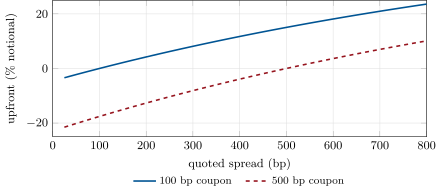
Upfront paid by the protection buyer of a five-year standard contract, from the quoted spread, at the two North American standard coupons. The upfront is zero where the quote equals the coupon and negative (received) below it. Data: the standard flat-hazard conversion; the chapter’s tutorial.
Figure 13.4. Upfront paid by the protection buyer of a five-year standard contract, from the quoted spread, at the two North American standard coupons. The upfront is zero where the quote equals the coupon and negative (received) below it. Data: the standard flat-hazard conversion; the chapter’s tutorial.

Exemples

Example 13.11 (Upfront at a standard coupon)

The five-year contract quoted at 120 basis points with a 100-basis-point coupon costs the protection buyer an upfront of 0.872% of notional (flat hazard from the quote, the five-year zero rate of 3.42% flat, recovery 40%). A name quoted at 500 has no upfront at the 500 coupon and one of 15.06% at the 100 coupon (Figure 13.4).

Lire dans le chapitre →