
جميع الكتب

مهني

1 Markets I: The Ecosystem and Exchange-Traded Marketsالأسواق عبر الإنترنت 2 Markets II: Rates, FX and Creditالأسواق عبر الإنترنت 3 Markets III: Commodities, Energy and Cryptoالأسواق عبر الإنترنت 4 Quantitative Methodsالأساليب عبر الإنترنت 5 Derivatives and Volatilityالمشتقات عبر الإنترنت 6 Rates, Credit, XVA and Riskالفائدة والائتمان والمخاطر عبر الإنترنت 7 Research Craft: Predictors, Backtests, Measurement, Portfoliosالبحث عبر الإنترنت 8 Strategies I: Equities and Futuresالاستراتيجيات عبر الإنترنت 9 Strategies II: Volatility, Relative Value, Macro and the Bank Desksالاستراتيجيات عبر الإنترنت 10 Microstructure and Executionالتنفيذ عبر الإنترنت 11 Market Making and High-Frequency Tradingصناعة السوق عبر الإنترنت 12 Machine Learning for Marketsتعلم الآلة عبر الإنترنت 13 Low-Latency Softwareالتكنولوجيا عبر الإنترنت 14 Networks, Hardware and Trading Infrastructureالتكنولوجيا عبر الإنترنت 15 Research, Data and Risk Platformsالتكنولوجيا عبر الإنترنت 16 The Desk and the Firmالشركة عبر الإنترنت 17 The Industry: Firms, Roles and Careersالمسارات المهنية عبر الإنترنت 18 The Interview Bookالمسارات المهنية عبر الإنترنت
التطبيقات حول المدرب تسجيل الدخول ابدأ القراءة

Quantitative Finance · المسرد

ما معنى Line rate, serialisation delay, maximum transmission unit؟

يُعرف أيضًا باسم: line rate · serialisation delay · maximum transmission unit

Definition 1.2 Networks, Hardware and Trading Infrastructure · الفصل 1 — Networking for Trading

The line rate RLR_{\mathrm L} of a link is the rate at which it clocks bits onto the medium (1, 10, 25 or 100 Gbit/s100\,\mathrm{G}\mathrm{bit}/\mathrm{s}). The serialisation delay of a frame is the time the link takes to put it on the wire. The maximum transmission unit (MTU) is the largest payload a link carries in one frame, 1 500 bytes for standard Ethernet.
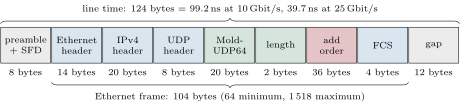
One add-order message on the wire, in the simulator’s feed format (a MoldUDP64 packet in a UDP datagram in an Ethernet frame). The 36 bytes the strategy reads are 29% of the line time the frame occupies. Boxes are not to scale; byte counts from  and the formats’ headers.
Figure 1.1. One add-order message on the wire, in the simulator’s feed format (a MoldUDP64 packet in a UDP datagram in an Ethernet frame). The 36 bytes the strategy reads are 29% of the line time the frame occupies. Boxes are not to scale; byte counts from Proposition 1.3 and the formats’ headers.
Frame (bytes)1 Gbit/s1\,\mathrm{G}\mathrm{bit}/\mathrm{s}10 Gbit/s10\,\mathrm{G}\mathrm{bit}/\mathrm{s}25 Gbit/s25\,\mathrm{G}\mathrm{bit}/\mathrm{s}100 Gbit/s100\,\mathrm{G}\mathrm{bit}/\mathrm{s}
64672.067.226.96.7
1281 184.0118.447.411.8
2562 208.0220.888.322.1
5124 256.0425.6170.242.6
1 0248 352.0835.2334.183.5
1 51812 304.01 230.4492.2123.0
Table 1.1. Serialisation delay in nanoseconds by frame size and line rate (Proposition 1.3, preamble and inter-frame gap included). Computed by nw_wire.frame_table.

أمثلة

Example 1.4 (One add order)

The exchange simulator of One Quant Book 10 publishes its feed as MoldUDP64 packets: a 20-byte header (session, sequence number, message count), then each message behind a 2-byte length. An add-order message is 36 bytes, so a packet carrying one is 58 bytes of UDP payload; with 8 bytes of UDP header, 20 of IPv4 header and 18 of Ethernet header and check sequence the frame is 104 bytes and occupies 124 bytes of line time (Figure 1.1): 99.2 ns99.2\,\mathrm{n}\mathrm{s} at 10 Gbit/s10\,\mathrm{G}\mathrm{bit}/\mathrm{s}, 39.7 ns39.7\,\mathrm{n}\mathrm{s} at 25. A venue that packs eight such messages in one packet spends the 66 bytes of fixed overhead once for eight messages instead of eight times.

اقرأ في الفصل →