جميع الكتب

مهني

1 Markets I: The Ecosystem and Exchange-Traded Marketsالأسواق عبر الإنترنت 2 Markets II: Rates, FX and Creditالأسواق عبر الإنترنت 3 Markets III: Commodities, Energy and Cryptoالأسواق عبر الإنترنت 4 Quantitative Methodsالأساليب عبر الإنترنت 5 Derivatives and Volatilityالمشتقات عبر الإنترنت 6 Rates, Credit, XVA and Riskالفائدة والائتمان والمخاطر عبر الإنترنت 7 Research Craft: Predictors, Backtests, Measurement, Portfoliosالبحث عبر الإنترنت 8 Strategies I: Equities and Futuresالاستراتيجيات عبر الإنترنت 9 Strategies II: Volatility, Relative Value, Macro and the Bank Desksالاستراتيجيات عبر الإنترنت 10 Microstructure and Executionالتنفيذ عبر الإنترنت 11 Market Making and High-Frequency Tradingصناعة السوق عبر الإنترنت 12 Machine Learning for Marketsتعلم الآلة عبر الإنترنت 13 Low-Latency Softwareالتكنولوجيا عبر الإنترنت 14 Networks, Hardware and Trading Infrastructureالتكنولوجيا عبر الإنترنت 15 Research, Data and Risk Platformsالتكنولوجيا عبر الإنترنت 16 The Desk and the Firmالشركة عبر الإنترنت 17 The Industry: Firms, Roles and Careersالمسارات المهنية عبر الإنترنت 18 The Interview Bookالمسارات المهنية عبر الإنترنت
التطبيقات حول المدرب تسجيل الدخول ابدأ القراءة

Quantitative Finance · المسرد

ما معنى M/M/1 queue؟

Definition 8.8 Quantitative Methods · الفصل 8 — Markov Chains and Queues

The M/M/1 queue has Poisson arrivals at rate λ\lambda, exponential service times with rate μ\mu and one server; the number in the system is a birth–death process with λn=λ\lambda_n = \lambda and μn=μ\mu_n = \mu. (Kendall’s notation: Markov arrivals, Markov service, one server.)
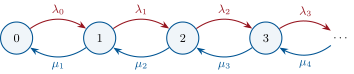
A birth–death chain: from state n the only moves are up at rate _n and down at rate _n. A best queue counted in orders is one, with limit orders as births and market orders and cancellations as deaths.
Figure 8.1. A birth–death chain: from state nn the only moves are up at rate λn\lambda_n and down at rate μn\mu_n. A best queue counted in orders is one, with limit orders as births and market orders and cancellations as deaths.
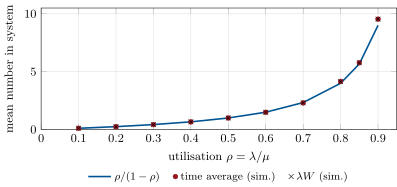
The M/M/1 queue: mean number in the system against utilisation, from the stationary law and from 200 000 simulated customers per point, whose time-averaged count agrees with W (Little’s law). Near saturation the simulation converges slowly. Data: the chapter’s tutorial, seeded.
Figure 8.2. The M/M/1 queue: mean number in the system against utilisation, from the stationary law and from 200 000 simulated customers per point, whose time-averaged count agrees with λW\lambda W (Little’s law). Near saturation the simulation converges slowly. Data: the chapter’s tutorial, seeded.
اقرأ في الفصل →