
全部书籍

专业

应用 关于 Coach 登录 开始阅读

书籍暂未推出简体中文版——当前显示英文版。

Quantitative Finance · 术语表

什么是 On-demand, reserved and spot capacity?

又称: on-demand capacity · reserved capacity · spot capacity

Definition 26.2 Research, Data and Risk Platforms · 第 26 章 — Cloud Against On-Premises

On-demand capacity is rented by the second or hour with no commitment, at the provider’s list price. Reserved capacity is committed for one or three years at a lower hourly price, paid whether used or not. Spot capacity is the provider’s unused capacity rented at a lower, changing price, which the provider can reclaim at short notice, interrupting whatever runs on it.
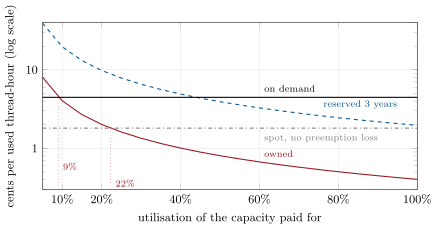
Cost per thread-hour actually used against the utilisation of the capacity paid for, at the cited prices and the model’s owned server. Owned capacity is cheaper than on-demand above 9% utilisation and cheaper than spot above 22%; three-year reserved capacity beats on-demand above 44% but never beats owning. Data: fig_cloudcost.py.
Figure 26.1. Cost per thread-hour actually used against the utilisation of the capacity paid for, at the cited prices and the model’s owned server. Owned capacity is cheaper than on-demand above 9% utilisation and cheaper than spot above 22%; three-year reserved capacity beats on-demand above 44% but never beats owning. Data: fig_cloudcost.py.
server priceper monthcents per thread-hourbreak-even: on demandspot
as assumed ($43 724)$1 5080.409.0%22.3%
twice$2 4190.6514.5%35.8%
three times$3 3300.8920.0%49.2%
Table 26.1. The utilisation above which the owned server costs less than renting the same threads, for three server prices. Even at three times the assumed price, owning wins for any capacity used more than a fifth of the time against on-demand, and half the time against spot.
在原文中阅读 →