 Coach
CoachPayoff smoothing replaces the payoff’s value at each grid node by its average over the node’s cell, so that the initial condition carries the kink’s effect without its discontinuous derivative; with Rannacher start-up it restores the scheme’s second-order convergence for non-smooth payoffs.
Voorbeelden
Example 22.2 (Gamma near expiry)
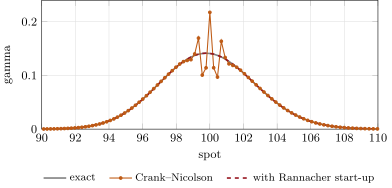
A European put one week from expiry (strike 100, 20% volatility), on a 200-node grid with ten time steps. Plain Crank–Nicolson gives a gamma of 0.217 at the strike, where the exact value is 0.141, and wiggles around the true curve on either side. With two Rannacher start-up steps the largest error is 0.0002 (Figure 22.1). A risk system that reports Crank–Nicolson gammas without the start-up will show hedgers a phantom gamma spike at every strike near expiry.
Example 22.8 (A tenth of a cent)
The one-year American put (spot and strike 100, rate 5%, volatility 20%) is worth 6.0904, from a Richardson-extrapolated grid (1 600 and 800 nodes and steps). The Cox–Ross–Rubinstein tree’s error alternates in sign with the parity of the step count. Its two neighbours are both within 0.1 cent from 1 500 steps, 1 125 750 node updates. The trinomial tree converges without the zigzag but at first order: its error is 0.11 cent at 1 600 steps and 0.054 at 3 200. The grid, with a node on the strike, payoff smoothing and Rannacher start-up, errs by 1.04 cent with 50 nodes and steps, 0.30 with 100, 0.091 with 200 and 0.029 with 400: second order. It is within 0.1 cent at 200, 40 600 node updates. That is 28 times less work than the tree (Figure 22.4). Without smoothing and start-up the grid errs by 0.125 cent at 200.