
সব বই

পেশাদার

1 Markets I: The Ecosystem and Exchange-Traded Marketsবাজার অনলাইন 2 Markets II: Rates, FX and Creditবাজার অনলাইন 3 Markets III: Commodities, Energy and Cryptoবাজার অনলাইন 4 Quantitative Methodsপদ্ধতি অনলাইন 5 Derivatives and Volatilityডেরিভেটিভস অনলাইন 6 Rates, Credit, XVA and Riskসুদহার, ঋণ ও ঝুঁকি অনলাইন 7 Research Craft: Predictors, Backtests, Measurement, Portfoliosগবেষণা অনলাইন 8 Strategies I: Equities and Futuresকৌশল অনলাইন 9 Strategies II: Volatility, Relative Value, Macro and the Bank Desksকৌশল অনলাইন 10 Microstructure and Executionএক্সিকিউশন অনলাইন 11 Market Making and High-Frequency Tradingমার্কেট মেকিং অনলাইন 12 Machine Learning for Marketsমেশিন লার্নিং অনলাইন 13 Low-Latency Softwareপ্রযুক্তি অনলাইন 14 Networks, Hardware and Trading Infrastructureপ্রযুক্তি অনলাইন 15 Research, Data and Risk Platformsপ্রযুক্তি অনলাইন 16 The Desk and the Firmপ্রতিষ্ঠান অনলাইন 17 The Industry: Firms, Roles and Careersক্যারিয়ার অনলাইন 18 Interviews I: Maths, Probability and Speedক্যারিয়ার অনলাইন 19 Interviews II: Markets, Trading Games and the Final Roundক্যারিয়ার অনলাইন 20 Interviews III: Codeক্যারিয়ার অনলাইন
অ্যাপ পরিচিতি Coach সাইন ইন পড়া শুরু করো

বইগুলো এখনো বাংলা ভাষায় পাওয়া যায় না — ইংরেজি সংস্করণ দেখানো হচ্ছে।

Quantitative Finance · পরিভাষা

Private endpoint, network load balancer কী?

অন্য নাম: private endpoint · network load balancer

Definition 18.2 Networks, Hardware and Trading Infrastructure · অধ্যায় 18 — Private Connectivity to Crypto Venues

A private endpoint is a network interface that a provider places in a customer’s virtual network, in chosen zones, through which the customer reaches another party’s service privately, without routing between the two networks. A network load balancer is the provider’s service that receives connections on one address and spreads them over target machines, at the level of TCP or UDP; a private-endpoint service is typically exposed through one.
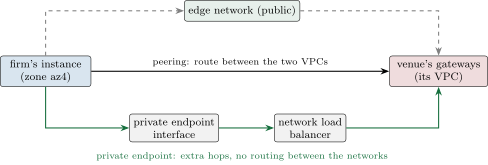
Three ways from a firm’s instance to a venue in the same cloud region, schematically: peering between the two virtual networks, a private endpoint (an interface in the firm’s network, a load balancer in front of the venue’s gateways), and the public endpoint through an edge network.
Figure 18.1. Three ways from a firm’s instance to a venue in the same cloud region, schematically: peering between the two virtual networks, a private endpoint (an interface in the firm’s network, a load balancer in front of the venue’s gateways), and the public endpoint through an edge network.
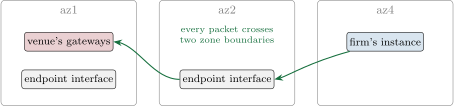
The endpoint in the wrong zone, schematically: the venue’s gateways in az1, its endpoint’s interfaces in az1 and az2, the firm’s instance in az4; the firm’s packets enter the interface in az2 and cross to the gateways through the load balancer. No placement of the endpoint keeps this path in one zone (); moving the instance to az1 does. Zone labels are identifiers, not names.
Figure 18.2. The endpoint in the wrong zone, schematically: the venue’s gateways in az1, its endpoint’s interfaces in az1 and az2, the firm’s instance in az4; the firm’s packets enter the interface in az2 and cross to the gateways through the load balancer. No placement of the endpoint keeps this path in one zone (Proposition 18.3); moving the instance to az1 does. Zone labels are identifiers, not names.
প্রসঙ্গসহ পড়ো →