सभी किताबें

पेशेवर

ऐप्स परिचय Coach लॉग इन पढ़ना शुरू करें

Quantitative Finance · शब्दावली

Queue imbalance क्या है?

Definition 8.1 Research Craft: Predictors, Backtests, Measurement, Portfolios · अध्याय 8 — Order-Book Features

The queue imbalance at the touch is I=(qb−qa)/(qb+qa)I = (q^b - q^a)/(q^b + q^a), where qbq^b and qaq^a are the quantities resting at the best bid and the best ask; it lies in [−1,1][-1, 1] and is positive when the bid queue is the larger.
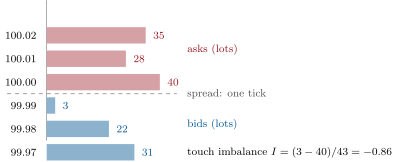
The book around the touch: three lots at the best bid (99.99), forty at the best ask (100.00). The queue imbalance at the touch is -0.86; over three levels on each side it is (56 - 103)/159 = -0.30, because the deeper bids are larger. A schematic, not data.
Figure 8.1. The book around the touch: three lots at the best bid (99.99), forty at the best ask (100.00). The queue imbalance at the touch is −0.86-0.86; over three levels on each side it is (56−103)/159=−0.30(56 - 103)/159 = -0.30, because the deeper bids are larger. A schematic, not data.
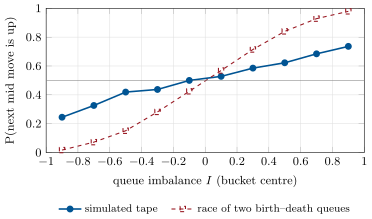
Probability that the next mid-price move is up, by tenth of queue imbalance at a one-tick spread: 0.245 to 0.736 in three hours of firm.tape, against 0.017 to 0.979 for the race of two independent birth–death queues with the rates measured on the same data. Data: firm.tape, seed 8; firm.queues.
Figure 8.2. Probability that the next mid-price move is up, by tenth of queue imbalance at a one-tick spread: 0.245 to 0.736 in three hours of firm.tape, against 0.017 to 0.979 for the race of two independent birth–death queues with the rates measured on the same data. Data: firm.tape, seed 8; firm.queues.
अध्याय में पढ़ें →