
All books

Professional

Apps About Coach Log in Start reading

Quantitative Finance · Glossary

What is Request signature?

Definition 17.5 Low-Latency Software · Chapter 17 — WebSocket, REST, TLS and JSON at Speed

A request signature is a message authentication code computed by the client over a request’s parameters with a secret shared with the venue (typically HMAC-SHA-256 of the query string and body, sent in hexadecimal with the API key), which lets the venue check that the request comes from the key’s owner and was not altered; a timestamp and a validity window inside the signed payload stop old requests from being replayed.
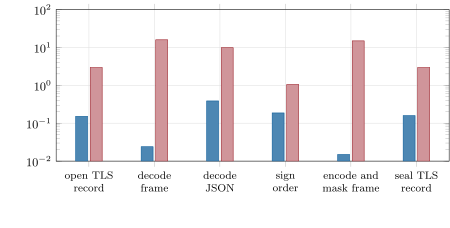
The processor time of one websocket order: receiving a depth update (TLS record, frame, JSON) and sending an order (signature, masked frame, TLS record). C++: the build’s decoders and OpenSSL; Python: the build’s reference and ssl (its record cost estimated as a quarter of the extra round-trip time over TLS). Measured on a laptop (Intel Core Ultra 7 155H) under WSL2, no isolated cores. Data: bench_web.py.
Figure 17.2. The processor time of one websocket order: receiving a depth update (TLS record, frame, JSON) and sending an order (signature, masked frame, TLS record). C++: the build’s decoders and OpenSSL; Python: the build’s reference and ssl (its record cost estimated as a quarter of the extra round-trip time over TLS). Measured on a laptop (Intel Core Ultra 7 155H) under WSL2, no isolated cores. Data: bench_web.py.
Read in context →