 Coach
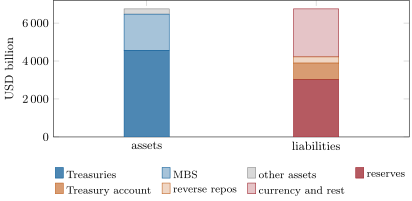
CoachReserves are the balances that banks, and some other institutions admitted to it, hold in accounts at the central bank. They are the asset in which payments between banks are finally settled: when a customer of one bank pays a customer of another, reserves move from the first bank’s account to the second’s.
उदाहरण
Example 1.3 (Tax day)
Companies pay USD 100 billion of taxes into the Treasury’s account at the Fed. Each payer’s bank loses reserves; the Treasury’s account gains the same amount. The banking system has USD 100 billion fewer reserves, although nobody decided anything about monetary policy. Movements in the government’s account are among the largest of these autonomous factors, and a central bank that wants a stable overnight rate must either offset them or hold so many reserves that they do not matter.
Example 1.7 (The euro corridor)
From 16 September 2026 the ECB’s deposit facility pays 2.50%, its weekly main refinancing operations lend at 2.65% and its marginal lending facility at 2.90%. The corridor is 40 basis points wide. Since 18 September 2024 the refinancing rate sits only 15 basis points above the deposit rate (it had been 50), a change announced in March 2024 so that banks would borrow in the weekly operations as reserves shrink and the overnight rate would stay close to the deposit rate. The euro area has, in effect, chosen a floor while keeping the corridor as its outer bounds.
Example 1.11 (One purchase, three balance sheets)
The central bank buys USD 10 billion of bonds from a pension fund. The central bank: securities , reserves (of the fund’s bank) . The fund’s bank: reserves , the fund’s deposit . The fund: bonds , deposit . The purchase created reserves and a bank deposit of the same size; it did not create a loan, and the bank cannot “lend out” the reserves to anyone but another bank, where they remain reserves (Proposition 1.2).