Markets II: Rates, FX and Credit · Markets
1Central Banks and the Short Rate
At 14:00 New York time on 16 September 2026 the Federal Open Market Committee published a statement of a few paragraphs raising its target for the federal funds rate by a quarter point, to a range of 3.75 to 4 percent. Nobody at the Federal Reserve bought or sold a bond to make it so. From the next morning the Fed paid 3.90% on every dollar banks kept in their accounts with it, lent against Treasury collateral at 4.00% to any eligible counterparty that asked, and took cash from money-market funds at 3.75%: three rates it simply announced, and between which the market rates of the world’s largest currency then moved. The same day the European Central Bank’s quarter point took effect; two days later the Bank of Japan raised its target from around 1% to around 1.25%. Every interest rate in this book, the yield of a thirty-year bond, the price of a swap, the forward points of a currency, is built on top of the overnight rate that these few institutions set. This chapter explains how they set it, and how the market turned it into the benchmark that replaced the interbank rates of the previous forty years.
1.1 Reserves and the central-bank balance sheet
Definition 1.1 (Reserves)
Reserves are the balances that banks, and some other institutions admitted to it, hold in accounts at the central bank. They are the asset in which payments between banks are finally settled: when a customer of one bank pays a customer of another, reserves move from the first bank’s account to the second’s.
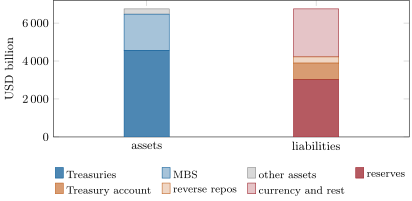
Reserves are a liability of the central bank, like the banknotes it issues and the account it keeps for the government. On the other side of its balance sheet sit the assets it bought or lent against: government bonds, mortgage securities, loans to banks. Figure 1.1 draws the Fed’s two sides on one Wednesday.
Proposition 1.2 (Only the central bank changes the total)
Payments among banks and their customers move reserves between accounts but do not change their total. The total changes only when an item of the central bank’s balance sheet changes: it rises when the central bank buys an asset or lends, and falls when it sells or is repaid, or when another of its liabilities (currency, the government’s account, reverse repos) grows at the expense of reserves.
Proof. The central bank’s balance sheet satisfies assets reserves other liabilities capital. A payment between two banks debits one reserve account and credits another: no term of the identity moves. Reserves can therefore change only if assets, capital or another liability change. ∎
Example 1.3 (Tax day)
Companies pay USD 100 billion of taxes into the Treasury’s account at the Fed. Each payer’s bank loses reserves; the Treasury’s account gains the same amount. The banking system has USD 100 billion fewer reserves, although nobody decided anything about monetary policy. Movements in the government’s account are among the largest of these autonomous factors, and a central bank that wants a stable overnight rate must either offset them or hold so many reserves that they do not matter.
1.2 Corridor and floor systems
Definition 1.4 (Policy rate and standing facilities)
A central bank’s policy rate is the interest rate it announces as the stance of monetary policy and steers the market’s overnight rates towards. A standing facility is an operation available at its counterparties’ initiative, in any amount (against collateral where it lends), at a rate the central bank fixes: a deposit facility that pays interest on reserves and a lending facility that lends reserves overnight.
Proposition 1.5 (The facilities bound the overnight rate)
Let be the rates of the deposit and lending facilities. A bank with access to both never lends reserves overnight below and never borrows above (against the same collateral). Among such banks the overnight rate lies in .
Proof. Lending in the market at earns less than leaving the reserves at the deposit facility; borrowing at costs more than the lending facility. Neither side accepts such a trade. ∎
Definition 1.6 (Corridor and floor systems)
In a corridor system the central bank keeps reserves scarce, so that banks trade them among themselves and the overnight rate settles inside , near a target it steers by adjusting the supply of reserves day by day. In a floor system it supplies reserves beyond what banks need, so that the marginal reserve is worth only the deposit rate, and the overnight rate sits at, or just below, .
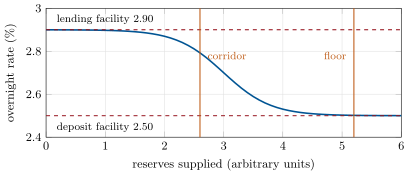
Figure 1.2 is the whole theory in one curve. Banks’ demand for reserves falls with their price: when reserves are scarce, a bank short at the end of the day pays up to the lending rate; when they are abundant, no bank pays more than the deposit rate to hold one more. Where the supply line crosses the curve is the overnight rate. On the steep part, a small change in supply moves the rate, and the central bank must forecast the autonomous factors of Example 1.3 every morning. On the flat part it can ignore them: the rate is whatever it pays on deposits, and moving that rate moves the market.
Example 1.7 (The euro corridor)
From 16 September 2026 the ECB’s deposit facility pays 2.50%, its weekly main refinancing operations lend at 2.65% and its marginal lending facility at 2.90%. The corridor is 40 basis points wide. Since 18 September 2024 the refinancing rate sits only 15 basis points above the deposit rate (it had been 50), a change announced in March 2024 so that banks would borrow in the weekly operations as reserves shrink and the overnight rate would stay close to the deposit rate. The euro area has, in effect, chosen a floor while keeping the corridor as its outer bounds.
Remark 1.8 (Below the floor)
The bound of Proposition 1.5 holds only for institutions that can use the deposit facility. Cash-rich institutions that cannot, such as money-market funds, lend to banks at whatever the banks will pay, and the banks deposit the proceeds at the central bank for the difference. That is why an overnight benchmark can print just below a floor: on 22 September 2026 the euro short-term rate was 2.440%, six basis points under the deposit rate. The Fed’s answer to the same leak is its reverse repo facility, open to money-market funds and government-sponsored enterprises as well as banks and dealers, which puts a second, lower floor under the market.
As of September 2026 — Four central banks’ administered rates
Federal Reserve (from 17 September 2026): target range for the federal funds rate 3.75–4.00%; interest on reserve balances 3.90%; standing repo facility 4.00%; overnight reverse repo facility 3.75% (USD 160 billion per counterparty and day); primary credit 4.00%. ECB (from 16 September 2026): deposit facility 2.50%, main refinancing operations 2.65%, marginal lending facility 2.90%. Bank of England: Bank Rate 3.75%, held on 16 September 2026 by six votes to three. Bank of Japan (from 24 September 2026): target for the uncollateralised overnight call rate around 1.25%; complementary deposit facility 1.25%; basic loan rate 1.50%.
1.3 Open-market operations and balance-sheet policy
Definition 1.9 (Open-market operation)
An open-market operation is a purchase or sale of securities, or a repo or reverse repo, that the central bank initiates, in an amount it chooses, to change the supply of reserves.
Definition 1.10 (Quantitative easing)
Quantitative easing is the purchase of large amounts of longer-term securities, government bonds and sometimes mortgage or corporate bonds, to lower longer-term yields once the policy rate can go no lower or no lower usefully. Its reversal, letting the securities mature without replacing them or selling them, is quantitative tightening.
Example 1.11 (One purchase, three balance sheets)
The central bank buys USD 10 billion of bonds from a pension fund. The central bank: securities , reserves (of the fund’s bank) . The fund’s bank: reserves , the fund’s deposit . The fund: bonds , deposit . The purchase created reserves and a bank deposit of the same size; it did not create a loan, and the bank cannot “lend out” the reserves to anyone but another bank, where they remain reserves (Proposition 1.2).
In a corridor system open-market operations are monetary policy: the desk adds or drains reserves each day to hold the rate at its target. In a floor system they are not: the rate is set by the deposit rate, and the size of the balance sheet becomes a separate instrument, used for longer-term yields (Definition 1.10) or for keeping reserves safely on the flat part of the curve. That separation is the point of a floor. It is also its cost: a central bank that pays interest on trillions of reserves pays banks for holding them, in public.
The Fed’s recent history shows both instruments at work. It shrank its securities holdings by more than USD 2.2 trillion from June 2022, stopped on 1 December 2025 once it judged reserves close to the edge of ample, and in December 2025 began buying Treasury bills again, not to ease policy but to keep reserves growing with the economy. Its implementation note of September 2026, the same one that raised rates, repeats the instruction to buy bills as needed: the rate went up and the balance sheet kept growing, without contradiction.
1.4 Overnight benchmarks and the end of the interbank offered rates
Definition 1.12 (Interbank offered rate)
An interbank offered rate (IBOR) is a benchmark for unsecured term borrowing between banks, one to twelve months, computed each day from submissions by a panel of banks of the rates at which they could borrow. LIBOR, for five currencies, was the largest; trillions of loans, bonds and derivatives referenced it.
Definition 1.13 (Overnight benchmark rate)
An overnight benchmark rate (also called a risk-free rate, RFR) is a benchmark computed from actual overnight transactions, published by a central bank or an administrator on the next business day. It is either secured (repo against government bonds) or unsecured (deposits taken by banks).
The transition from the first kind to the second was forced by the sparseness of the market the first measured: few banks still borrowed from each other unsecured for three months, and a benchmark built on judgement rather than transactions proved both fragile and manipulable. On 5 March 2021 the UK regulator announced the end dates: most LIBOR settings after 31 December 2021, the main dollar settings after 30 June 2023. Synthetic dollar settings were published as a bridge for legacy contracts until 30 September 2024; since then all thirty-five LIBOR settings have ceased.
As of September 2026 — The four main overnight benchmarks
SOFR (US dollar, secured): overnight Treasury repo, tri-party, general-collateral and cleared bilateral, with specials filtered out; published by the Federal Reserve Bank of New York at about 08:00 New York time for the previous business day. €STR (euro, unsecured): euro-area banks’ overnight wholesale borrowing; published by the ECB each TARGET business day for the previous one (22 September 2026: 2.440% on EUR 69.9 billion, 929 transactions, 47 banks). SONIA (sterling, unsecured): what banks pay to borrow sterling overnight from financial institutions; published by the Bank of England at 09:00 London time the next business day. Japan: the uncollateralised overnight call rate, the Bank of Japan’s operating target.
An overnight rate is known one day at a time, but a loan or a swap pays interest for a quarter or a year. The market’s answer is to compound the daily rates over the period and pay at its end.
Definition 1.14 (Compounding in arrears)
Over an interest period of calendar days with business days , fixings and weights , the calendar days from to the next business day, the rate compounded in arrears is
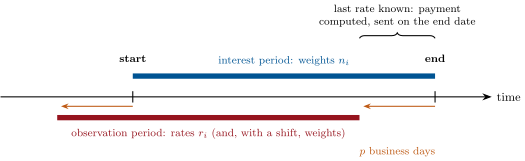
with for the dollar and euro and 365 for sterling. It is known only after the last fixing. Three conventions bring the payment date forward: a lookback of business days uses from days before each with the period’s own weights; an observation shift takes rates and weights from a period moved back by business days; a lockout freezes the last fixings at the one before them.
Proposition 1.15 (Compounding adds a second-order term)
Let be the day-weighted simple average. If all then ; for a constant rate fixed on every calendar day,
Proof. With , , and . For a constant daily rate, ; multiply by . ∎
Example 1.16 (September 2026, illustrated)
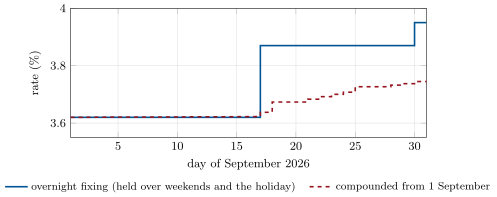
Take illustrative fixings of 3.62% up to 16 September, 3.87% from the hike, and 3.95% on the quarter-end day, 30 September (Figure 1.3). Over 1 September to 1 October (30 days, 21 fixings, Labor Day on 7 September) the day-weighted average is 3.7393% and the compounded rate 3.7448%: compounding adds 0.54 basis points, against the 0.56 of Proposition 1.15 for a flat 3.74%. With a five-day lookback the rate is 3.6836%, 6.12 basis points lower, USD 5 098 on USD 100 million: the lookback moves five days of the new rate into the next period, where the borrower will pay them.
Definition 1.17 (Fallback spread)
A fallback spread is the fixed adjustment added to a compounded overnight rate when it replaces an interbank offered rate in an existing contract, to compensate for the credit and term premium the old rate contained. For LIBOR it was set as the five-year median of the difference between the two rates, fixed on 5 March 2021: for dollar LIBOR against SOFR, 11.448 basis points at one month, 26.161 at three months and 42.826 at six months.
1.5 Tutorial: compounding a month in arrears
Goal. Compound a month of overnight fixings on a real calendar, with and without a lookback, and compare with the simple average. End state: the four numbers of Example 1.16 and Figure 1.3.
Business days and weights. A fixing accrues until the next business day; a Friday’s accrues three days.
    def business_days(self, start: dt.date, end: dt.date) -> list[dt.date]:
        """Business days d with start <= d < end."""
        out, d = [], start
        while d < end:
            if self.is_business_day(d):
                out.append(d)
            d += ONE_DAY
        return out


def weights(cal: Calendar, days: list[dt.date], end: dt.date) -> list[int]:
    """Calendar days each fixing accrues for: to the next business day, capped at the period end."""
    nxt = days[1:] + [end]
    return [(b - a).days for a, b in zip(days, nxt, strict=True)]
Listing 1.1. Business days of a period and the calendar days each fixing accrues. code/firm/rfr/firm_rfr.py You should see weights
[1, 4, 1, 1]for 3 to 10 September 2026: the Friday before Labor Day counts four days.Which fixing, which weight. One function returns, for each step of the period, the date of the fixing used and the days it accrues, for all three conventions.
def observations(cal: Calendar, start: dt.date, end: dt.date, conv: Convention) -> list[tuple[dt.date, int]]:
    """(fixing date, weight in days) for each accrual step of the interest period."""
    days = cal.business_days(start, end)
    if conv.shift:
        o_start, o_end = cal.add(start, -conv.lookback), cal.add(end, -conv.lookback)
        obs = cal.business_days(o_start, o_end)
        w = weights(cal, obs, o_end)
    else:
        obs = [cal.add(d, -conv.lookback) for d in days]
        w = weights(cal, days, end)
    if conv.lockout:
        frozen = obs[-conv.lockout - 1]
        obs = obs[:-conv.lockout] + [frozen] * conv.lockout
    return list(zip(obs, w, strict=True))
Listing 1.2. Fixing dates and weights under a lookback, an observation shift or a lockout. code/firm/rfr/firm_rfr.py Compound.
def compound_in_arrears(fixings: dict[dt.date, float], cal: Calendar, start: dt.date, end: dt.date,
                        conv: Convention = PLAIN) -> float:
    """Annualised compounded rate for the period: (prod(1 + r_i n_i / B) - 1) * B / N."""
    growth, n_total = 1.0, 0
    for d, n in observations(cal, start, end, conv):
        growth *= 1.0 + fixings[d] * n / conv.basis
        n_total += n
    return (growth - 1.0) * conv.basis / n_total
Listing 1.3. The compounded rate of the period, annualised. code/firm/rfr/firm_rfr.py - Run the month.
short_rate_demo.month_summary()prints 3.7393% (simple), 3.7448% (compounded) and 3.6836% (five-day lookback);fig_short_rate.pywrites the chart’s data.
What to change next. Replace the lookback by a two-day lockout, and by a five-day observation shift, and explain why the second gives exactly the lookback’s number in this month (Exercise 1.7). Then move the hike to the last week and watch the lookback’s error grow.
1.6 Build: the overnight-rate compounding engine
Purpose. Every floating leg in the miniature firm, loans, swaps (Chapter 9), futures on overnight rates (Chapter 8), repo accruals, pays a compounded overnight rate. This component computes it, once and correctly.
Interface. Calendar(holidays) with is_business_day, add(d, n), business_days(start, end); Convention(lookback, shift, lockout, basis); observations(cal, start, end, conv); compound_in_arrears(fixings, cal, start, end, conv); simple_average(…); rate_from_index(i0, i1, start, end).
Rules. Business days exclude weekends and the calendar’s holidays; weights run to the next business day and stop at the period end; rates are decimals and may be negative; the basis is 360 unless the currency says 365.
Acceptance tests. code/firm/rfr/tests/: a Friday counts three days and the Friday before a Monday holiday four; a flat rate compounds to the closed form and exceeds its simple average; a lookback keeps the period’s weights; an observation shift takes the shifted period’s; a lockout repeats the last free fixing; the published-index route gives the same rate; negative rates.
Stretch. Rounding as a published compounded index rounds (to eight decimals); a payment-delay convention; a holiday calendar loaded from the firm’s reference data (One Quant Book 1, chapter 28).
Sources and further reading
- Board of Governors of the Federal Reserve System, Implementation Note issued September 16, 2026; statistical release H.4.1, 17 September 2026; minutes of the FOMC, December 2025.
- European Central Bank, Key ECB interest rates; press release Changes to the operational framework for implementing monetary policy, 13 March 2024; Euro short-term rate.
- Bank of England, Monetary Policy Summary, September 2026; SONIA interest rate benchmark. Bank of Japan, Change in the Guideline for Money Market Operations, 18 September 2026.
- Federal Reserve Bank of New York, Secured Overnight Financing Rate; Reverse repo FAQ.
- Financial Conduct Authority, The end of LIBOR, 2024; ISDA, statement on the FCA announcement, 5 March 2021; ARRC recommended spread adjustments, 2021.
1.7 Exercises
Exercise 1.1 ★
An interest period runs from Thursday to the following Tuesday, with fixings of 3.90% (Thursday), 3.88% (Friday) and 3.92% (Monday). Give the rate compounded in arrears (basis 360) and the simple average.
Solution
Solution of Exercise 1.1.
Thursday accrues 1 day, Friday 3, Monday 1: . , times , gives 3.8926%. The day-weighted average is ; compounding adds 0.06 basis points over five days.
Exercise 1.2 ★
With the ECB rates of Box 1.1, give the width of the corridor and the refinancing rate’s distance from the deposit rate. The euro short-term rate prints at 2.440%. Which bound of Proposition 1.5 does that seem to violate, and why does it not?
Solution
Solution of Exercise 1.2.
Corridor basis points; the refinancing rate is 15 basis points above the deposit rate. At 2.440% the benchmark is 6 basis points below the deposit rate, which a bank with access to the facility would never accept as a lender. But the rate measures what banks pay to borrow, including from money-market funds, insurers and other institutions that cannot deposit at the central bank; the bound binds only lenders with access.
Exercise 1.3 ★
The central bank sells USD 10 billion of bonds to an insurance company. Write the changes on the balance sheets of the central bank, the insurer’s bank and the insurer.
Exercise 1.4 ★★
Estimate the difference, in basis points, between a flat 4% overnight rate compounded daily over 91 calendar days and its simple average, first with Proposition 1.15 and then exactly.
Solution
Solution of Exercise 1.4.
Approximation: basis points. Exactly: basis points. Over a quarter the term is not negligible for a swap of USD 1 billion: 2 basis points for a quarter is about USD 50 000.
Exercise 1.5 ★★
Tax receipts of USD 150 billion flow into the Treasury’s account on one day. What happens to the overnight rate in a corridor system and in a floor system? What does each central bank have to do about it?
Solution
Solution of Exercise 1.5.
Reserves fall by USD 150 billion (Proposition 1.2). In a corridor, supply moves left along the steep part of the demand curve and the overnight rate rises towards the lending rate unless the desk adds USD 150 billion, by repo or purchases, the same morning; it must forecast the tax flow to do so. In a floor, if reserves remain on the flat part the rate does not move and the central bank does nothing. The size of the buffer it keeps is the price of not having to forecast.
Exercise 1.6 ★★
A legacy USD 50 million loan paid three-month dollar LIBOR plus 150 basis points and fell back to compounded SOFR. Over a 91-day period SOFR compounds to 3.80%. Give the all-in rate and the interest (ACT/360).
Solution
Solution of Exercise 1.6.
All-in . Interest . The 26.161 basis points stand for the bank credit and term premium that LIBOR contained and SOFR does not.
Exercise 1.7 ★★★
Coding. With firm_rfr and the fixings of the tutorial, compute the September rate with a two-day lockout and with a five-day observation shift. Give each difference from the plain compounded rate in basis points, and explain why the shift gives exactly the lookback’s number.
Solution
Solution of Exercise 1.7.
Lockout of two days: 3.7421%, 0.27 basis points below the plain 3.7448% (30 September’s quarter-end 3.95% is replaced by 28 September’s 3.87%, and 29 September’s by the same). Observation shift of five days: 3.6836%, 6.12 basis points below, exactly the lookback’s number. Both use the fixings of 25 August to 23 September; they differ only in which weight each fixing carries, and here the two weight lists are the same multiset for each rate: the four-day weight of the Labor Day weekend falls on a 3.62% fixing in both (28 August under the lookback, 4 September under the shift), and the three-day weights likewise. With only two rate levels in the window, the product of Definition 1.14 is identical. A hike inside the long weekend would break the tie.
Exercise 1.8 ★★★
Find the flaw. “To raise the federal funds rate by a quarter point, the Fed’s trading desk sells Treasuries every morning until the rate has risen enough.” Correct the statement for the system the Fed ran in 2026. In which system would it have been roughly right?
Solution
Solution of Exercise 1.8.
In 2026 the Fed ran a floor with ample reserves: it raised the rate by raising the rates it administers (interest on reserves, the reverse repo and standing repo rates, the discount rate) and did not need to change the quantity of reserves at all; its bill purchases in the same weeks added reserves. The statement describes a corridor system with scarce reserves, where the desk drains or adds reserves each day to move the rate along the steep part of the demand curve, roughly how the Fed operated before 2008.
1.8 Problem: The Price of a Reserve
Problem 1.1
Weekend problem — the month the corridor moved
A central bank runs a corridor with a deposit facility at 2.25% and a lending facility at 2.65% (basis 360). Halfway through a 30-day period it moves both by 25 basis points, to 2.50% and 2.90%. Bank A holds EUR 2 billion of reserves more than it needs over the whole period; bank B is EUR 2 billion short over the whole period. There are no other banks.
Part I — The facilities.
- A leaves its excess at the deposit facility for 30 days. What does it earn?
- B covers its shortfall at the lending facility for 30 days. What does it pay?
- What is the difference, and to whom does it go?
- Why does a central bank leave a gap between the two rates at all?
- Both rates moved by 25 basis points. Why does that move the market rate by 25 basis points, whatever the supply of reserves?
Part II — The interbank market.
- A lends its excess to B directly at the middle of the corridor. What interest changes hands over the period?
- Give A’s gain over the deposit facility and B’s saving over the lending facility.
- Nothing forces the middle. What decides where in the corridor the rate settles?
- A asks 5 basis points above the middle for lending unsecured to B. Give the two new gains.
- B could borrow from the central bank only against collateral; A lends without. Which rate does an unsecured overnight benchmark measure, and which does a secured one?
Part III — The flood.
- The central bank buys EUR 50 billion of bonds. Where does the interbank rate go, and why?
- What is A’s gain from lending to B now?
- The central bank wants to raise rates by 25 basis points. What does it change, and what does it no longer need to do?
- Does it still need open-market operations day to day? What is its balance sheet for now?
- A money-market fund with EUR 1 billion cannot use the deposit facility. It lends to A at 6 basis points below the deposit rate for 30 days, and A deposits the cash. What does A earn on the trade?
Part IV — Judgement.
- Give two reasons a central bank might prefer a corridor with scarce reserves.
- Give two reasons it might prefer a floor.
- What does the ECB’s 15-basis-point gap between its refinancing and deposit rates since 2024 tell you about its choice?
- State the named result: the gain from trade in reserves over the period, as a formula and in euros, and what becomes of it in a floor.
- In one sentence: what sets the overnight rate?
Solution
Solution of Problem 1.1.
1. . 2. . 3. EUR 666 667, to the central bank, which pays the deposit rate and receives the lending rate on the same reserves. 4. So that banks prefer to trade with each other: the gap rewards an interbank market, which spreads information about banks and does the central bank’s allocating for it, and it makes the lending facility a backstop rather than a habit. 5. Every rate in the market lies inside the corridor (Proposition 1.5); moving both walls moves the whole interval, and banks’ relative bargaining is unchanged. 6. Middle: 2.45% then 2.70%. Interest EUR 4 291 667. 7. A gains EUR 333 333 over the deposit facility; B saves EUR 333 333 over the lending facility. 8. The scarcity of reserves, and so each side’s alternative: with more excess reserves in the system lenders compete and the rate falls towards the deposit rate; with fewer, borrowers compete and it rises. This is the demand curve of Figure 1.2. 9. 5 basis points on EUR 2 billion for 30 days is EUR 83 333: A gains EUR 416 667, B saves EUR 250 000. The premium is the price of B’s credit, which the facility does not charge because it takes collateral. 10. An unsecured benchmark (€STR, SONIA) measures what A charges B without collateral; a secured one (SOFR) measures the repo market, where collateral removes most of the credit premium. 11. To the deposit rate: with EUR 50 billion added, B has reserves of its own, nobody needs to borrow, and a lender’s only alternative is the deposit facility. 12. Nothing: B does not borrow, or would pay no more than A earns at the facility. 13. It raises the deposit rate (and the lending rate with it); it no longer needs to adjust the quantity of reserves. 14. Not for the rate. Its balance sheet is now a separate instrument: for longer-term yields, or simply a buffer that keeps reserves on the flat part of the curve whatever the autonomous factors do. 15. : A earns the gap between the fund’s rate and the facility, without risk, because it can use the facility and the fund cannot. 16. A smaller balance sheet and less interest paid to banks on reserves; an active interbank market in which banks monitor each other and the rate carries information. 17. Control of the rate without forecasting autonomous factors every day; the freedom to use the balance sheet (purchases after a crisis, or liquidity) without losing the rate. 18. With refinancing only 15 basis points above the deposit rate, banks short of reserves borrow from the central bank cheaply, so reserves are supplied on demand and the market rate stays close to the deposit rate even as the balance sheet shrinks: a floor, supplied by demand. 19. Named result: the gain from trade in reserves over the period is , shared between A and B by where the interbank rate settles. In a floor it is zero: no bank is short, and the rate sits on the deposit rate. 20. The rates the central bank administers, and where the supply of reserves it chooses meets banks’ demand for them.
1.9 Interview questions
Interview question 1.1 ★ trader, bank
What is the difference between SOFR and dollar LIBOR, and why is a SOFR loan’s margin higher than the LIBOR loan it replaced?
Solution
Solution of Interview question 1.1.
LIBOR was a panel of banks’ estimate of the rate at which they could borrow unsecured for a term (one to twelve months), set each morning for the period ahead. SOFR is a transaction-based overnight rate for repo secured by Treasuries, compounded over the period and known at its end. LIBOR contained bank credit risk and a term premium; SOFR contains neither. A loan that moved to SOFR adds a spread (26.161 basis points for three-month dollar LIBOR in the fallback) or a higher margin to keep the lender whole.
What the interviewer is looking for: secured versus unsecured, term versus overnight, forward-looking versus in arrears, and why the spread exists.
Interview question 1.2 ★ trader, researcher
How can an overnight benchmark print below the central bank’s deposit rate?
Solution
Solution of Interview question 1.2.
The deposit rate binds only institutions that can use the deposit facility. Cash-rich institutions that cannot, money-market funds, insurers, some government agencies, lend to banks, which accept the cash only below the deposit rate and deposit it at the central bank for the difference. An unsecured benchmark that counts such borrowing, like the €STR, prints below the floor; the Fed’s reverse repo facility, open to money funds, puts a second floor under that leak.
What the interviewer is looking for: who has access to the facility, and the arbitrage that follows.
Interview question 1.3 ★★ trader, researcher, bank
Walk me through the balance sheets when a central bank does quantitative easing. Does it give banks more to lend?
Solution
Solution of Interview question 1.3.
Central bank: bonds up, reserves up. The seller’s bank: reserves up, the seller’s deposit up. The seller: bonds down, deposit up. Reserves are not “lent out”: a bank that lends creates a deposit, and the reserves only move between banks; their total is set by the central bank. What QE changes is the duration and composition the private sector holds, hence longer-term yields, and the amount of reserves, hence where the overnight rate sits on the demand curve.
What the interviewer is looking for: the three T-accounts, and rejection of the money-multiplier story.
Interview question 1.4 ★★ developer, bank
Why do loans that pay compounded SOFR use a lookback or an observation shift? What is the difference between the two?
Solution
Solution of Interview question 1.4.
Compounding in arrears knows the rate only after the last day of the period, too late to send an invoice and a payment on that day. A lookback uses fixings from business days earlier with the interest period’s own day weights; an observation shift moves the whole observation period back days and uses its weights. The shift is what a published compounded index reproduces (a ratio of two index values), so it is simpler to verify; the lookback matches the calendar of the loan. They give different numbers when weekends and holidays fall differently in the two periods.
What the interviewer is looking for: the operational reason, and a precise statement of the difference in weights.
Interview question 1.5 ★★ researcher, trader
From market data alone, how would you tell whether a central bank runs a floor or a corridor system?
Solution
Solution of Interview question 1.5.
Look at where the market overnight rate sits relative to the facility rates and whether it responds to changes in reserves. In a floor it sits at or just below the deposit rate and barely moves when reserves change by large amounts (tax days, the government’s account); in a corridor it sits inside the corridor and jumps with reserve shocks and at quarter- and month-ends. The central bank’s balance sheet (reserves much larger than required) and its daily operations (few or none) confirm it.
What the interviewer is looking for: spread to the deposit rate and sensitivity to reserve supply as the two tests.
Interview question 1.6 ★★★ developer
You are writing the function that computes interest on a compounded-SOFR loan. List the edge cases your tests must cover.
Solution
Solution of Interview question 1.6.
Weekends and holidays (weights of 3 or 4 days; the right holiday calendar, which for SOFR is the US government-securities calendar); a lookback that reaches back into the previous period; an observation shift at month-ends where the two periods have different numbers of business days; lockouts; missing or republished fixings; negative rates; the period’s first day being a holiday; the day-count basis by currency; rounding of the compounded rate and of the interest amount, and of a published index if used; a period of one day; payment dates after the period end; consistency with the published compounded index to its rounding.
What the interviewer is looking for: a systematic list organised by calendar, conventions, data and rounding, and tests that compare against an independent source.