
All books

Professional

Apps About Coach Log in Start reading

Quantitative Finance · Glossary

What is Risk gate, fail-closed design?

Also known as: risk gate · fail-closed design

Definition 22.1 Low-Latency Software · Chapter 22 — Pre-Trade Risk and Kill Switches

A risk gate is the component on the path of every order, between the code that decides to send it and the order gateway, that checks it against the firm’s limits and refuses it if any is exceeded; nothing reaches the venue without passing it. A fail-closed design is one whose failures stop the activity it protects: a risk gate that has lost its limits, its reference prices or its view of the firm’s position refuses orders rather than passing them.
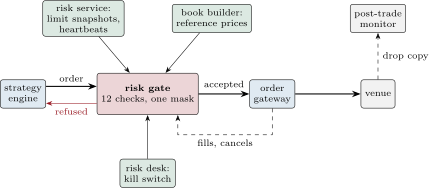
Where the gate sits: on the path of every order, before the gateway, fed by limits with heartbeats, reference prices and the gateway’s own view of fills and orders in flight. A post-trade monitor on the drop copy (chapter 21) is a second line, not a substitute: it sees what has already happened.
Figure 22.1. Where the gate sits: on the path of every order, before the gateway, fed by limits with heartbeats, reference prices and the gateway’s own view of fills and orders in flight. A post-trade monitor on the drop copy (chapter 21) is a second line, not a substitute: it sees what has already happened.
Read in context →