
جميع الكتب

مهني

1 Markets I: The Ecosystem and Exchange-Traded Marketsالأسواق عبر الإنترنت 2 Markets II: Rates, FX and Creditالأسواق عبر الإنترنت 3 Markets III: Commodities, Energy and Cryptoالأسواق عبر الإنترنت 4 Quantitative Methodsالأساليب عبر الإنترنت 5 Derivatives and Volatilityالمشتقات عبر الإنترنت 6 Rates, Credit, XVA and Riskالفائدة والائتمان والمخاطر عبر الإنترنت 7 Research Craft: Predictors, Backtests, Measurement, Portfoliosالبحث عبر الإنترنت 8 Strategies I: Equities and Futuresالاستراتيجيات عبر الإنترنت 9 Strategies II: Volatility, Relative Value, Macro and the Bank Desksالاستراتيجيات عبر الإنترنت 10 Microstructure and Executionالتنفيذ عبر الإنترنت 11 Market Making and High-Frequency Tradingصناعة السوق عبر الإنترنت 12 Machine Learning for Marketsتعلم الآلة عبر الإنترنت 13 Low-Latency Softwareالتكنولوجيا عبر الإنترنت 14 Networks, Hardware and Trading Infrastructureالتكنولوجيا عبر الإنترنت 15 Research, Data and Risk Platformsالتكنولوجيا عبر الإنترنت 16 The Desk and the Firmالشركة عبر الإنترنت 17 The Industry: Firms, Roles and Careersالمسارات المهنية عبر الإنترنت 18 The Interview Bookالمسارات المهنية عبر الإنترنت
التطبيقات حول المدرب تسجيل الدخول ابدأ القراءة

Quantitative Finance · المسرد

ما معنى Risk reversal, strangle, butterfly؟

يُعرف أيضًا باسم: risk reversal · strangle · butterfly

Definition 19.4 Markets II: Rates, FX and Credit · الفصل 19 — The FX Options Market

The 25-delta risk reversal is the difference between the implied volatility of the 25-delta call and that of the 25-delta put, σ25C−σ25P\sigma_{25C} - \sigma_{25P}; as a trade, it is a long call and a short put (or the reverse). The 25-delta strangle is a long 25-delta call and a long 25-delta put; its volatility quoted over the at-the-money volatility is the 25-delta butterfly.
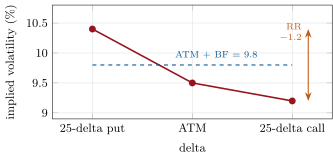
The three quotes of  as three points of the USDJPY smile: the put wing 10.4%, at the money 9.5%, the call wing 9.2%. The risk reversal is the difference between the wings, the butterfly the height of their average over the centre. Illustrative.
Figure 19.1. The three quotes of Example 19.6 as three points of the USDJPY smile: the put wing 10.4%, at the money 9.5%, the call wing 9.2%. The risk reversal is the difference between the wings, the butterfly the height of their average over the centre. Illustrative.
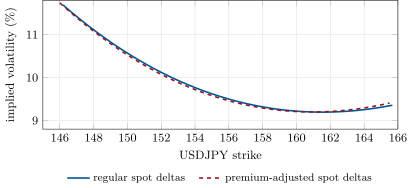
A three-month USDJPY smile built from the same three quotes (ATM 9.5%, 25-delta risk reversal -1.2, butterfly 0.3) with two delta conventions. The premium-adjusted convention, the market’s for this pair, places the wing and centre strikes lower, so the same volatility belongs to a different strike. Illustrative quotes; data: the chapter’s tutorial.
Figure 19.2. A three-month USDJPY smile built from the same three quotes (ATM 9.5%, 25-delta risk reversal −1.2-1.2, butterfly 0.3) with two delta conventions. The premium-adjusted convention, the market’s for this pair, places the wing and centre strikes lower, so the same volatility belongs to a different strike. Illustrative quotes; data: the chapter’s tutorial.

أمثلة

Example 19.6 (Two smiles from one screen)

USDJPY three months: ATM 9.5%, risk reversal −1.2-1.2 (dollar puts over), butterfly 0.3. By Equation 19.1 the 25-delta dollar call is at 9.2% and the put at 10.4%. With regular spot deltas their strikes are 160.85 and 150.71; with premium-adjusted spot deltas, the pair’s convention, 160.68 and 150.52. A trader who priced the 150.71 put at 10.4% while the market meant 150.52 would misprice it by the smile’s slope over 19 pips of strike (Figure 19.2).

اقرأ في الفصل →