Markets II: Rates, FX and Credit · Markets
19The FX Options Market
In most option markets a trader asks for the price of an option at a strike. In foreign exchange the question is different. A broker’s screen for three-month dollar–yen shows three numbers: an at-the-money volatility, a 25-delta risk reversal and a 25-delta butterfly. There is no strike on it, and the numbers do not mean the same thing in every pair: whether “25 delta” is a spot or a forward delta, whether it counts the premium, which strike is “at the money”, all depend on conventions that differ between dollar–yen and euro–dollar. Two traders who price the same option from the same screen with different conventions get different strikes and different prices. FX options more than doubled their trading between the central banks’ surveys of 2022 and 2025, to 7% of all FX turnover, and every one of those trades begins by agreeing on these conventions. This chapter explains them, shows how a smile is built from the three quotes, and follows the flows that barrier options send into the spot market.
19.1 Delta and at-the-money conventions
The model is the Black–Scholes model with two interest rates, the Garman–Kohlhagen model: for a pair BASEQUOTE with spot , the quote currency’s rate and the base currency’s , the forward is and a call on the base currency with strike is worth , with the usual . What changes from Book 1 is the delta, which FX quotes in four ways.
Definition 19.1 (Spot, forward and premium-adjusted delta)
The spot delta of an FX option is the amount of the base currency, per unit of notional, to trade in the spot market to hedge it: , with for a call and for a put. The forward delta is the amount to trade in the forward market, . The premium-adjusted delta corrects either for a premium paid in the base currency, which is itself a position in that currency: (spot) or (forward).
The adjustment matters. A euro call whose delta is 60% and whose premium, 73 669 euros per million, is paid in euros is hedged by buying only 526 331 euros: its premium-adjusted delta is 52.63%. Which delta a pair uses is a convention, documented in the literature on FX smile construction: pairs made of rich-country currencies use spot deltas up to one year and forward deltas beyond; pairs with an emerging-market currency use forward deltas; and the delta is premium-adjusted when the premium is paid in the base currency, as in dollar–yen, dollar–Swiss franc and euro–yen, but not in euro–dollar or sterling–dollar, where it is paid in dollars, the quote currency.
Definition 19.2 (Delta-neutral straddle)
The delta-neutral straddle is the call and the put at the strike where their deltas add to zero; its strike is the default “at the money” for short-dated FX options: with regular deltas and with premium-adjusted ones.
Example 19.3 (Three-month strikes)
With EURUSD at 1.1464, dollar and euro rates of 3.68% and 2.00% (simple, for three months) and a volatility of 7%, the forward is 1.15119 and the delta-neutral straddle strike 1.15190. For USDJPY at 156.87, with a yen rate of 0.977% and a volatility of 9.5%, the forward is 155.8196; the straddle strike is 155.9955 with regular deltas and 155.6439 with premium-adjusted ones, a gap of 35 pips of 0.01 yen between two definitions of the same “at the money”.
19.2 Risk reversals, butterflies and the smile
Definition 19.4 (Risk reversal, strangle, butterfly)
The 25-delta risk reversal is the difference between the implied volatility of the 25-delta call and that of the 25-delta put, ; as a trade, it is a long call and a short put (or the reverse). The 25-delta strangle is a long 25-delta call and a long 25-delta put; its volatility quoted over the at-the-money volatility is the 25-delta butterfly.
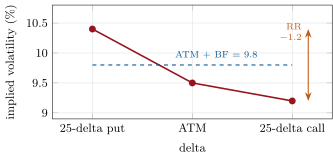
The risk reversal measures the smile’s slope: negative when the base currency’s puts are dearer than its calls, as when a fall of the dollar against the yen is feared more than a rise. The butterfly measures its curvature: how much the wings cost over the centre. A broker who says a risk reversal is “1.2, puts over” means that the put’s volatility exceeds the call’s by 1.2 points (Figure 19.1). The simplest way to turn the three quotes into two wing volatilities, often used as a first approximation, is
which reproduces the risk reversal exactly. The market’s quoted strangle is a slightly different object from the average of the two wings, and building a smile that reproduces it exactly needs a calibration; the approximation is the one we use.
Proposition 19.5 (From quotes to a smile)
Given , RR and BF and a delta convention, the 25-delta volatilities of Equation 19.1 and the strikes , at which the options with those volatilities have deltas of and give, with the at-the-money strike, three points of the smile in strike; any interpolation through them, here a quadratic in , gives a volatility at every strike.
Proof. For regular deltas the strike follows in closed form from (spot) or (forward); for premium-adjusted deltas it is found numerically, on the side of the strike range where the delta is monotone. Three distinct points determine the quadratic. ∎
Example 19.6 (Two smiles from one screen)
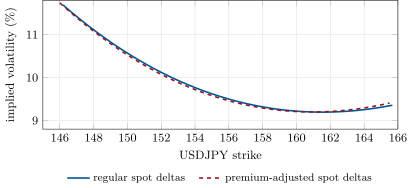
USDJPY three months: ATM 9.5%, risk reversal (dollar puts over), butterfly 0.3. By Equation 19.1 the 25-delta dollar call is at 9.2% and the put at 10.4%. With regular spot deltas their strikes are 160.85 and 150.71; with premium-adjusted spot deltas, the pair’s convention, 160.68 and 150.52. A trader who priced the 150.71 put at 10.4% while the market meant 150.52 would misprice it by the smile’s slope over 19 pips of strike (Figure 19.2).
19.3 Premium currency and premium-adjusted delta
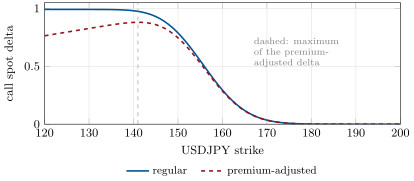
The premium currency changes both the hedge and the quote. A dollar-based bank that sells a USDJPY call and receives its premium in dollars already holds some of the dollars its hedge requires: it buys fewer. The market therefore quotes the pair’s deltas premium-adjusted, and the premium-adjusted call delta has a maximum: deep in the money it rises with the strike, then falls again, so two strikes can share a delta and the convention is to take the one above the maximum (Figure 19.3). The build does so.
The consequence for a trader is practical: before computing a single number, check the pair’s delta type, the at-the-money definition and the premium currency of the quote.
19.4 Broker markets and barrier-driven flows
Definition 19.7 (Barrier option, knock-out, knock-in)
A barrier option is an option whose existence depends on whether spot touches a level, the barrier, before expiry. A knock-out option ceases to exist when the barrier is touched; a knock-in option comes into existence only then.
Between dealers, vanilla FX options are quoted as at-the-money straddles, risk reversals and strangles rather than as single strikes, through brokers and on electronic platforms. Barriers and other exotics are sold to companies and investors and hedged by the dealers in vanillas and spot. Barriers appeal to buyers because they are cheaper than vanillas, and they matter to the spot market because their hedges change abruptly at the barrier.
Proposition 19.8 (The hedge at the barrier)
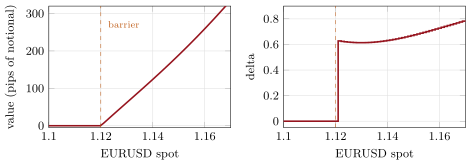
A dealer short a knock-out option of notional and delta-hedged holds of the base currency. When spot touches the barrier the option and its delta vanish, and the dealer must trade at once, in the direction that pushes spot further through the barrier: for a down-and-out call, selling at the barrier.
Proof. Before the touch the hedge is with as spot approaches from above; after it, the option is gone and the hedge must be zero. A down-and-out call’s hedge is long the base currency, so unwinding it sells at the barrier, where spot has just fallen. ∎
This is why barriers are defended and attacked. Holders of knock-outs, and dealers long them, buy near the barrier to keep it from trading; dealers short them know that their own hedge unwinds will add to a move through it, and those who know where large barriers sit may try to push spot to them. Stop orders may sit at the same levels, for the same reason: they are levels many people watch.
As of September 2026 — Size of the market
In April 2025 FX options were 7% of global FX turnover, more than double their 2022 turnover, according to the BIS Triennial Survey. The survey does not break options into vanillas and barriers.
19.5 Tutorial: from quotes to a smile
Goal. Price FX options, compute their deltas in the four conventions, recover the 25-delta and at-the-money strikes from broker quotes, build the smile, and compute the hedge a knock-out releases at its barrier. End state: Figures 19.2 and 19.4, Examples 19.3 and 19.6 and the numbers of the weekend problem.
Deltas and strikes: the four delta conventions and the strike with a given delta.
def delta(s: float, k: float, t: float, rd: float, rf: float, vol: float, phi: int = 1, kind: str = "spot") -> float:
    """kind: spot, forward, spot_pa, forward_pa (premium-adjusted: premium paid in the base currency)."""
    f, sd = forward(s, t, rd, rf), vol * math.sqrt(t)
    d1 = math.log(f / k) / sd + 0.5 * sd
    d2 = d1 - sd
    return {"spot": phi * math.exp(-rf * t) * N(phi * d1), "forward": phi * N(phi * d1),
            "spot_pa": phi * math.exp(-rf * t) * (k / f) * N(phi * d2), "forward_pa": phi * (k / f) * N(phi * d2)}[kind]


def strike_from_delta(s: float, t: float, rd: float, rf: float, vol: float, d: float, phi: int = 1,
                      kind: str = "spot") -> float:
    """Strike with the given delta. Regular deltas in closed form; premium-adjusted ones by bisection on
    the side of the strike range where the delta is monotone (above its maximum for calls)."""
    f, sd = forward(s, t, rd, rf), vol * math.sqrt(t)
    if kind in ("spot", "forward"):
        dd = d * math.exp(rf * t) if kind == "spot" else d
        return f * math.exp(-phi * sd * n_inv(phi * dd) + 0.5 * sd * sd)
    lo, hi = f * math.exp(-8 * sd), f * math.exp(8 * sd)
    if phi == 1:                                                   # PA call delta rises then falls in K
        grid = [lo * (hi / lo) ** (i / 400) for i in range(401)]
        lo = max(grid, key=lambda k: delta(s, k, t, rd, rf, vol, 1, kind))
    for _ in range(200):
        mid = math.sqrt(lo * hi)
        if delta(s, mid, t, rd, rf, vol, phi, kind) > d:            # deltas fall as the strike rises
            lo = mid
        else:
            hi = mid
    return math.sqrt(lo * hi)
Listing 19.1. Spot, forward and premium-adjusted deltas, and the strike with a given delta. code/firm/fxsmile/firm_fxsmile.py At the money and the smile: the delta-neutral straddle, the simplified wing volatilities and a quadratic smile.
def atm_dns(s: float, t: float, rd: float, rf: float, vol: float, premium_adjusted: bool = False) -> float:
    """Delta-neutral straddle strike: call delta = - put delta."""
    return forward(s, t, rd, rf) * math.exp((-0.5 if premium_adjusted else 0.5) * vol * vol * t)


def smile_vols(atm: float, rr: float, bf: float) -> tuple[float, float]:
    """(25-delta call vol, 25-delta put vol) by the simplified formula: RR = call - put, BF = the
    average of the two wings over ATM (smile strangle)."""
    return atm + bf + 0.5 * rr, atm + bf - 0.5 * rr


def quadratic_smile(points: list[tuple[float, float]]):
    """Vol as a quadratic in log-strike through three (strike, vol) points."""
    (x1, y1), (x2, y2), (x3, y3) = ((math.log(k), v) for k, v in points)

    def vol(k: float) -> float:
        x = math.log(k)
        return (y1 * (x - x2) * (x - x3) / ((x1 - x2) * (x1 - x3)) + y2 * (x - x1) * (x - x3) / ((x2 - x1) * (x2 - x3))
                + y3 * (x - x1) * (x - x2) / ((x3 - x1) * (x3 - x2)))
    return vol
Listing 19.2. At-the-money strike, wing volatilities and a three-point smile. code/firm/fxsmile/firm_fxsmile.py - Run
fxopt_demo.smilefor each convention,fxopt_demo.barrier()andfig_fxopt.py.
What to change next. Replace the simplified formula by a calibration that matches the market strangle exactly, and compare the wing strikes; then value the knock-out with the smile’s volatility at the barrier instead of a flat one.
19.6 Build: the quote-to-smile converter
Purpose. The miniature firm’s FX option desk receives broker quotes in ATM, RR and BF, and must price single strikes and barriers consistently with them and hedge them with the right amount of spot.
Interface. gk(s, k, t, rd, rf, vol, phi); delta(…, kind) with kind in spot, forward, spot_pa, forward_pa; strike_from_delta; atm_dns; smile_vols(atm, rr, bf); quadratic_smile(points); down_and_out_call; barrier_delta.
Rules. Continuously compounded rates; the premium-adjusted call strike taken above the delta’s maximum; the simplified formula for the wings, flagged as an approximation.
Acceptance tests. code/firm/fxsmile/tests/: put–call parity; strike-to-delta round trips in all four conventions for calls and puts; the published premium-adjustment example; delta-neutral strikes; the smile’s anchors; the barrier’s value at and far from the barrier.
Stretch. Calibration to the market strangle; smile interpolation in delta (SABR or vanna–volga, One Quant Book 5); barrier pricing under the smile.
Sources and further reading
- D. Reiswich and U. Wystup, “FX volatility smile construction”, Centre for Practical Quantitative Finance, Working Paper 20, Frankfurt School of Finance and Management, 2010 (conventions after I. Clark, Foreign Exchange Option Pricing).
- Bank for International Settlements, Triennial Central Bank Survey 2025.
19.7 Exercises
Exercise 19.1 ★
The EURUSD 25-delta risk reversal is and the butterfly 0.2, ATM 7%. Give the wing volatilities by the simplified formula, and say which option is dearer.
Solution
Solution of Exercise 19.1.
for the 25-delta euro call and for the put: the euro put is dearer, by the half-point of the risk reversal.
Exercise 19.2 ★
Which delta convention does the market use for EURUSD, USDJPY and USDBRL, and why does the premium currency matter?
Solution
Solution of Exercise 19.2.
EURUSD regular deltas (premium in dollars, the quote currency); USDJPY premium-adjusted (premium in dollars, the base currency); USDBRL forward and premium-adjusted (an emerging-market pair, premium in dollars). The premium paid in the base currency is a position in it, which changes the hedge and so the delta that defines each quoted strike.
Exercise 19.3 ★
A euro call has a spot delta of 60% and costs 73 669 euros per EUR 1 million, paid in euros. How many euros does the seller buy to hedge?
Exercise 19.4 ★★
Give the three-month EURUSD 25-delta call and put strikes with regular spot and forward deltas, using the quotes of Exercise 19.1.
Solution
Solution of Exercise 19.4.
Regular spot deltas: call 1.17904, put 1.12357; forward deltas: 1.17920 and 1.12341.
Exercise 19.5 ★★
Why is the premium-adjusted delta-neutral strike below the forward, and the regular one above?
Solution
Solution of Exercise 19.5.
With regular deltas the call delta equals the put’s when , that is , above the forward. The premium-adjusted delta uses scaled by , and neutrality requires , that is , below it.
Exercise 19.6 ★★
Why is a down-and-out call cheaper than the vanilla call, and when is the difference large?
Solution
Solution of Exercise 19.6.
It pays nothing in the paths where spot touches the barrier before expiry, some of which would have ended in the money. The difference is large when the barrier is close to spot, volatility is high and the expiry long, since the touch is then likely.
Exercise 19.7 ★★★
Coding. With strike_from_delta, give the USDJPY 25-delta strikes with forward deltas, and compare them with the spot and premium-adjusted ones of Example 19.6.
Solution
Solution of Exercise 19.7.
With forward deltas the call strike is 160.90 and the put 150.65, against 160.85 and 150.71 with regular spot deltas and 160.68 and 150.52 with premium-adjusted spot deltas.
Exercise 19.8 ★★★
Find the flaw. “The risk reversal is negative, so the market expects the dollar to fall against the yen.” Correct it.
Solution
Solution of Exercise 19.8.
A risk reversal is a price, not a forecast: dollar puts are dearer than calls because more buyers want protection against a fall, and dealers who sell it charge for the risk of a sharp move that way. It says the market pays more to insure against a dollar fall; the forward, not the smile, carries the market’s expected rate under the pricing measure.
19.8 Problem: The Barrier Defence
Problem 19.1
Weekend problem — what a knock-out sends into the spot market
A company buys from a dealer a three-month EURUSD down-and-out call on EUR 500 million, strike 1.1464, barrier 1.1200, spot 1.1464, with the rates of Example 19.3 and a volatility of 7%. The dealer delta-hedges.
Part I — The option.
- Give the vanilla call’s value, in pips of notional.
- Give the knock-out’s value, and the saving for the company.
- Give the knock-out’s delta now, and the dealer’s hedge.
- Why is the knock-out’s delta larger than the vanilla’s?
- Give the delta just above the barrier, and the vanilla’s there.
Part II — At the barrier.
- What does the dealer hold just before spot touches 1.1200?
- What must it trade at the touch, and in which direction?
- How does that trade affect spot?
- What would a dealer long such a barrier do as spot approaches it?
- Why might others trade towards a known large barrier?
Part III — Managing it.
- How can the dealer spread the unwind instead of doing it at the touch?
- What does that cost, and what risk does it leave?
- Why does the dealer’s gamma near the barrier make daily hedging expensive?
- How would a volatility smile change the knock-out’s value?
- What should the company understand about the option it bought?
Part IV — Judgement.
- Is defending a barrier market manipulation?
- Why do barriers cluster at round numbers?
- What information about barriers should a dealer keep confidential?
- State the named result: the spot the dealer must sell at the barrier.
- In one sentence: why do barrier options move spot?
Solution
Solution of Problem 19.1.
1. 183.8 pips of notional (0.01838 dollars per euro). 2. 165.2 pips; the company saves 18.6 pips, about USD 930 000 on EUR 500 million. 3. 0.657; the dealer holds about EUR 328.7 million. 4. Near the barrier the knock-out’s value falls to zero much faster than the vanilla’s as spot falls, so its value is more sensitive to spot. 5. 0.631 just above 1.1200, against 0.298 for the vanilla. 6. About EUR 315.5 million, long euros. 7. Sell all of it, EUR 315.5 million, at the touch. 8. It adds a large sale at the moment spot is falling through the barrier, pushing it lower. 9. Buy euros near 1.1200, to keep the barrier from trading and the option alive. 10. If they know a large hedge unwinds there, pushing spot to it may trigger the sale and a move they can profit from. 11. By selling part of the hedge in advance as spot approaches, or by buying vanilla options that offset the barrier’s delta jump. 12. It gives up hedge accuracy: if spot turns back, the dealer is short the delta it sold early; the options cost premium. 13. Gamma near a knock-out barrier is large and changes sign across it: small moves require large rebalancing trades, each paying a spread. 14. With a smile the volatility at the barrier (a euro put’s) is higher, the probability of touching higher, and the knock-out cheaper than with the flat volatility. 15. That the protection disappears exactly when spot falls through 1.1200, and that its discount is the price of that risk. 16. Hedging an exposure is legitimate; trading to prevent or cause a touch in order to benefit from it, using client information, is not, and falls under the rules against manipulation and the FX Global Code. 17. Clients choose round levels, which are easy to remember and watch. 18. Clients’ barrier levels and sizes, which reveal where others could push the market. 19. Named result: the barrier defence sets the dealer’s sale at the touch at about EUR 315.5 million, a delta of 0.631 on EUR 500 million, all at 1.1200. 20. Because the hedges of options that vanish or appear at a level must be unwound or put on there, in size and at once.
19.9 Interview questions
Interview question 19.1 ★ trader, researcher
What do the at-the-money volatility, the 25-delta risk reversal and the butterfly tell you about a currency pair’s smile?
Solution
Solution of Interview question 19.1.
The ATM volatility is the level; the 25-delta risk reversal, the call’s volatility minus the put’s, is the skew: which side the market pays more to insure; the butterfly, the wings’ average over ATM, is the curvature: how fat the tails are priced. Together they give three points of the smile.
What the interviewer is looking for: level, skew and curvature.
Interview question 19.2 ★ developer, trader
What is a premium-adjusted delta, and when is it used?
Solution
Solution of Interview question 19.2.
The delta corrected for a premium paid in the base currency, which is itself a position in that currency: in forward terms, or discounted for spot. It is the convention for pairs whose premium is paid in the base currency, such as USDJPY or EURJPY.
What the interviewer is looking for: why the premium changes the hedge, and which pairs.
Interview question 19.3 ★★ researcher
Given ATM, RR and BF quotes, how do you find the strike of the 25-delta put?
Solution
Solution of Interview question 19.3.
Convert the quotes to the put’s volatility, by the simplified formula or a calibration to the market strangle; then solve for the strike at which a put with that volatility has a delta of in the pair’s convention: closed form for regular deltas, a monotone root search for premium-adjusted ones.
What the interviewer is looking for: the order: volatility first, then strike, in the right delta.
Interview question 19.4 ★★ trader
You are short a large down-and-out call and spot is falling towards the barrier. What do you do?
Solution
Solution of Interview question 19.4.
Estimate the delta that will be released at the touch and the gamma on the way; sell part of the hedge early or buy options that offset the jump, within limits; keep the barrier confidential; do not trade to cause or prevent the touch; if the touch comes, execute the unwind as planned rather than chase.
What the interviewer is looking for: preparation, not manipulation.
Interview question 19.5 ★★ researcher, trader
Why is at-the-money in FX defined as the delta-neutral straddle rather than the forward?
Solution
Solution of Interview question 19.5.
Because the straddle at that strike has no delta, so it trades as a pure volatility instrument and needs no hedge on the trade; the forward strike would leave a small delta. The convention reflects what traders use at-the-money options for: trading volatility.
What the interviewer is looking for: delta neutrality as the purpose.
Interview question 19.6 ★★★ developer
Design a volatility-surface service for fifty currency pairs that accepts broker quotes and serves volatilities by strike and expiry to pricing engines.
Solution
Solution of Interview question 19.6.
Store per pair its conventions (delta type by tenor, ATM definition, premium currency); ingest ATM, RR and BF by tenor with timestamps; calibrate a smile per expiry exactly to the quotes; interpolate in time on total variance; serve volatilities by strike or delta with the convention stated; version every surface; check for arbitrage (calendar and butterfly) and stale quotes; test against hand-built cases.
What the interviewer is looking for: conventions as data, exact calibration, arbitrage checks.