
全部书籍

专业

应用 关于 Coach 登录 开始阅读

书籍暂未推出简体中文版——当前显示英文版。

Quantitative Finance · 术语表

什么是 Schedule-based initial margin, initial-margin threshold?

又称: schedule-based initial margin · initial-margin threshold

Definition 25.5 Rates, Credit, XVA and Risk · 第 25 章 — Margin Models

Schedule-based initial margin applies fixed shares of notional by asset class and maturity (for interest rates 1%, 2% and 4% for maturities up to two, two to five and over five years; 6% for FX; 15% for equity), netted as 0.4×gross+0.6×NGR×gross0.4\times\text{gross}+0.6\times\mathrm{NGR}\times\text{gross} with NGR the ratio of net to gross replacement cost. The initial-margin threshold, up to EUR 50 million per group, is the margin a party need not collect.
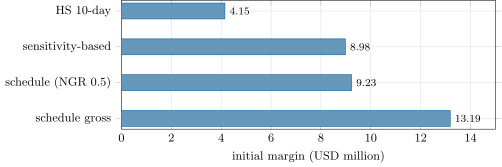
Bilateral initial margin of the member’s book today under a ten-day historical model, the sensitivity-based model with illustrative parameters, and the regulatory schedule. Simpler methods charge more. Data: US Treasury par yields; the chapter’s tutorial.
Figure 25.2. Bilateral initial margin of the member’s book today under a ten-day historical model, the sensitivity-based model with illustrative parameters, and the regulatory schedule. Simpler methods charge more. Data: US Treasury par yields; the chapter’s tutorial.

示例

Example 25.6 (Three bilateral numbers)

Today, for the same book traded bilaterally: a ten-day historical 99% margin of USD 4.15 million; a sensitivity-based margin of 8.98 million with illustrative ten-day risk weights of 60, 60, 55 and 50 basis points; and a schedule margin of 13.19 million gross, 9.23 million net at an NGR of 0.5 (Figure 25.2). The schedule ignores the offsets between tenors; the sensitivity model sees them only through its correlations.

在原文中阅读 →