 Coach
CoachA snowball is an autocallable, common in China, whose coupon accrues at an annual rate and is paid in a lump when the note knocks out (autocalls) on a monthly observation, or at maturity if it neither knocked out nor knocked in; the knock-in is monitored daily, and after a knock-in the investor bears the underlying’s loss at maturity.
Exemplos
Example 18.7 (Where the Phoenix goes)
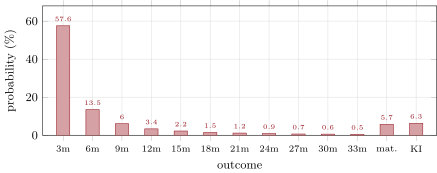
Under chapter 9’s local volatility, the note is called at the first observation with probability 57.6%, and within the first year with probability 80.5%. It reaches maturity unbroken with probability 5.7%, and knocked in with probability 6.3% (Figure 18.1). The fair quarterly coupon, the one that prices the note at par, is 1.55%, or 6.18% a year. Without coupons the note is worth 95.99, and each point of quarterly coupon adds 2.60.
Example 18.11 (The knock-in cliff)
A two-year snowball is observed monthly for knock-out at 103% from the third month, with a daily knock-in at 75% and a coupon of 15% a year. Under local volatility it is worth 100.44 (standard error 0.06), and its knock-in probability is 15.6%. One month before maturity, at 25% volatility, with the full 30% coupon due if the barrier holds and the spot 1% above the barrier, the issuer’s delta is 7.63 per unit of notional. A 1% fall knocks the note in, and the delta drops to 1.00. Per 100 million of notes the issuer sells 497 million of the underlying, measured at the barrier level. With three months left the figure is 254 million, and with a year left 97 million (Figure 18.4).