सभी किताबें

पेशेवर

ऐप्स परिचय Coach लॉग इन पढ़ना शुरू करें

Quantitative Finance · शब्दावली

Surface SVI क्या है?

Definition 8.3 Derivatives and Volatility · अध्याय 8 — Parametrising the Surface

Surface SVI (SSVI) writes the whole surface as a function of log-moneyness and the at-the-money total variance θT\theta_T of each expiry,

w(k,θT)=θT2(1+ρφ(θT)k+(φ(θT)k+ρ)2+1−ρ2),w(k,\theta_T)=\frac{\theta_T}2\Bigl(1+\rho\varphi(\theta_T)k+\sqrt{\bigl(\varphi(\theta_T)k+\rho\bigr)^2+1-\rho^2}\Bigr),

with one correlation-like parameter ρ\rho and a curvature function φ\varphi, commonly the power law φ(θ)=ηθ−γ\varphi(\theta)=\eta\theta^{-\gamma}.

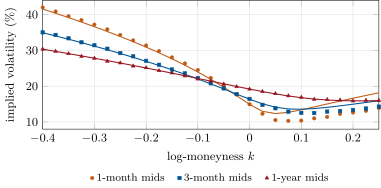
One SSVI surface (lines) fitted to five expiries at once, shown at three of them against the mids (markers). The fit is close at one year and misses the one-month skew, which is steeper than a single  allows. Data: the tutorial.
Figure 8.2. One SSVI surface (lines) fitted to five expiries at once, shown at three of them against the mids (markers). The fit is close at one year and misses the one-month skew, which is steeper than a single ρ\rho allows. Data: the tutorial.

उदाहरण

Example 8.5 (One surface, five numbers)

Fitted to the tutorial’s five expiries (one month to two years), SSVI returns ρ=−0.560\rho=-0.560, η=1.095\eta=1.095, γ=0.478\gamma=0.478 and satisfies both conditions. It misses the mids by 0.09 volatility points at one year, 0.76 at three months and 2.0 at one month (Figure 8.2): the market’s short smiles are more skewed than one ρ\rho can describe. Desks use SSVI as the arbitrage-free backbone and add slice-by-slice corrections where the quotes demand them.

अध्याय में पढ़ें →