
सभी किताबें

पेशेवर

1 Markets I: The Ecosystem and Exchange-Traded Marketsबाज़ार ऑनलाइन 2 Markets II: Rates, FX and Creditबाज़ार ऑनलाइन 3 Markets III: Commodities, Energy and Cryptoबाज़ार ऑनलाइन 4 Quantitative Methodsविधियाँ ऑनलाइन 5 Derivatives and Volatilityडेरिवेटिव्स ऑनलाइन 6 Rates, Credit, XVA and Riskब्याज दरें, क्रेडिट और जोखिम ऑनलाइन 7 Research Craft: Predictors, Backtests, Measurement, Portfoliosअनुसंधान ऑनलाइन 8 Strategies I: Equities and Futuresरणनीतियाँ ऑनलाइन 9 Strategies II: Volatility, Relative Value, Macro and the Bank Desksरणनीतियाँ ऑनलाइन 10 Microstructure and Executionनिष्पादन ऑनलाइन 11 Market Making and High-Frequency Tradingमार्केट मेकिंग ऑनलाइन 12 Machine Learning for Marketsमशीन लर्निंग ऑनलाइन 13 Low-Latency Softwareतकनीक ऑनलाइन 14 Networks, Hardware and Trading Infrastructureतकनीक ऑनलाइन 15 Research, Data and Risk Platformsतकनीक ऑनलाइन 16 The Desk and the Firmफ़र्म ऑनलाइन 17 The Industry: Firms, Roles and Careersकरियर ऑनलाइन 18 Interviews I: Maths, Probability and Speedकरियर ऑनलाइन 19 Interviews II: Markets, Trading Games and the Final Roundकरियर ऑनलाइन 20 Interviews III: Codeकरियर ऑनलाइन
ऐप्स परिचय Coach लॉग इन पढ़ना शुरू करें

Quantitative Finance · शब्दावली

Swing contract, take-or-pay clause क्या है?

अन्य नाम: swing contract · take-or-pay clause

Definition 12.4 Markets III: Commodities, Energy and Crypto · अध्याय 12 — Commodity Options and Structured Hedges

A swing contract lets its holder choose, each day, a quantity between a minimum and a maximum around a daily contract quantity, at a fixed or indexed price, subject to limits on the total taken over the year. A take-or-pay clause obliges the buyer to pay for a minimum annual quantity whether or not it takes it.
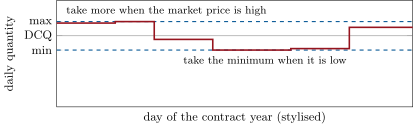
A swing contract, schematic: each day the holder nominates between a minimum and a maximum around the daily contract quantity (DCQ); the year’s total must stay within annual limits, and the take-or-pay clause makes the lowest total a payment in any case. Stylised, no data.
Figure 12.2. A swing contract, schematic: each day the holder nominates between a minimum and a maximum around the daily contract quantity (DCQ); the year’s total must stay within annual limits, and the take-or-pay clause makes the lowest total a payment in any case. Stylised, no data.

उदाहरण

Example 12.5 (Three days of swing)

A buyer holds a three-day contract at 40 EUR/MWh40\,\mathrm{EUR}/\mathrm{MWh} with a daily contract quantity of 100 MWh, a swing of 20 MWh either way, and a total that must equal 300 MWh. Market prices turn out to be 30, 50 and 40. Taking 80 on the first day (buying the missing 20 in the market at 30) and 120 on the second (selling the extra 20 at 50) is worth 20×(40−30)+20×(50−40)=40020 \times (40 - 30) + 20 \times (50 - 40) = 400 euros more than taking 100 every day. With prices unknown in advance, the holder must decide each day, and the flexibility is worth less than this perfect-foresight value.

अध्याय में पढ़ें →