
Todos los libros

Profesional

Apps Acerca de Coach Iniciar sesión Empezar a leer

Quantitative Finance · Glosario

¿Qué es Theory of storage, convenience yield?

También llamado: theory of storage · convenience yield

Definition 10.3 Markets III: Commodities, Energy and Crypto · Capítulo 10 — Forward Curves, Storage and Convenience Yield

The theory of storage (Kaldor, Working, Brennan) explains the futures–spot spread by the cost of storage and a benefit of holding inventory. That benefit, per unit of value and time, is the convenience yield ycy_c: the value of being able to use the commodity now, avoiding a stock-out, keeping a plant running. With it,
Ft,T=St e(r+u−yc) τ.F_{t,T} = S_t\,e^{(r + u - y_c)\,\tau}.
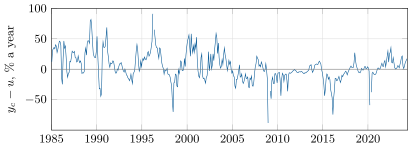
Net convenience yield of WTI implied by contracts 1 and 2 and the 3-month Treasury bill, monthly means of daily values, January 1985 to March 2024 (months below -100\%, such as April 2020, are off the chart). The median month is close to zero; the curve was in backwardation on 45% of days. Data: EIA; FRED DTB3.
Figure 10.2. Net convenience yield of WTI implied by contracts 1 and 2 and the 3-month Treasury bill, monthly means of daily values, January 1985 to March 2024 (months below −100%-100\%, such as April 2020, are off the chart). The median month is close to zero; the curve was in backwardation on 45% of days. Data: EIA; FRED DTB3.

Ejemplos

Example 10.5 (Reading a spread)

The front WTI contract is at $80.00 and the second at $79.40, a month apart, with the rate at 4%. The net convenience yield is 0.04−12ln⁡(79.40/80.00)=13.0%0.04 - 12\ln(79.40/80.00) = 13.0\% a year: the market pays about 13% a year above financing to hold oil now. With the second at $80.60, it is −5.0%-5.0\%: storage is being paid for.

Leer en el capítulo →