
جميع الكتب

مهني

1 Markets I: The Ecosystem and Exchange-Traded Marketsالأسواق عبر الإنترنت 2 Markets II: Rates, FX and Creditالأسواق عبر الإنترنت 3 Markets III: Commodities, Energy and Cryptoالأسواق عبر الإنترنت 4 Quantitative Methodsالأساليب عبر الإنترنت 5 Derivatives and Volatilityالمشتقات عبر الإنترنت 6 Rates, Credit, XVA and Riskالفائدة والائتمان والمخاطر عبر الإنترنت 7 Research Craft: Predictors, Backtests, Measurement, Portfoliosالبحث عبر الإنترنت 8 Strategies I: Equities and Futuresالاستراتيجيات عبر الإنترنت 9 Strategies II: Volatility, Relative Value, Macro and the Bank Desksالاستراتيجيات عبر الإنترنت 10 Microstructure and Executionالتنفيذ عبر الإنترنت 11 Market Making and High-Frequency Tradingصناعة السوق عبر الإنترنت 12 Machine Learning for Marketsتعلم الآلة عبر الإنترنت 13 Low-Latency Softwareالتكنولوجيا عبر الإنترنت 14 Networks, Hardware and Trading Infrastructureالتكنولوجيا عبر الإنترنت 15 Research, Data and Risk Platformsالتكنولوجيا عبر الإنترنت 16 The Desk and the Firmالشركة عبر الإنترنت 17 The Industry: Firms, Roles and Careersالمسارات المهنية عبر الإنترنت 18 The Interview Bookالمسارات المهنية عبر الإنترنت
التطبيقات حول المدرب تسجيل الدخول ابدأ القراءة

Quantitative Finance · المسرد

ما معنى Trading game؟

Definition 6.3 The Interview Book · الفصل 6 — The Final Round and Trading Games

A trading game is an interview exercise in which candidates make markets on, bet on or trade an uncertain quantity whose distribution can be reasoned about (dice, cards, an estimation question), against the interviewer or each other, while information is revealed.
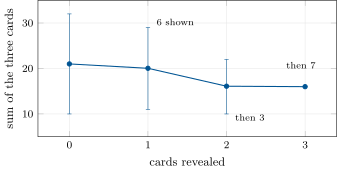
One three-card game: the fair value of the sum (dots) and the range holding 90% of the outcomes (bars) after 0, 1, 2 and 3 cards are shown. The cards were 6, 3 and 7 (a seeded draw). Exact enumeration; data: fig_iv_game.py.
Figure 6.1. One three-card game: the fair value of the sum (dots) and the range holding 90% of the outcomes (bars) after 0, 1, 2 and 3 cards are shown. The cards were 6, 3 and 7 (a seeded draw). Exact enumeration; data: fig_iv_game.py.

أمثلة

Example 6.4 (The three-card market)

Cards count 1 (ace) to 13 (king), four of each, 52 in all. The sum of three cards drawn without replacement has mean 3×7=213 \times 7 = 21 and variance 3×14×4951≈40.43 \times 14 \times \tfrac{49}{51} \approx 40.4 (each card has variance (132−1)/12=14(13^2 - 1)/12 = 14, reduced by the finite-population factor), so a standard deviation of about 6.35; an exact enumeration puts 90% of the outcomes between 10 and 32. A market of 19 at 23 is centred and about a third of a standard deviation wide on each side. When a card is shown, the fair value becomes that card plus twice the mean of the 51 remaining cards: a king moves it to 13+2×351/51≈26.7613 + 2 \times 351/51 \approx 26.76. Figure 6.1 follows one game’s fair value as its cards appear.

اقرأ في الفصل →