 Coach
CoachA trading game is an interview exercise in which candidates make markets on, bet on or trade an uncertain quantity whose distribution can be reasoned about (dice, cards, an estimation question), against the interviewer or each other, while information is revealed.
fig_iv_game.py.Exemplos
Example 6.4 (The three-card market)
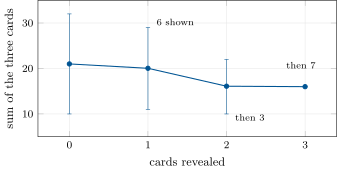
Cards count 1 (ace) to 13 (king), four of each, 52 in all. The sum of three cards drawn without replacement has mean and variance (each card has variance , reduced by the finite-population factor), so a standard deviation of about 6.35; an exact enumeration puts 90% of the outcomes between 10 and 32. A market of 19 at 23 is centred and about a third of a standard deviation wide on each side. When a card is shown, the fair value becomes that card plus twice the mean of the 51 remaining cards: a king moves it to . Figure 6.1 follows one game’s fair value as its cards appear.