All books

Professional

Apps About Coach Log in Start reading

Quantitative Finance · Glossary

What is Tranche, attachment and detachment points?

Also known as: tranche · attachment point · detachment point

Definition 24.5 Markets II: Rates, FX and Credit · Chapter 24 — Credit Indices and Tranches

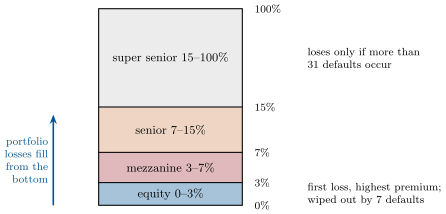
A tranche of an index is a contract that covers only the portfolio losses between two levels, expressed as fractions of the index notional: losses start to reduce it at the attachment point aa and have wiped it out at the detachment point dd. For a portfolio loss LL, the tranche loses min⁡(max⁡(L−a,0), d−a)\min\bigl(\max(L - a, 0),\, d - a\bigr), a fraction min⁡(max⁡(L−a,0),d−a)/(d−a)\min(\max(L-a,0), d-a)/(d-a) of its own notional.

The tranches of this chapter’s example (heights not to scale). Portfolio losses fill the stack from the bottom: the equity tranche takes the first 3% of losses, the mezzanine the next 4%, and so on; with a 40% recovery each of 125 defaults costs 0.48% of the notional. Schematic.
Figure 24.3. The tranches of this chapter’s example (heights not to scale). Portfolio losses fill the stack from the bottom: the equity tranche takes the first 3% of losses, the mezzanine the next 4%, and so on; with a 40% recovery each of 125 defaults costs 0.48% of the notional. Schematic.

Examples

Example 24.7 (Tranche losses)

For the stylised index, the five-year default probability implied by the intrinsic spread is 5.95%, and the portfolio’s expected loss 3.57%. With ρ=0.3\rho = 0.3 the expected losses are 59.6% of the equity tranche, 24.1% of the mezzanine, 7.83% of the senior and 0.22% of the super senior; weighted by their widths, 3, 4, 8 and 85%, they add up to 3.57%. The equity’s expected loss is 64.0% at ρ=0.25\rho = 0.25, and inverting the model at that value returns a base correlation of 25%. The mezzanine’s is 24.3% at ρ=0.10\rho = 0.10, 25.0% at 0.20 and 21.9% at 0.45: it is 24.3% again at 0.28.

Read in context →