جميع الكتب

مهني

1 Markets I: The Ecosystem and Exchange-Traded Marketsالأسواق عبر الإنترنت 2 Markets II: Rates, FX and Creditالأسواق عبر الإنترنت 3 Markets III: Commodities, Energy and Cryptoالأسواق عبر الإنترنت 4 Quantitative Methodsالأساليب عبر الإنترنت 5 Derivatives and Volatilityالمشتقات عبر الإنترنت 6 Rates, Credit, XVA and Riskالفائدة والائتمان والمخاطر عبر الإنترنت 7 Research Craft: Predictors, Backtests, Measurement, Portfoliosالبحث عبر الإنترنت 8 Strategies I: Equities and Futuresالاستراتيجيات عبر الإنترنت 9 Strategies II: Volatility, Relative Value, Macro and the Bank Desksالاستراتيجيات عبر الإنترنت 10 Microstructure and Executionالتنفيذ عبر الإنترنت 11 Market Making and High-Frequency Tradingصناعة السوق عبر الإنترنت 12 Machine Learning for Marketsتعلم الآلة عبر الإنترنت 13 Low-Latency Softwareالتكنولوجيا عبر الإنترنت 14 Networks, Hardware and Trading Infrastructureالتكنولوجيا عبر الإنترنت 15 Research, Data and Risk Platformsالتكنولوجيا عبر الإنترنت 16 The Desk and the Firmالشركة عبر الإنترنت 17 The Industry: Firms, Roles and Careersالمسارات المهنية عبر الإنترنت 18 The Interview Bookالمسارات المهنية عبر الإنترنت
التطبيقات حول المدرب تسجيل الدخول ابدأ القراءة

Quantitative Finance · المسرد

ما معنى Tranche, attachment and detachment points؟

يُعرف أيضًا باسم: tranche · attachment point · detachment point

Definition 24.5 Markets II: Rates, FX and Credit · الفصل 24 — Credit Indices and Tranches

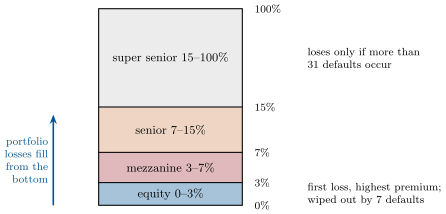
A tranche of an index is a contract that covers only the portfolio losses between two levels, expressed as fractions of the index notional: losses start to reduce it at the attachment point aa and have wiped it out at the detachment point dd. For a portfolio loss LL, the tranche loses min⁡(max⁡(L−a,0), d−a)\min\bigl(\max(L - a, 0),\, d - a\bigr), a fraction min⁡(max⁡(L−a,0),d−a)/(d−a)\min(\max(L-a,0), d-a)/(d-a) of its own notional.

The tranches of this chapter’s example (heights not to scale). Portfolio losses fill the stack from the bottom: the equity tranche takes the first 3% of losses, the mezzanine the next 4%, and so on; with a 40% recovery each of 125 defaults costs 0.48% of the notional. Schematic.
Figure 24.3. The tranches of this chapter’s example (heights not to scale). Portfolio losses fill the stack from the bottom: the equity tranche takes the first 3% of losses, the mezzanine the next 4%, and so on; with a 40% recovery each of 125 defaults costs 0.48% of the notional. Schematic.

أمثلة

Example 24.7 (Tranche losses)

For the stylised index, the five-year default probability implied by the intrinsic spread is 5.95%, and the portfolio’s expected loss 3.57%. With ρ=0.3\rho = 0.3 the expected losses are 59.6% of the equity tranche, 24.1% of the mezzanine, 7.83% of the senior and 0.22% of the super senior; weighted by their widths, 3, 4, 8 and 85%, they add up to 3.57%. The equity’s expected loss is 64.0% at ρ=0.25\rho = 0.25, and inverting the model at that value returns a base correlation of 25%. The mezzanine’s is 24.3% at ρ=0.10\rho = 0.10, 25.0% at 0.20 and 21.9% at 0.45: it is 24.3% again at 0.28.

اقرأ في الفصل →