
Tous les livres

Professionnel

Applis À propos Coach Connexion Commencer la lecture

Quantitative Finance · Glossaire

Qu'est-ce que « Uncertainty-zone model » ?

Definition 6.3 Microstructure and Execution · Chapitre 6 — Tick Size, Queues and Priority

In the uncertainty-zone model of Robert and Rosenbaum, the traded price changes only when the efficient price P∗P^\ast moves far enough from the last traded price: around each mid-tick value lies a zone of width 2η δtick2\eta\,\delta_{\mathrm{tick}}, 0<η≤10<\eta\le1, and the traded price moves to a new tick when P∗P^\ast crosses the zone’s far edge. The parameter η\eta measures the aversion of market participants to price changes of one tick; Dayri and Rosenbaum (2015) call 2η δtick2\eta\,\delta_{\mathrm{tick}} the implicit spread of a large-tick asset.
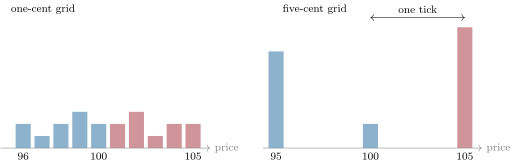
The same resting orders on two grids, prices in cents. Rounding away from the market sends the bids at 96 to 99 down to 95 and the asks at 101 to 105 up to 105: the spread becomes one tick of five cents, and the best ask queue holds the orders of five former levels.
Figure 6.1. The same resting orders on two grids, prices in cents. Rounding away from the market sends the bids at 96 to 99 down to 95 and the asks at 101 to 105 up to 105: the spread becomes one tick of five cents, and the best ask queue holds the orders of five former levels.
Lire dans le chapitre →