
সব বই

পেশাদার

1 Markets I: The Ecosystem and Exchange-Traded Marketsবাজার অনলাইন 2 Markets II: Rates, FX and Creditবাজার অনলাইন 3 Markets III: Commodities, Energy and Cryptoবাজার অনলাইন 4 Quantitative Methodsপদ্ধতি অনলাইন 5 Derivatives and Volatilityডেরিভেটিভস অনলাইন 6 Rates, Credit, XVA and Riskসুদহার, ঋণ ও ঝুঁকি অনলাইন 7 Research Craft: Predictors, Backtests, Measurement, Portfoliosগবেষণা অনলাইন 8 Strategies I: Equities and Futuresকৌশল অনলাইন 9 Strategies II: Volatility, Relative Value, Macro and the Bank Desksকৌশল অনলাইন 10 Microstructure and Executionএক্সিকিউশন অনলাইন 11 Market Making and High-Frequency Tradingমার্কেট মেকিং অনলাইন 12 Machine Learning for Marketsমেশিন লার্নিং অনলাইন 13 Low-Latency Softwareপ্রযুক্তি অনলাইন 14 Networks, Hardware and Trading Infrastructureপ্রযুক্তি অনলাইন 15 Research, Data and Risk Platformsপ্রযুক্তি অনলাইন 16 The Desk and the Firmপ্রতিষ্ঠান অনলাইন 17 The Industry: Firms, Roles and Careersক্যারিয়ার অনলাইন 18 Interviews I: Maths, Probability and Speedক্যারিয়ার অনলাইন 19 Interviews II: Markets, Trading Games and the Final Roundক্যারিয়ার অনলাইন 20 Interviews III: Codeক্যারিয়ার অনলাইন
অ্যাপ পরিচিতি Coach সাইন ইন পড়া শুরু করো

বইগুলো এখনো বাংলা ভাষায় পাওয়া যায় না — ইংরেজি সংস্করণ দেখানো হচ্ছে।

Quantitative Finance · পরিভাষা

Wholesaler and internalisation কী?

অন্য নাম: wholesaler · internalisation

Definition 10.1 Markets I: The Ecosystem and Exchange-Traded Markets · অধ্যায় 10 — Retail Flow and Wholesaling

A wholesaler is a market-making firm that receives the marketable orders of retail brokers’ customers and executes most of them as principal, against its own account, away from any exchange. Internalisation is the execution of a client order against the executing firm’s own inventory instead of against other investors’ orders on a venue.
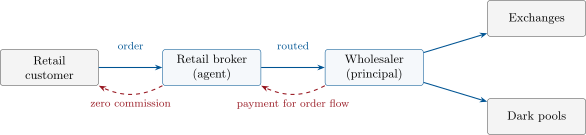
A retail market order. The wholesaler fills it from inventory at the national best price or slightly better, pays the broker, and manages the resulting position on exchanges and in dark pools. Only that residual hedging reaches a public order book.
Figure 10.1. A retail market order. The wholesaler fills it from inventory at the national best price or slightly better, pays the broker, and manages the resulting position on exchanges and in dark pools. Only that residual hedging reaches a public order book.

উদাহরণ

Example 10.6 (Reading one fill)

The national best quote is 20.00×20.0220.00 \times 20.02; a customer’s market purchase of 100 shares is filled at 20.018. Price improvement: 0.2 cent a share, 20 cents on the order. Effective half-spread: 20.018−20.010=0.820.018 - 20.010 = 0.8 cent. Five minutes later the mid is 20.013: the realised half-spread is 20.018−20.013=0.520.018 - 20.013 = 0.5 cent and the price impact 0.3 cent. The wholesaler’s gross revenue on this fill was 50 cents, out of which it pays the broker and its own costs.

Example 10.8 (The same cent, two flows)

Take h=1h = 1 cent, J=3J = 3 cents, κ=0.10\kappa = 0.10 cent. On an exchange, where 35% of the orders hitting a quote are informed, a market maker earns 1−1.05<01 - 1.05 < 0 before costs: the quoted spread is, in equilibrium, barely enough. For retail flow with p=5%p = 5\% and θ=20%\theta = 20\%: πmax⁡=0.80−0.15−0.10=0.55\pi_{\max} = 0.80 - 0.15 - 0.10 = 0.55 cent. The wholesaler can pay the broker 0.25 cent and keep 0.30 (Figure 10.2). Nothing here depends on speed or on being cleverer than the customer: the value lies entirely in the segmentation of orders by how much they know.

প্রসঙ্গসহ পড়ো →