
Todos os livros

Profissional

Apps Sobre Coach Entrar Começar a ler

Quantitative Finance · Glossário

O que é Zero-coupon rate, par yield, STRIPS?

Também chamado de: zero-coupon rate · par yield · STRIPS

Definition 3.12 Markets II: Rates, FX and Credit · Capítulo 3 — Government Bonds

The zero-coupon rate z(T)z(T) for maturity TT is the yield of a single payment at TT: P(0,T)=(1+z/f)−fTP(0,T) = (1 + z/f)^{-fT}. The par yield for TT is the coupon that would price a bond maturing at TT at 100. STRIPS are the US Treasury’s zero-coupon securities, created by separating an eligible note or bond into its individual coupon and principal payments, each of which then trades on its own; a complete set can be reassembled into the original security.
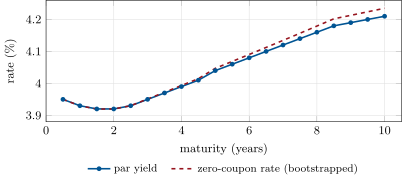
An illustrative par curve and the zero curve bootstrapped from it (). Where the par curve rises, the zero curve lies above it, because a coupon bond’s yield averages the zero rates of all its payments, most of them earlier and lower; where the par curve dips, at one to two years, the zero curve dips below it. Data: the chapter’s tutorial.
Figure 3.3. An illustrative par curve and the zero curve bootstrapped from it (Proposition 3.13). Where the par curve rises, the zero curve lies above it, because a coupon bond’s yield averages the zero rates of all its payments, most of them earlier and lower; where the par curve dips, at one to two years, the zero curve dips below it. Data: the chapter’s tutorial.
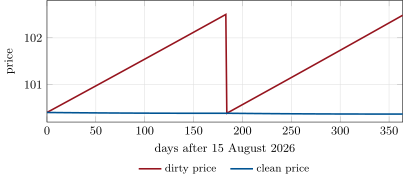
The ten-year note over a year at a constant yield of 4.20%, daily. The dirty price climbs as the coupon accrues and drops by the coupon when it is paid (15 February, day 184); the clean price moves only by its slow pull towards par. Data: the chapter’s tutorial.
Figure 3.4. The ten-year note over a year at a constant yield of 4.20%, daily. The dirty price climbs as the coupon accrues and drops by the coupon when it is paid (15 February, day 184); the clean price moves only by its slow pull towards par. Data: the chapter’s tutorial.
Ler no capítulo →