 Coach
CoachA gene is imprinted when only one of its two alleles is expressed, and which one depends on the parent it came from: some genes are expressed only from the paternal copy, others only from the maternal. Mammals have some imprinted genes, clustered, each cluster governed by an imprinting control region (ICR) that is methylated on one parental allele and not the other. The methylation is set in the germ line — one pattern in sperm, another in eggs — erased in the germ cells of the next generation and set again according to the sex of that individual. A child who receives both copies of a chromosome from the same parent (uniparental disomy) therefore has the wrong dose of the imprinted genes on it although its sequence is entirely normal.
Examples
Example 1.15 (The Igf2–H19 cluster)
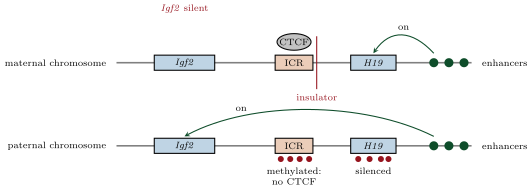
Igf2, a fetal growth factor, is expressed from the paternal allele; its neighbour H19, a non-coding RNA, from the maternal. Between them lies the ICR and, beyond H19, a shared set of enhancers. On the maternal chromosome the ICR is unmethylated and binds CTCF, which acts as an insulator: the enhancers can reach H19 but not Igf2. On the paternal chromosome the ICR is methylated (set in the sperm), CTCF cannot bind, and the enhancers reach across to Igf2; the methylation also spreads to silence the H19 promoter. One mark, set in one germ line, decides both genes.
Example 1.16 (Prader–Willi and Angelman)
The same deletion of about in chromosome 15 (region 15q11–q13) causes Prader–Willi syndrome — poor muscle tone at birth, then insatiable appetite and obesity — when it is on the paternal chromosome, and Angelman syndrome — severe intellectual disability, absent speech, a happy demeanour and seizures — when on the maternal. The region carries paternally expressed genes (SNRPN and a cluster of small RNAs) whose only active copy is lost in the first case, and the maternally expressed UBE3A, lost in the second. Maternal uniparental disomy of 15, with no deletion at all, also gives Prader–Willi: two maternal copies, silent for the paternal genes.