
All books

Professional

Apps About Coach Log in Start reading

Chemistry · Glossary

What is Carbon nanomaterials?

Also known as: fullerene · carbon nanotube · graphene

Definition 23.23 University Chemistry — Year 3 · Chapter 23 — Inorganic Materials and Nanomaterials

A fullerene is a closed cage molecule of carbon atoms, each bonded to three others, with five- and six-membered rings, such as icosahedral CX60\ce{C60}. A carbon nanotube is a sheet of graphite rolled into a seamless cylinder about a nanometre across. Graphene is a single layer of graphite, one atom thick.
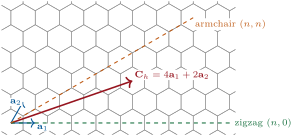

A graphene sheet and the chiral vector of a nanotube: rolling the sheet so that the tip of C_h = n a_1 + m a_2 meets its origin gives the (n, m) tube, here (4, 2). Along a_1 the rim of a (n, 0) tube is a zigzag; along a_1 + a_2, at 30°, that of an (n, n) tube is an armchair.
A graphene sheet and the chiral vector of a nanotube: rolling the sheet so that the tip of Ch=na1+ma2\mathbf C_h = n\mathbf a_1 + m\mathbf a_2 meets its origin gives the (n,m)(n, m) tube, here (4,2)(4, 2). Along a1\mathbf a_1 the rim of a (n,0)(n, 0) tube is a zigzag; along a1+a2\mathbf a_1 + \mathbf a_2, at 30°, that of an (n,n)(n, n) tube is an armchair.
The Lycurgus cup, a Roman glass of the fourth century, lit from inside: it looks green in reflected light and red in transmitted light, an effect of gold–silver nanoparticles in the glass. Photograph: Marie-Lan Nguyen, CC BY 2.5.
Read in context →