University Chemistry — Year 3 · Bachelor Year 3
23Inorganic Materials and Nanomaterials
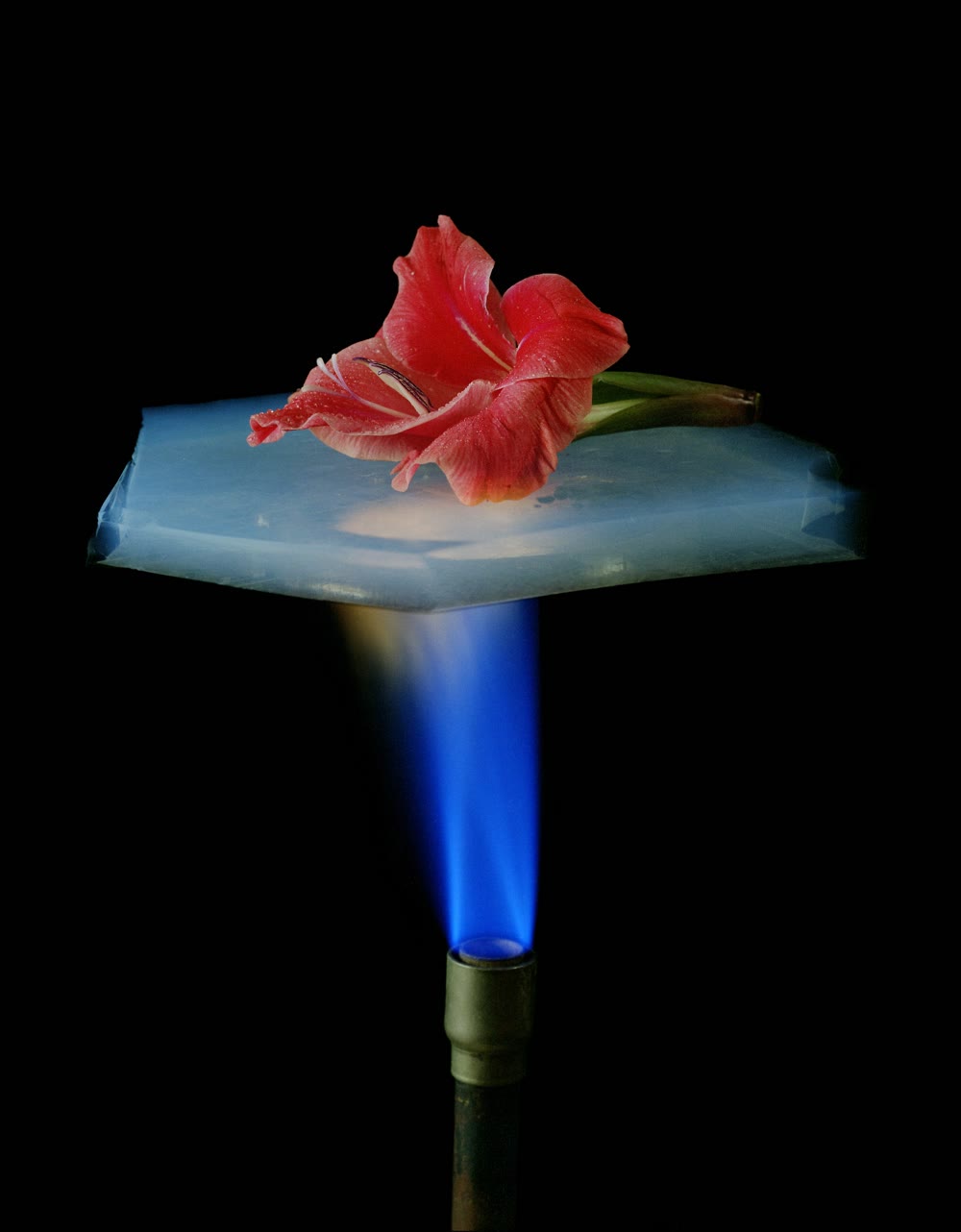
A slab of silica aerogel, a solid that is mostly air, holds a flower above a gas flame without letting it wilt. It is a glass, made not by melting sand but by letting a liquid set into a gel and then drying the gel without letting it collapse. Materials chemistry works in that order: choose the structure, then the route that makes it, then read off the properties. This chapter follows the routes to inorganic solids, the structures of ceramics, glasses and porous crystals, and what happens to matter when a particle is only a few nanometres across.
You already know
The Year 1 volume described crystal structure types, interstitial sites, allotropes, graphite and diamond; the Year 2 volume phase diagrams, the glass transition temperature and polymers. Chapter 16 defined the specific surface area, Chapter 17 sols and gels, Chapter 22 bands, point defects and ionic conductors; Chapter 1 solved the particle in a box, and Chapter 4 gave the icosahedral group.
23.1 Synthesis routes
Definition 23.1 (Ceramic method)
The ceramic method makes a solid compound by grinding the solid reactants together and heating them, often for days and with regrinding, at temperatures high enough for ions to diffuse through the solids.
The reaction of two solids happens at their contact, and the product forms a layer between them through which the ions must then travel: the slowest step is diffusion, and it slows down as the layer thickens.
Proposition 23.2 (Parabolic growth)
If the growth of a product layer is limited by diffusion across it, its thickness grows as .
Proof. With fixed concentrations on the two faces of the layer, the flux through it follows Fick’s law, . The layer grows in proportion to the flux: , with the volume of product per mole transported. Then , and integrating from at gives . ∎
Doubling the particle size thus multiplies the reaction time by four: hence fine grinding, mixing at the atomic scale in a precursor (a mixed oxalate or citrate gel that decomposes into the target), or a solution route.
Definition 23.3 (Sol–gel process)
The sol–gel process makes an oxide by hydrolysis and condensation of molecular precursors, usually alkoxides, in solution: the solution becomes a sol of small oxide clusters, then a gel, a continuous solid network filled with liquid. Dried by evaporation, the gel shrinks into a dense xerogel; dried above the critical point of the liquid, which removes it without a liquid–gas interface, it keeps its volume as an aerogel.


The two reactions together give, for complete reaction, . Acid catalysis makes the hydrolysis fast and the condensation slow, giving thin, chain-like polymers; base catalysis the opposite, giving dense particles. Coatings (antireflection layers on glass) are made by dipping a part into the sol and drawing it out.
Definition 23.4 (Hydrothermal synthesis)
Hydrothermal synthesis crystallises a solid from water above its normal boiling point, in a closed vessel under its own vapour pressure; solvothermal synthesis does the same in another solvent.
Definition 23.5 (Chemical vapour deposition)
Chemical vapour deposition (CVD) grows a solid film on a heated surface by the reaction of gaseous precursors there, as silicon from silane, , or diamond from methane and hydrogen.
Method 23.6 (Choosing a synthesis route)
- A stable, refractory oxide in bulk powder: the ceramic method, with a precursor if mixing is hard.
- A metastable phase, a fine powder or a coating at low temperature: sol–gel or a precipitation.
- Large single crystals of a phase soluble only in hot water (quartz) or a framework built around a template (zeolites): hydrothermal.
- A thin, pure film on a substrate (semiconductor layers): CVD.
In the lab — A sol–gel coating and an autoclave
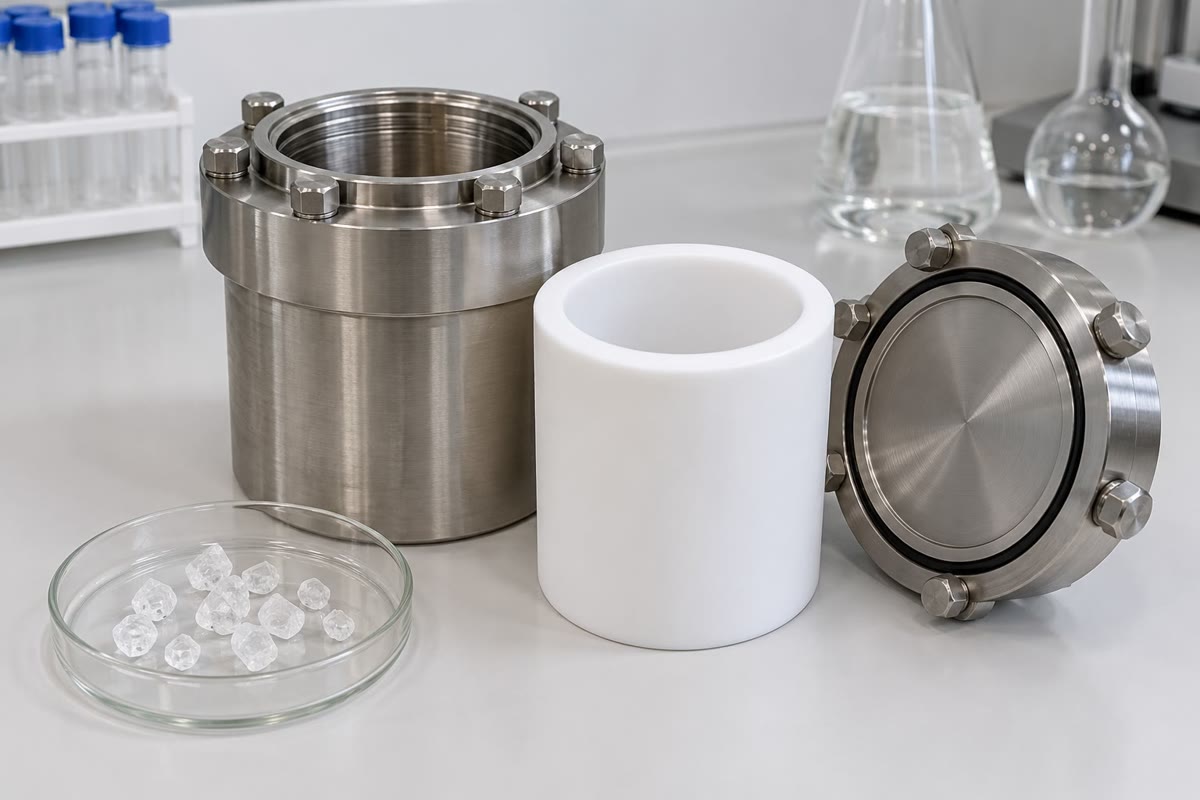
Tetraethyl orthosilicate is stirred with ethanol, water and a drop of acid until the solution is clear; a clean glass slide is dipped in and drawn out at a steady slow speed, dried and heated, leaving a silica film thin enough to show interference colours. For a hydrothermal synthesis the reactants are put in a polytetrafluoroethylene liner, filled no more than about two thirds so that the expanding liquid does not fill the vessel, sealed in a steel autoclave and heated in an oven; the autoclave is opened only once cold.
23.2 Ceramics and glasses
Definition 23.7 (Ceramic)
A ceramic is an inorganic, non-metallic solid made by heating a powder: oxides, nitrides and carbides, or clay products.
Definition 23.8 (Perovskite structure)
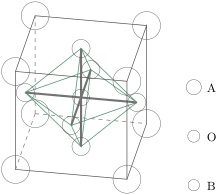
The perovskite structure of an oxide has the small B cations at the centres of corner-sharing octahedra and the large A cations in the twelve-coordinate cavities between them; in the ideal cubic cell, B is at the centre, O at the face centres, A at the corners. The tolerance factor measures how well the ions fit:
Proposition 23.9 (Ideal tolerance factor)
In the ideal cubic perovskite, with the ions touching along the B–O and A–O directions, .
Proof. With edge , B at the centre and O at a face centre are apart: . A at a corner and O at the centre of an adjacent face are half a face diagonal apart: . Dividing, , so . ∎
When is slightly below 1, the A ion is too small for its cavity and the octahedra tilt to close around it, lowering the symmetry; when is above 1, the B ion is too small for its octahedron and can move off centre.
Definition 23.10 (Ferroelectric)
A ferroelectric is a crystal with a spontaneous electric polarisation that an applied electric field can reverse.
Barium titanate is the classic case: with (twelve-coordinate), and , . Below a transition temperature the titanium ions shift off centre, all in the same direction within a domain, and the crystal polarises; the huge permittivity near the transition makes barium titanate the dielectric of most ceramic capacitors.
Definition 23.11 (Oxide glasses)
An oxide glass is an amorphous oxide solid, made by cooling a melt without crystallisation. Its network formers (, , ) build a continuous network of corner-sharing polyhedra; its network modifiers (, ) break bridges in that network, each oxide ion added turning one bridging oxygen into two non-bridging ones, with the cations sitting in the holes.
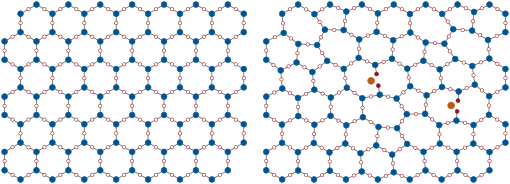
William Zachariasen argued in 1932 that an oxide forms a glass easily when its cation is surrounded by few oxygens (three or four), each oxygen links at most two cations, and the polyhedra share corners, not edges or faces: then a random network costs little more energy than the crystal. Window glass is silica with sodium and calcium oxides as modifiers, which lower the melting temperature. Toughened cover glass for phones is soaked in molten potassium nitrate: larger ions replace ions in the surface and, being crowded, put it under compression, so that cracks do not open.
23.3 Porous solids: zeolites and frameworks
Definition 23.12 (Zeolites)
A zeolite is a crystalline aluminosilicate whose framework of corner-sharing and tetrahedra encloses cages and channels of molecular size, with exchangeable cations and water inside. A molecular sieve is a porous solid that admits molecules according to their size; shape selectivity is the control of a reaction by the size and shape of the pores in which it takes place.
Each tetrahedron carries one negative charge more than an (aluminium(III) in place of silicon(IV)); cations in the cages, or , balance it, and can be exchanged.
Proposition 23.13 (Löwenstein’s rule)
In a zeolite framework two tetrahedra never share an oxygen: Al–O–Al links are absent (an observation on all known aluminosilicate frameworks). As a consequence the ratio Si/Al of a zeolite is at least 1.
Proof of the consequence. Each aluminium has four oxygens, each shared with a silicon by the rule: Al–O–Si links. Each silicon has only four oxygens, so it takes part in at most four such links: , that is . Equality forces every silicon to have four aluminium neighbours: Si and Al alternate. ∎
Method 23.14 (Formula and exchange capacity of a zeolite)
- Write the framework as : Si/Al .
- The framework charge is balanced by cations: monovalent or divalent.
- The exchange capacity is the amount of exchangeable charge per gram: moles of monovalent cations, of divalent ones, with the molar mass of the formula as weighed (anhydrous or hydrated).
Proposition 23.15 (Exchange capacity)
The capacity of a zeolite for a cation of charge is moles per gram, where is the number of aluminium atoms in a formula of molar mass .
Proof. Each aluminium contributes one negative charge to the framework; electrical neutrality requires units of positive charge, all of them exchangeable, so cations of charge per formula unit, that is per mass . ∎
Zeolite A has windows of eight tetrahedra, across: water and small ions pass, branched molecules do not. ZSM-5 has two sets of channels of ten tetrahedra, about 0.51 to : in the conversion of methanol or the alkylation of toluene, the slim para-xylene diffuses out much faster than its ortho and meta isomers, which stay and isomerise. That is shape selectivity.
Definition 23.16 (Metal–organic frameworks)
A metal–organic framework (MOF) is a crystalline solid built from metal ions or clusters joined by polytopic organic linkers into a porous network. A secondary building unit is the metal cluster with its coordinating groups, treated as one node of the net; reticular synthesis is the design of a framework by choosing nodes and linkers of given geometry so that they assemble into a chosen net.
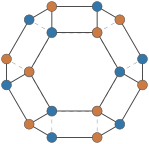
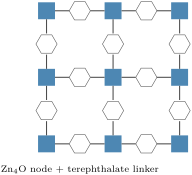
In MOF-5, clusters with six carboxylate groups are octahedral nodes, and benzene-1,4-dicarboxylate linkers join them along the edges of a cubic net, for a cell of eight nodes. Replacing the linker by a longer one keeps the net and enlarges the pores: that is the reticular idea. Such frameworks have surface areas of thousands of square metres per gram and are studied for storing hydrogen and methane and for capturing carbon dioxide.
Definition 23.17 (Pore sizes)
By convention, micropores are narrower than , mesopores between 2 and , and macropores wider than .
Zeolites and most MOFs are microporous; silica gels and aerogels mesoporous.
23.4 Nanoparticles
Definition 23.18 (Nanomaterials)
A nanomaterial has at least one dimension between about 1 and ; a nanoparticle has all three.
Proposition 23.19 (Magic clusters)
A cuboctahedral cluster made of a central atom and complete shells has
atoms, of which are on the surface: 13, 55, 147, 309, …
Proof. The -th shell of a cuboctahedron has 12 vertices, 24 edges with atoms inside each, 8 triangular faces with inner atoms each and 6 square faces with : in total . Then , which expands to the formula; the outer shell, atoms, is the surface. ∎
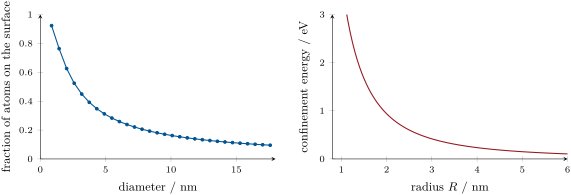
With a large fraction of its atoms at the surface, where they have fewer neighbours, a nanoparticle melts at a lower temperature than the bulk metal, is more reactive, and can be a far better catalyst: bulk gold is inert, gold particles a few nanometres across oxidise carbon monoxide at room temperature.
Definition 23.20 (Quantum dots)
A quantum dot is a semiconductor nanocrystal small enough that the confinement of its electrons and holes raises its band gap above that of the bulk solid.
Theorem 23.21 (Confinement in a sphere)
A particle of mass confined in a sphere of radius by infinite walls has the ground-state energy , with wavefunction .
Proof. For a spherically symmetric state , the Laplacian gives , so the Schrödinger equation inside becomes , that of a particle on a line. The solution with finite at the centre has : , with . The wall requires , so for the ground state, and . ∎
In a dot, the electron and the hole are both confined; the energy of the lowest excitation is to a first approximation, with their reduced mass (their Coulomb attraction lowers it a little). Halving the radius multiplies the confinement energy by four: cadmium selenide dots of a few nanometres glow red, green or blue according to size alone, and are used as emitters in displays.
Definition 23.22 (Surface plasmon resonance)
A surface plasmon resonance is a collective oscillation of the conduction electrons of a metal nanoparticle driven by light; it gives a strong absorption band whose wavelength depends on the metal, the size and shape of the particle and its surroundings.
Gold nanoparticles of a few tens of nanometres absorb green light and look ruby red in a glass or a colloid; as they aggregate, the band shifts to longer wavelengths and the colour turns blue: the basis of many rapid tests, in which an antibody-coated gold colloid gathers into a coloured line.
23.5 Carbon nanomaterials
Definition 23.23 (Carbon nanomaterials)
A fullerene is a closed cage molecule of carbon atoms, each bonded to three others, with five- and six-membered rings, such as icosahedral . A carbon nanotube is a sheet of graphite rolled into a seamless cylinder about a nanometre across. Graphene is a single layer of graphite, one atom thick.
Proposition 23.24 (Twelve pentagons)
Every fullerene has exactly twelve pentagons, whatever its number of hexagons.
Proof. A closed cage is a polyhedron: Euler’s formula holds. Each atom has three bonds and each bond two atoms: . With pentagons and hexagons, counting edges by faces gives , and . Then and Euler’s formula reads , that is , so : . ∎
Proposition 23.25 (Metallic and semiconducting nanotubes)
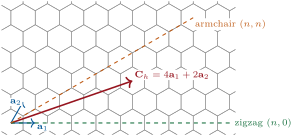
A single-walled carbon nanotube is metallic when is a multiple of 3, and a semiconductor otherwise.
Proof. Admitted at this level. ∎
A third of all possible tubes are thus metallic, among them every armchair tube; the gap of the others falls as their diameter grows. Graphene itself has no gap at all: its valence and conduction bands touch at single points, and its electrons move as if they had no mass.
Safety


Tetraethyl orthosilicate: flammable liquid and vapour, harmful if inhaled, irritating to the eyes and airways; handled in a fume hood. Nanopowders: the finest particles reach deep into the lungs, and many are not yet classified; they are weighed and handled in an enclosure or as a suspension, never as a loose dust in open air.
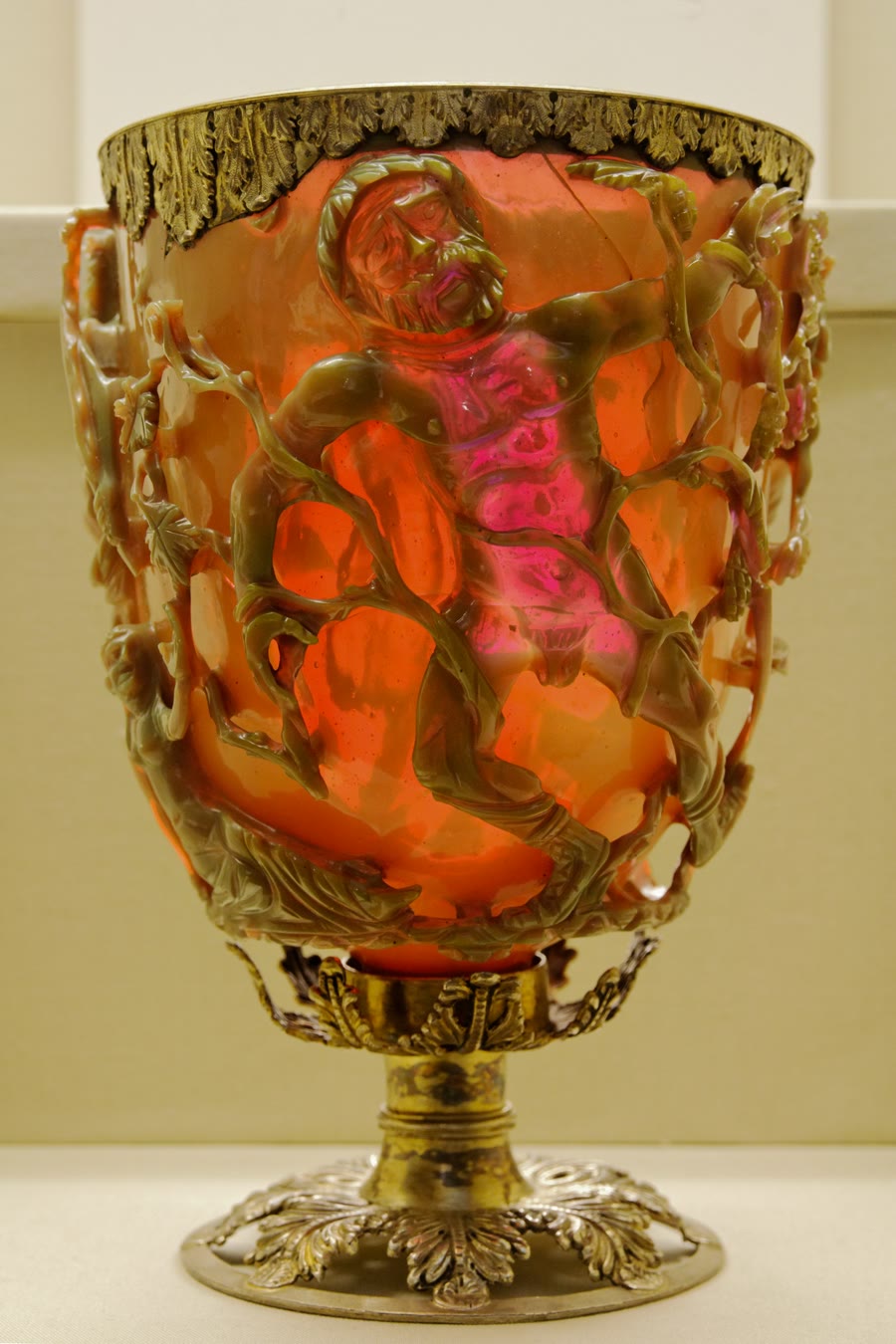
History — Nanoparticles before the word, and a football of carbon
Glassmakers coloured glass red with gold long before anyone knew why; the Lycurgus cup shows the effect at its most striking. Michael Faraday made gold colloids in the 1850s and saw that their colour came from particles too small to see. In 1985 Harold Kroto, Robert Curl and Richard Smalley, vaporising graphite with a laser, found that clusters of sixty carbon atoms were exceptionally stable and proposed the closed cage of twelve pentagons and twenty hexagons; they received the 1996 Nobel Prize in Chemistry.
23.6 Exercises
Exercise 23.1 ★
A product layer between two solids is thick after . How long until it is thick, if the growth is parabolic?
Solution
Solution of Exercise 23.1.
: three times thicker takes nine times longer, .
Exercise 23.2 ★
Write the hydrolysis of tetraethyl orthosilicate to silicic acid, the condensation of two silicic acid molecules, and the overall reaction giving silica.
Solution
Solution of Exercise 23.2.
Hydrolysis: . Condensation: . Overall: .
Exercise 23.3 ★
Classify , , and as network formers or modifiers, and say what does to the network of silica.
Solution
Solution of Exercise 23.3.
Formers: , . Modifiers: , . Each oxide ion of breaks one Si–O–Si bridge into two Si–O ends, each paired with a : the network is cut, the melt flows more easily and melts lower.
Exercise 23.4 ★
How many pentagons and hexagons does have? How many bonds?
Solution
Solution of Exercise 23.4.
Twelve pentagons (as for every fullerene). , bonds, faces, so hexagons.
Exercise 23.5 ★★
Compute the tolerance factors of , and with the twelve-coordinate radii of (), () and (), and . What do they predict?
Solution
Solution of Exercise 23.5.
. : , the ideal cubic perovskite. : , titanium too small for its octahedron, off-centre: ferroelectric. : , calcium too small for its cavity: tilted octahedra, lower symmetry.
Exercise 23.6 ★★
A zeolite X has the anhydrous formula (data of the exercise). Give Si/Al and its exchange capacity for in millimoles per gram.
Solution
Solution of Exercise 23.6.
Si/Al . ; 43 per formula: .
Exercise 23.7 ★★
Gold is face-centred cubic with . Estimate the number of shells of a cuboctahedral gold particle about across, its number of atoms and the fraction on its surface.
Solution
Solution of Exercise 23.7.
Nearest-neighbour distance . A cluster of shells is across: , so (). atoms, on the surface: 31 %.
Exercise 23.8 ★★
A semiconductor has a bulk gap of , and its electron and hole a reduced mass of (data of the exercise). Estimate the colour of the light emitted by dots of radius 2.0 and , neglecting the Coulomb attraction.
Solution
Solution of Exercise 23.8.
with : at and at . Emission at , (blue), and , (yellow): the smaller dot emits the bluer light.
Exercise 23.9 ★★
Are the nanotubes , , and metallic or semiconducting? Which are armchair, which zigzag?
Solution
Solution of Exercise 23.9.
: armchair, , metallic. : zigzag, 10 not a multiple of 3, semiconducting. : zigzag, metallic. : neither (chiral), , semiconducting.
Exercise 23.10 ★★★
MOF-5, , is cubic with and eight formula units per cell. Compute its density. If one gram has a surface area of (data of the exercise), how many football pitches of is that?
Solution
Solution of Exercise 23.10.
; ; . A pitch is : one gram holds pitch, and a teaspoon of a few grams more than a whole pitch.
Exercise 23.11 ★★★
Using the shell count of Proposition 23.19, show that the surface fraction of a cuboctahedral cluster tends to for large , and compare with the exact fraction for .
Solution
Solution of Exercise 23.11.
. For : exact , against ; the approximation overestimates small clusters, whose inner shells are not negligible.
Exercise 23.12 ★★★
A closed carbon cage with three bonds per atom contains pentagons, hexagons and heptagons. Show that .
Solution
Solution of Exercise 23.12.
, , . Euler: , with : , so , that is : . Each heptagon needs one extra pentagon.
23.7 Problem: Softening Water with Zeolite A
Problem 23.1
Weekend problem — softening water with zeolite A: the formula and Löwenstein’s rule, the theoretical exchange capacity, the zeolite needed for one wash, and the window that lets calcium in and keeps detergents out
Zeolite A, used in detergents in place of phosphates, has the formula and windows across. A tap water contains of , and a wash uses of it; in the time of a wash the zeolite reaches 60 % of its capacity (data of the problem).
Part I — The formula.
- Compute the molar mass of the anhydrous formula.
- Compute that of the hydrated formula.
- Give Si/Al.
- State Löwenstein’s rule and what it implies here for the arrangement of Si and Al.
- What is the charge of the framework per formula?
- Compute the mass fraction of water in the hydrated zeolite.
Part II — Exchange capacity.
- Write the exchange equilibrium between the sodium zeolite and calcium ions.
- How many can one formula take up?
- Compute the theoretical capacity of the anhydrous zeolite in mmol of per gram.
- Compute it for the hydrated zeolite.
- Express the anhydrous capacity as milligrams of per gram, the usual unit for water hardness.
Part III — One wash.
- Compute the amount of in the water of one wash.
- Compute the mass of hydrated zeolite needed at the theoretical capacity.
- Compute it at 60 % of the capacity.
- Compute the mass of sodium released into the water.
- Why did detergent makers replace phosphates?
- Why does zeolite A take up more slowly than ?
Part IV — The window.
- Compare the window with the diameter of a ion (six-coordinate radius ).
- What must a hydrated ion do to pass?
- Why does a surfactant anion such as dodecyl sulfate stay out?
- What does zeolite A do as a drying agent, and why is it called a molecular sieve?
- How would replacing by change the size of the molecules admitted?
- In ZSM-5, why does para-xylene leave the pores faster than ortho-xylene?
- State the result: the theoretical exchange capacity of anhydrous zeolite A for .
Solution
Solution of Problem 23.1.
1. : .
2. .
3. Si/Al .
4. No Al–O–Al links; with Si/Al every Si has four Al neighbours and every Al four Si: strict alternation.
5. , one per aluminium.
6. %.
7. .
8. Six (twelve charges).
9. .
10. .
11. of per gram.
12. .
13. .
14. .
15. of , .
16. Phosphates in waste water feed algae in rivers and lakes; the blooms and their decay use up the dissolved oxygen (eutrophication).
17. The smaller holds its water molecules more tightly; it must shed them to pass the window and reach the sites, which is slow at washing temperatures.
18. The bare ion is about across, half the window.
19. The hydrated ion is larger than the window: it must shed part of its water shell to pass, and the oxygens of the framework take the place of the water.
20. The framework is negatively charged and exchanges only cations; a large anion with a long chain is repelled and cannot pass the window, so it stays in the water, where it does its work.
21. Dehydrated, the zeolite takes up water strongly into its cages; only molecules smaller than the window enter, so it separates molecules by size: a sieve on the molecular scale.
22. The larger ions sit in the windows and narrow them: only smaller molecules, such as water, are admitted.
23. The slim, linear para isomer fits the channels and diffuses fast; the wider ortho and meta isomers diffuse slowly, stay and isomerise.
24. Anhydrous zeolite A can take up, in theory, of per gram.