
All books

Professional

Apps About Coach Log in Start reading

Chemistry · Glossary

What is Chromatographic techniques?

Also known as: gas chromatography · high-performance liquid chromatography · reversed phase · gradient elution

Definition 31.11 University Chemistry — Year 2 · Chapter 31 — Chromatography

In gas chromatography (GC), the mobile phase is a gas (helium, hydrogen or nitrogen) and the stationary phase a liquid film coating the inside of a long capillary column, kept in an oven. In high-performance liquid chromatography (HPLC), a pump pushes a liquid mobile phase through a short column packed with small particles. In reversed phase HPLC, the stationary phase is nonpolar (silica carrying long alkyl chains) and the mobile phase a polar mixture of water with methanol or acetonitrile. In gradient elution, the composition of the mobile phase is changed during the run, in liquid chromatography, to elute strongly retained compounds faster.
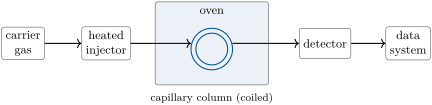

Block diagrams. Top: a gas chromatograph; the sample is vaporised in the injector, carried by the gas through a capillary column tens of metres long coiled in an oven, and detected at the outlet. Bottom: a liquid chromatograph; the pump mixes the solvents (gradient elution) and pushes them at high pressure through a short packed column to a UV absorbance cell. Block diagrams. Top: a gas chromatograph; the sample is vaporised in the injector, carried by the gas through a capillary column tens of metres long coiled in an oven, and detected at the outlet. Bottom: a liquid chromatograph; the pump mixes the solvents (gradient elution) and pushes them at high pressure through a short packed column to a UV absorbance cell.
Block diagrams. Top: a gas chromatograph; the sample is vaporised in the injector, carried by the gas through a capillary column tens of metres long coiled in an oven, and detected at the outlet. Bottom: a liquid chromatograph; the pump mixes the solvents (gradient elution) and pushes them at high pressure through a short packed column to a UV absorbance cell.
Read in context →