All books

Professional

Apps About Coach Log in Start reading

Chemistry · Glossary

What is Cooperative binding?

Also known as: Hill coefficient

Definition 24.6 University Chemistry — Year 3 · Chapter 24 — Bioinorganic Chemistry

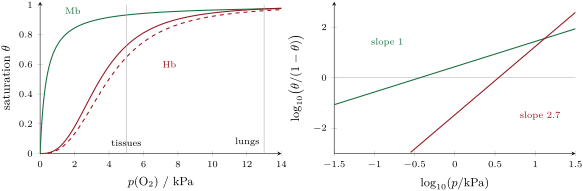
Binding to a protein with several sites is cooperative when the binding of one ligand raises the affinity of the remaining sites. The Hill coefficient nn is the slope of the Hill plot, log⁡θ1−θ\log\frac{\theta}{1 - \theta} against log⁡p\log p, at half saturation (θ\theta is the fraction of sites occupied).

Left: oxygen saturation of myoglobin (green) and haemoglobin (red; dashed: at a lower pH) against the pressure of oxygen, with model values p_50 = 0.37\, kPa (Mb) and 3.5\, kPa (Hb), n = 2.7. Between the lungs and the tissues haemoglobin gives up a quarter of its oxygen, myoglobin almost none. Right: the corresponding Hill plots, straight lines in this model (real haemoglobin’s plot bends to slope 1 at both ends).
Left: oxygen saturation of myoglobin (green) and haemoglobin (red; dashed: at a lower pH) against the pressure of oxygen, with model values p50=0.37 kPap_{50} = 0.37\,\mathrm{kPa} (Mb) and 3.5 kPa3.5\,\mathrm{kPa} (Hb), n=2.7n = 2.7. Between the lungs and the tissues haemoglobin gives up a quarter of its oxygen, myoglobin almost none. Right: the corresponding Hill plots, straight lines in this model (real haemoglobin’s plot bends to slope 1 at both ends).
Read in context →