
All books

Professional

Apps About Coach Log in Start reading

Chemistry · Glossary

What is Differential corrosion?

Also known as: galvanic corrosion · differential aeration

Definition 12.4 University Chemistry — Year 2 · Chapter 12 — Corrosion and Protection

Differential corrosion is a corrosion in which the anodic and cathodic sites are separated, the metal being oxidised preferentially at the anodic sites. It is galvanic corrosion when two different metals in electrical contact share the same electrolyte, and differential aeration when one metal is exposed to waters of different oxygen contents.
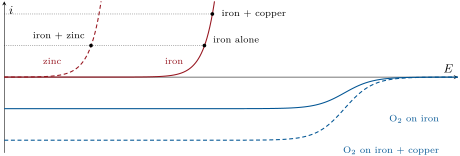
Iron coupled to other metals (model curves). With zinc, the common potential falls to where zinc carries the anodic current: iron is protected, zinc corrodes. With copper, the cathodic area for oxygen doubles: the corrosion current of iron doubles too.
Read in context →