University Chemistry — Year 2 · Bachelor Year 2
12Corrosion and Protection
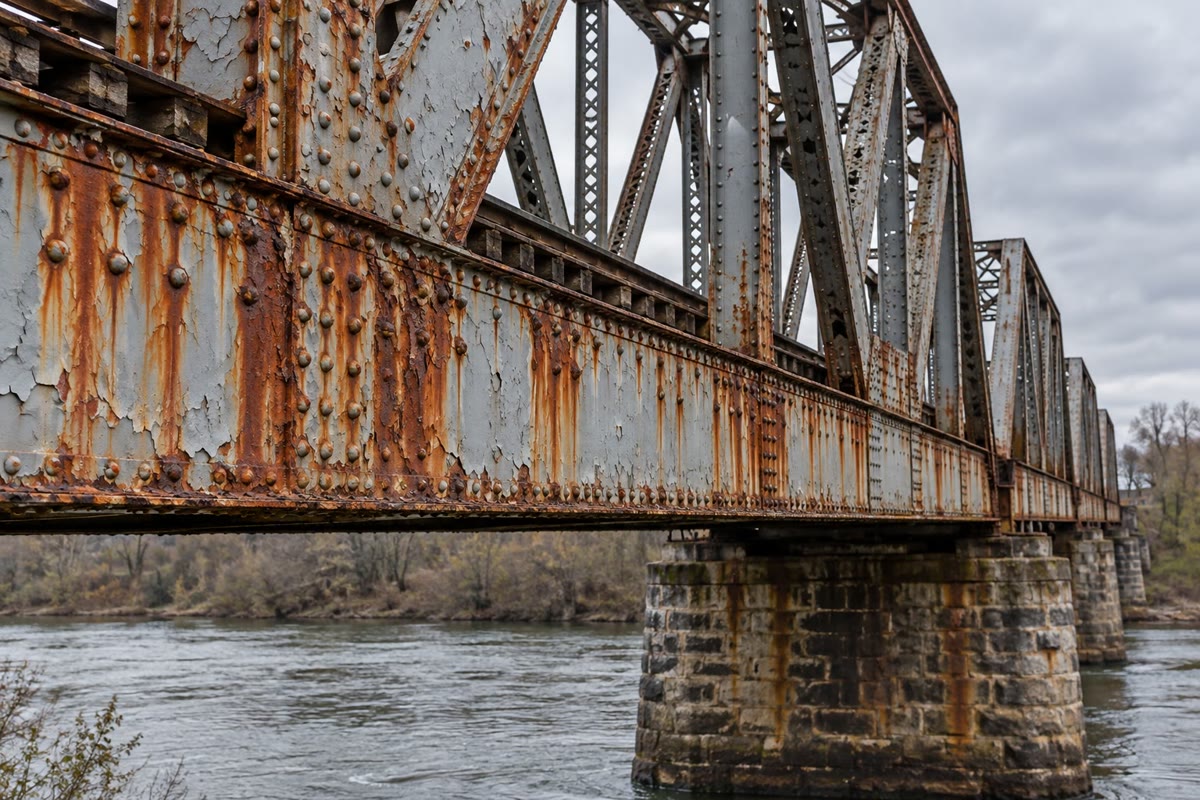
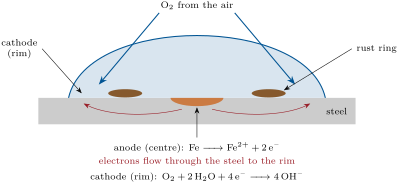
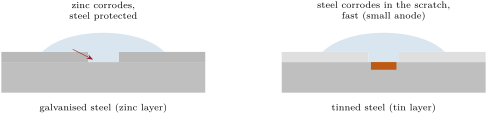
Leave a drop of salt water on a clean piece of steel. After a day the metal is pitted at the centre of the drop, while the rust has formed in a ring near its edge, where the oxygen of the air dissolves. The iron dissolves where there is the least oxygen, and the oxygen is reduced where there is the most: the drop is a cell that nobody built, short-circuited through the metal itself. This chapter reads corrosion on current–potential curves, explains why a scratched galvanised sheet does not rust while a scratched tin can does, and designs the protection of a buried pipeline.
You already know
The Year 1 volume: E–pH diagrams of metals and their domains of immunity, corrosion and passivation (“whether a coat protects is a kinetic matter”). Chapter 10: current–potential curves, limiting currents. Chapter 11: the mixed potential. The school volume: corrosion, rust, galvanising.
12.1 Wet corrosion as a short-circuited cell
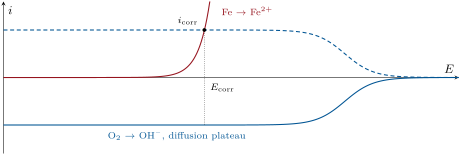
In water containing dissolved oxygen, iron is oxidised, , and the electrons are taken up on the same piece of metal by the reduction of dioxygen, (in acid, also by ). The iron(II) ions and the hydroxide ions meet in the water, and further oxidation by the air turns their precipitate into rust, a hydrated iron(III) oxide.
Definition 12.1 (Uniform corrosion)
Uniform corrosion is the corrosion of a metal whose oxidation and the reduction of the oxidant take place at sites spread evenly over its surface. The corrosion potential is the mixed potential the metal then takes, and the corrosion current the anodic current of the metal’s oxidation at that potential.
Proposition 12.2 (Corrosion rate)
A metal of molar mass and density , oxidised with electrons per atom under a corrosion current density (current per unit area), loses per unit area and time the mass , that is a thickness
Proof. By Proposition 10.3, the anodic current density oxidises moles of metal per unit area and time; multiply by for the mass and divide by for the thickness. ∎
Example 12.3 (Iron at )
With , , , : , that is per year.
12.2 Differential corrosion
Definition 12.4 (Differential corrosion)
Differential corrosion is a corrosion in which the anodic and cathodic sites are separated, the metal being oxidised preferentially at the anodic sites. It is galvanic corrosion when two different metals in electrical contact share the same electrolyte, and differential aeration when one metal is exposed to waters of different oxygen contents.
Proposition 12.5 (Two metals in contact)
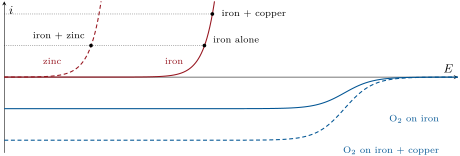
When two metals in electrical contact dip into the same aerated water, they take a single mixed potential. The metal whose corrosion potential is lower becomes the anode and corrodes faster than alone; the other becomes a cathode, on which dioxygen is reduced, and is protected.
Proof. Connected by a conductor of negligible resistance, the two metals are at the same potential, where the sum of all anodic currents equals minus the sum of all cathodic currents. The anodic curve of the less noble metal rises first; at the common potential it carries nearly all of the anodic current, and the oxygen is reduced on the whole wetted surface, including the nobler metal, whose own anodic current is negligible there. ∎
Proposition 12.6 (Differential aeration)
On a metal exposed to waters of different oxygen contents, the less aerated zone is anodic and corrodes; the better aerated zone is cathodic.
Proof. Where the oxygen content is higher, the / couple has a higher Nernst potential and a larger limiting current: the cathodic curve lies higher and reaches further. The metal, a single conductor, settles at one potential; the large cathodic current available in the aerated zone must be balanced by an anodic current, which flows where the metal can be oxidised with little competition from oxygen reduction, the poorly aerated zone. Oxidation concentrates there. ∎
The same mechanism attacks crevices, the parts of a structure under a deposit or a gasket, and a steel pile in the sea just below the water line, where the water is less aerated than at the surface.
Method 12.7 (Diagnosing a corrosion)
- List the metals in contact and the electrolyte; check that they are electrically connected.
- For two metals, the one of lower corrosion potential (usually the lower standard potential) is the anode.
- For one metal, find the less aerated zones (crevices, under deposits, the bottom of a drop): they are anodic.
- The rate is set by the cathodic reaction (oxygen supply, cathode area): a small anode on a large cathode corrodes fast.
12.3 Passivation
Definition 12.8 (Passivation)
Passivation is the strong decrease of the corrosion rate of a metal when it is covered by a thin, compact, adherent layer of its oxide, the passive film, which separates it from the solution. A metal in this state is said to be passive.
Proposition 12.9 (The passive plateau)
The anodic curve of a passivable metal rises from its corrosion potential, reaches a peak, then falls to a small, nearly constant passive current over a range of potentials, before rising again at high potentials (transpassive region: oxidation of the film or of water). The passive state can break down locally, for instance under chloride ions, giving pits.
Argument. At low overpotentials the bare metal dissolves faster and faster. Beyond a threshold the oxide becomes stable at the surface (the passivation domain of the E–pH diagram) and forms a film through which ions move only slowly: the current collapses to that small flux. At high potentials the film itself is oxidised to soluble species, or water is oxidised on it. Chloride ions, small and strongly complexing, can dissolve the film at weak points, where the bare metal then corrodes as a small anode in front of a huge passive cathode. The shape of the curve is a model here. ∎
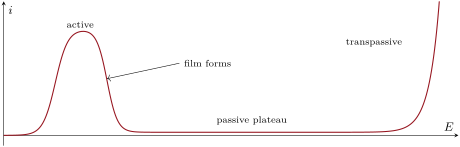
Stainless steels hold enough chromium to form a passive chromium oxide film that heals itself in air; aluminium is protected by its alumina film, which makes a metal far below hydrogen in the series usable for window frames and drinks cans. Copper turns green in the open air, the patina being a layer of basic copper salts that slows further attack.

12.4 Protection
Corrosion is fought by separating the metal from water and oxygen (paint, plastic, enamel, or a layer of another metal), by changing the medium (removing oxygen, adding inhibitors that adsorb on the metal), or by shifting the potential of the metal into its domain of immunity.
Definition 12.10 (Cathodic protection)
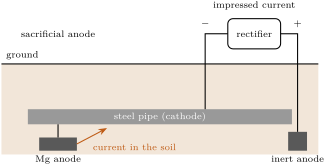
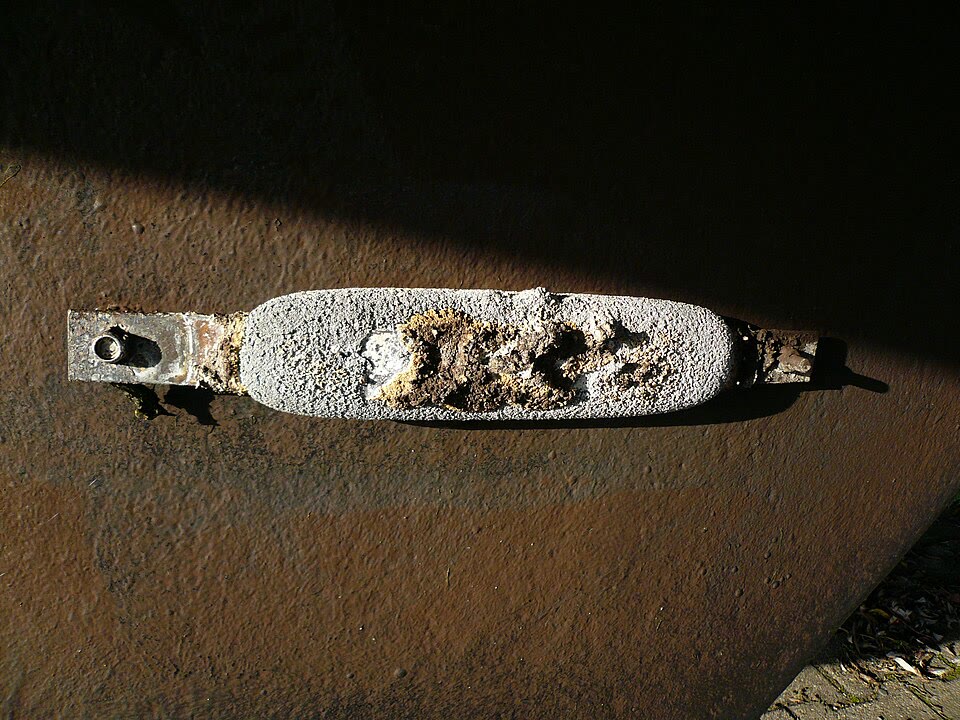
Cathodic protection lowers the potential of a metal structure until its oxidation stops, by making it the cathode of a cell. The cell can be formed with a sacrificial anode, a less noble metal (zinc, magnesium, aluminium alloys) connected to the structure and consumed in its place, or driven by a generator, in impressed-current protection, the anode being then an inert electrode buried nearby.
Proposition 12.11 (Lifetime of a sacrificial anode)
A sacrificial anode of mass and molar mass , oxidised with electrons and an efficiency (the fraction of the metal that produces useful current, the rest corroding by itself), delivers a current for a time
Proof. The useful charge is ; divide by the current. ∎
Method 12.12 (Choosing a protection)
- Avoid galvanic couples: insulate dissimilar metals, or make the less noble one the larger.
- Coat: a barrier coat (paint, tin) only protects while intact; a sacrificial coat (zinc) protects even when scratched.
- For a structure in soil or sea water, add cathodic protection: sacrificial anodes for small currents or conductive water, impressed current for long structures or resistive soils.
- Do not over-protect: too low a potential reduces water to hydrogen at the structure, which lifts coatings and can embrittle high-strength steels.
12.5 Exercises
Exercise 12.1 ★
Zinc corrodes uniformly under a current density of . Compute its loss of thickness per year ().
Solution
Solution of Exercise 12.1.
: , that is per year.
Exercise 12.2 ★
Steel bolts hold copper sheets on a roof. Which metal corrodes? Same question for zinc nails in steel sheets.
Solution
Solution of Exercise 12.2.
Steel bolts on copper: iron, the less noble, is the anode, and the small bolts on a large copper cathode corrode fast. Zinc nails in steel: the zinc corrodes and protects the steel around it.
Exercise 12.3 ★
Two steel plates are held together by a bolt and left in sea water. Where does the corrosion concentrate, and why?
Solution
Solution of Exercise 12.3.
In the narrow gap between the plates and under the bolt head, where the water is renewed slowly and its oxygen is soon used up: by differential aeration these confined zones become anodes, the open surfaces cathodes.
Exercise 12.4 ★
A galvanised bucket and a tin can are both scratched down to the steel. Which one rusts at the scratch?
Solution
Solution of Exercise 12.4.
The tin can: tin, nobler than iron, makes the exposed steel the anode of a large cathode. On the galvanised bucket the zinc corrodes instead of the steel.
Exercise 12.5 ★★
On the Evans diagram of iron in aerated water, explain what happens to the corrosion potential and current when the water is stirred, then when it is freed from oxygen.
Solution
Solution of Exercise 12.5.
Stirring thins the diffusion layer: the oxygen plateau rises, the anodic curve of iron meets it higher, so both the corrosion potential and the corrosion current increase. Without oxygen, the only cathodic reaction left in neutral water is the slow reduction of water: the corrosion potential falls and the corrosion current becomes very small.
Exercise 12.6 ★★
A zinc anode of protects a boat hull with a current of , with an efficiency of 90 % (exercise data). How long does it last?
Solution
Solution of Exercise 12.6.
, about 4.2 years.
Exercise 12.7 ★★
Compute the charge, in ampere-hours per kilogram, delivered by zinc, magnesium and aluminium anodes at 100 % efficiency, and the standard potentials of their couples from ( , , ). Why is magnesium preferred in dry soils?
Solution
Solution of Exercise 12.7.
Charge per kilogram, : zinc , magnesium , aluminium . Standard potentials: / , / , / . In a dry, resistive soil the current must be driven through a large resistance: magnesium, much further below iron, offers the largest driving voltage.
Exercise 12.8 ★★
A buried pipe needs of protection current. The ground bed of the inert anode has a resistance of to the soil and the cell needs a further (exercise data). Compute the voltage of the rectifier and the electrical energy per year.
Solution
Solution of Exercise 12.8.
; power ; per year , .
Exercise 12.9 ★★
A steel pile stands in the sea. Explain why it corrodes most a little below the water line, and not at the water line itself.
Solution
Solution of Exercise 12.9.
At the water line the metal is wetted by water rich in oxygen, a cathode; just below, the water is less aerated and the zone becomes the anode of the cell formed with the water line: the steel corrodes there, in a band.
Exercise 12.10 ★★★
Explain, with the passive curve, why stainless steel resists aerated water but may pit in sea water, and why a pit, once started, grows deeper rather than wider.
Solution
Solution of Exercise 12.10.
In aerated water the corrosion potential of stainless steel falls on its passive plateau: a tiny current, the film healing itself. Chloride ions break the film at weak points; the bare metal there is a small anode facing an enormous passive cathode, so its current density is huge. Inside the pit the metal ions hydrolyse and acidify the solution, chloride is drawn in to balance the charge, and the film cannot reform: the pit deepens.
Exercise 12.11 ★★★
A copper fitting is screwed on a steel pipe carrying aerated water. The oxygen limiting current density is on every wetted surface; the copper offers and the steel near the joint (exercise data). Estimate the corrosion current of the steel and its loss of thickness per year near the joint.
Solution
Solution of Exercise 12.11.
Oxygen is reduced on all : cathodic current , all supplied by the oxidation of the of steel near the joint, . The loss is times that of iron at , about per year.
Exercise 12.12 ★★★
Using the E–pH diagram of iron and the curves of water, explain why the potential of a protected steel structure should be held below about but not far below in neutral water.
Solution
Solution of Exercise 12.12.
Iron is immune below the / line, : held below about the steel no longer dissolves. Much lower, water is reduced at a growing rate on the steel (the / line is at at pH 7 and the overpotential on steel is a few tenths of a volt): current is wasted and hydrogen lifts the coating.
12.6 Problem: Protecting a Pipeline
Problem 12.1
Weekend problem — the corrosion of a bare steel pipe in wet soil, the choice of a sacrificial metal, the magnesium needed for twenty years, and the impressed-current alternative
A steel pipeline long and in diameter is buried in wet soil. Data: iron , ; magnesium ; (): , , , . Exercise data: corrosion current density of bare steel in this soil ; design current density for the protection of bare steel ; the coating leaves 1.0 % of the surface bare; magnesium anodes of , efficiency 50 %; ground-bed resistance for the impressed current .
Part I — The bare pipe.
- Write the anodic and cathodic reactions on the pipe.
- Why is the corrosion current set by the supply of oxygen?
- Compute the mass of iron lost per square metre and per year.
- Compute the loss of wall thickness per year.
- How long would the bare pipe take to lose half of an wall?
- Why does the real pipe fail sooner, at a few points?
Part II — The anode metal.
- Compute the standard potentials of the couples of iron, zinc, magnesium and aluminium.
- Which metals can protect iron as sacrificial anodes?
- Why is aluminium little used in soils?
- Why is magnesium preferred to zinc in a soil of high resistivity?
- Compute the mass of magnesium consumed per ampere and per year.
Part III — Design.
- Compute the outer surface of the pipe.
- Compute the bare surface left by the coating.
- Compute the protection current.
- Compute the charge needed for twenty years.
- Compute the mass of magnesium needed.
- How many anodes are needed?
- Why are they distributed along the pipe rather than buried at one point?
Part IV — Impressed current.
- Describe the impressed-current alternative.
- Estimate the voltage of the rectifier from the ground-bed resistance, adding for the electrodes.
- Compute the electrical energy used per year.
- What goes wrong if the pipe is over-protected?
- Below which potential is iron immune in neutral water, taking an iron(II) concentration of ?
- State the mass of magnesium anodes needed for twenty years.
Solution
Solution of Problem 12.1.
1. ; . 2. The reduction of oxygen, slow and reaching its diffusion plateau, limits the cathodic current; the anodic curve of iron meets it on that plateau. 3. : per square metre and per year. 4. , per year. 5. years. 6. The corrosion is not uniform: crevices, differences of aeration between soils, and defects of the coating concentrate the anodic current on small areas, where pits perforate the wall long before. 7. for each couple: , , , . 8. Zinc, magnesium and aluminium, all below iron. 9. Aluminium passivates: its oxide film stops its dissolution and it then delivers little current, unless alloyed to prevent the film (which works in sea water, not in soils). 10. The current must cross the resistance of the soil: the driving voltage between the anode and the protected steel is about for magnesium against for zinc (from the standard potentials). 11. per ampere and per year. 12. . 13. . 14. . 15. . 16. , (or ). 17. anodes. 18. The resistance of the soil limits how far a single anode can push its current along the pipe: distributed anodes protect it evenly. 19. A rectifier drives current from an inert anode buried in a ground bed, through the soil, into the pipe connected to its negative pole. 20. . 21. ; , per year. 22. Water is reduced at the pipe: hydrogen forms, lifts the coating and can embrittle the steel, and current is wasted. 23. . 24. Twenty years of protection need of magnesium anodes.