
全部书籍

专业

应用 关于 Coach 登录 开始阅读

书籍暂未推出简体中文版——当前显示英文版。

Chemistry · 术语表

什么是 Diffusion layer and limiting current?

又称: diffusion layer · limiting current

Definition 10.7 University Chemistry — Year 2 · 第 10 章 — Current–Potential Curves

The diffusion layer is the layer of solution, of thickness δ\delta (a few to some tens of micrometres in a stirred solution), next to the electrode, across which species move by diffusion only. The limiting current is the current reached when the electroactive species is consumed as fast as it arrives, its concentration at the surface being zero.
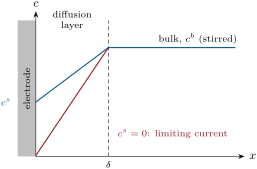
Concentration of the reactant near an electrode in a stirred solution. Across the diffusion layer the profile is linear; the flux, hence the current, is proportional to cb - cs. It is largest when the reactant is consumed as soon as it arrives (cs = 0, red).
Concentration of the reactant near an electrode in a stirred solution. Across the diffusion layer the profile is linear; the flux, hence the current, is proportional to cb−csc^b - c^s. It is largest when the reactant is consumed as soon as it arrives (cs=0c^s = 0, red).

示例

Example 10.9 (Size of a limiting current)

For a species at 10 mmol/L10\,\mathrm{mmol}/\mathrm{L} (10 mol/m310\,\mathrm{mol}/\mathrm{m}^{3}), with D=7×10⁻¹⁰ m2/sD = 7 \times 10^{-10}\,\mathrm{m}^{2}/\mathrm{s}, δ=20 µm\delta = 20\,\text{µ}\mathrm{m}, n=1n = 1, on 1.0 cm21.0\,\mathrm{cm}^{2}: ∣ilim⁡∣=96 485×10−4×7×10−10×10/(2×10−5)=3.4 mA|i_{\lim}| = 96\,485 \times 10^{-4} \times 7 \times 10^{-10} \times 10/(2 \times 10^{-5}) = 3.4\,\mathrm{mA}.

在原文中阅读 →