University Chemistry — Year 2 · Bachelor Year 2
10Current–Potential Curves
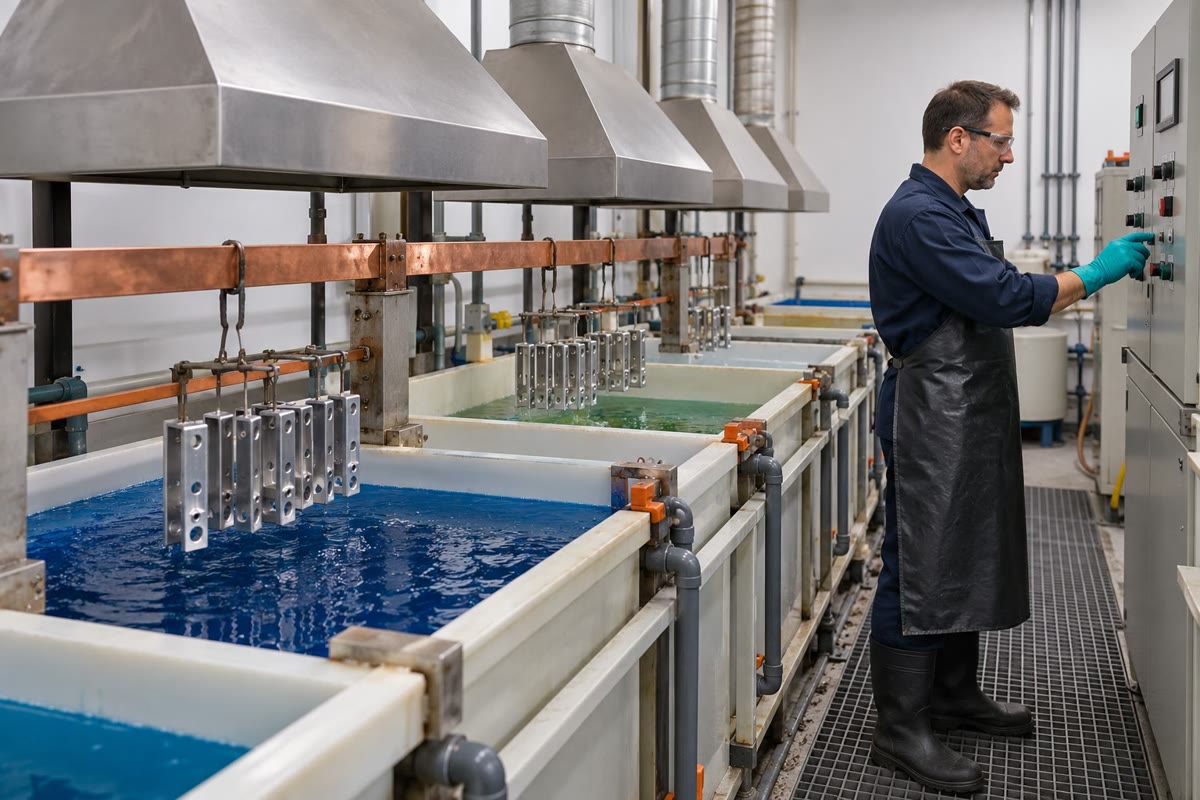
Zinc is electroplated onto steel from acidic baths. Yet the E–pH diagram of the Year 1 volume says that zinc, far below the hydrogen line, should reduce the acid and dissolve as fast as it is deposited. It does not, because a diagram says what may happen, not how fast. The rate of an electrode reaction is a current, and plotting that current against the electrode potential shows at once which reactions are fast, which are slow, and which are held back by the supply of reactant. These current–potential curves are the tool of every electrochemist who plates a metal, charges a battery or measures oxygen in a river.
You already know
The Year 1 volume: electrode potential, reference electrode, the Nernst equation, E–pH diagrams and their limit (they tell what is possible, not how fast). Chapter 9: , the Nernst equation derived. From physics: diffusion and Fick’s law, .
10.1 An electrode out of equilibrium
Definition 10.1 (Current–potential curve)
The current–potential curve of an electrode in a solution is the graph of the current through the electrode against its potential . An anodic current, counted positive, corresponds to an oxidation at the electrode; a cathodic current, counted negative, to a reduction.
Definition 10.2 (Electroactive species)
An electroactive species is a species that can be oxidised or reduced at the electrode in the range of potentials considered.
Proposition 10.3 (Current and rate)
If a single half-reaction with electrons takes place at an electrode, the current measures its rate: , with the advancement of the oxidation (so that for an oxidation, for a reduction).
Proof. By Proposition 9.2, an advancement moves the charge through the electrode in time . ∎
To record such a curve, the potential of one electrode must be imposed and measured while a current flows through it — which a two-electrode cell cannot do, since the current also changes the potential of the second electrode.
Definition 10.4 (Three-electrode set-up)
In a three-electrode set-up, the current flows between the working electrode, the one studied, and the counter electrode, which closes the circuit; the potential of the working electrode is measured against a reference electrode through which no current flows. An electronic potentiostat adjusts the current so that this potential keeps the imposed value.
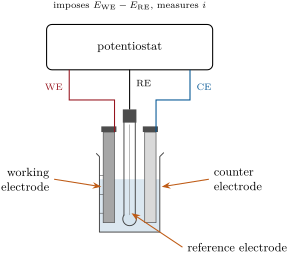
When no current flows and both forms of a couple are present, the electrode takes the Nernst potential of the couple — if the electron exchange is fast enough to establish it. Moving the potential away from it makes a current flow.
10.2 Fast and slow systems
Definition 10.5 (Overpotential)
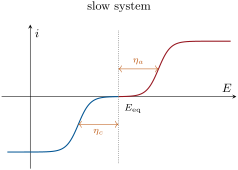
The overpotential of an electrode through which a current flows is , the difference between its potential and the equilibrium (Nernst) potential of the couple. The threshold potential of a half-reaction is the potential beyond which its current becomes noticeable.
Definition 10.6 (Fast and slow systems)
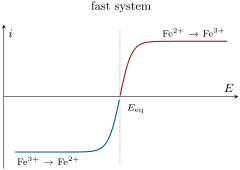
A couple is a fast system at a given electrode if a noticeable current flows as soon as the potential departs from its Nernst potential; it is a slow system if an overpotential of some tenths of a volt is needed before the current becomes noticeable, in either direction.
Whether a system is fast or slow depends on the couple and on the electrode material. The / and / couples are fast on platinum; the reduction of is fast on platinum but slow on mercury, lead or zinc; the oxidation of water to dioxygen is slow on every electrode. Electron transfers that break or form bonds, like those of or , are typically slow; the transfer of an electron between two ions of nearly the same shape is fast. The shape of the rising part of a slow curve comes from the kinetics of electron transfer, derived in the Year 3 volume.
10.3 Mass transport and limiting currents
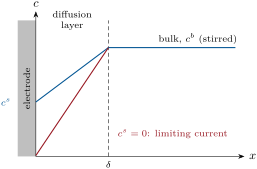
When the electron transfer is fast, the current is limited by the arrival of the reactant at the electrode. In a stirred solution, a thin layer of liquid next to the electrode stays nearly still, and the reactant crosses it by diffusion.
Definition 10.7 (Diffusion layer and limiting current)
The diffusion layer is the layer of solution, of thickness (a few to some tens of micrometres in a stirred solution), next to the electrode, across which species move by diffusion only. The limiting current is the current reached when the electroactive species is consumed as fast as it arrives, its concentration at the surface being zero.
Theorem 10.8 (Limiting current)
For a species of bulk concentration and diffusion coefficient , crossing a diffusion layer of thickness to an electrode of area , the limiting current is, in absolute value,
Proof. At steady state the concentration profile in the layer is linear (Fick’s second law with gives ), so the flux towards the electrode is , in moles per unit area and time. Every molecule arriving reacts with electrons: , largest for . ∎
Example 10.9 (Size of a limiting current)
For a species at (), with , , , on : .
Theorem 10.10 (Wave of a fast system)
For a fast couple , with anodic limiting current (set by Red) and cathodic limiting current (set by Ox), the steady-state curve is
the layer thickness being the same for both forms.
Proof. Fast system: the Nernst equation holds at the surface, . Linear profiles: an anodic current consumes Red and produces Ox at the surface, . With and , these give and . Substitute in the Nernst equation. ∎
Corollary 10.11 (Half-wave potential)
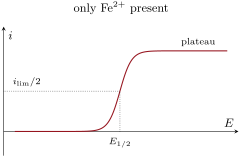
When the two forms have equal diffusion coefficients, : with only one form present, the current is half its limiting value at the standard potential of the couple.
Proof. With only Red present, , and for the logarithm vanishes: when . ∎
Proposition 10.12 (Plateaus measure concentrations)
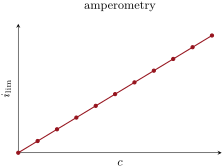
At fixed stirring and electrode, the height of a plateau is proportional to the concentration of the species that it consumes: an electrode held at a potential on the plateau is an amperometric sensor.
Proof. and the factor in brackets is constant at fixed stirring and temperature. ∎
10.4 The solvent and the electrode
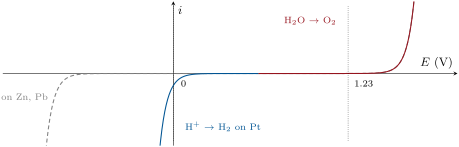
Water is itself electroactive: it is oxidised to dioxygen () and reduced to dihydrogen (, or ). As the solvent is never exhausted, its curves have no plateau: they rise steeply and bound every other curve.
Definition 10.13 (Electroactivity window)
The solvent walls are the steep branches of the oxidation and reduction of the solvent. The electroactivity window is the range of potentials between them, in which the curves of the dissolved species can be observed.
Proposition 10.14 (The window of water)
In water at a given pH the window lies around the thermodynamic range of the two couples of water, and , widened on each side by the overpotential of the corresponding reaction on the electrode used.
Argument. Each wall starts near the Nernst potential of its couple shifted by the threshold overpotential: the oxidation of water is slow on all electrodes, so the anodic wall lies some tenths of a volt above (at pH 0); the reduction of is fast on platinum, whose cathodic wall stays close to , but slow on zinc, lead or mercury, whose wall lies several tenths of a volt lower. ∎
10.5 Reading curves
Method 10.15 (Sketching the curves of a solution)
- Draw the two walls of the solvent for the pH and the electrode material.
- For each couple present, place its Nernst potential (both forms present) or (one form): a fast system crosses the axis there steeply; a slow system is shifted by its overpotentials.
- Give each wave a plateau proportional to the concentration of the species it consumes; a metal electrode that oxidises itself has no plateau (the metal is not exhausted).
- Add the currents of the reactions possible at each potential.
Method 10.16 (Reading the curves)
- At an imposed potential, read on each curve the current of each reaction: they run simultaneously, in proportion to their currents.
- At an imposed current (electrolysis), find the potential at which the anodic or cathodic curves add up to that current; the reactions involved are those whose curves contribute there.
- For a cell, or a corroding metal, the anodic current of one reaction equals the cathodic current of the other: look for that pair of points.
Example 10.17 (Zinc plating from an acidic bath)
In an acidic zinc bath, the cathode carries two possible reductions: (, fast) and (). Thermodynamically, hydrogen should come first and zinc never. But on zinc the reduction of is slow: its wall lies below , and at the potential where zinc is deposited at a useful rate, little hydrogen is formed. The curve, not the diagram, explains the plating.
History — Polarography
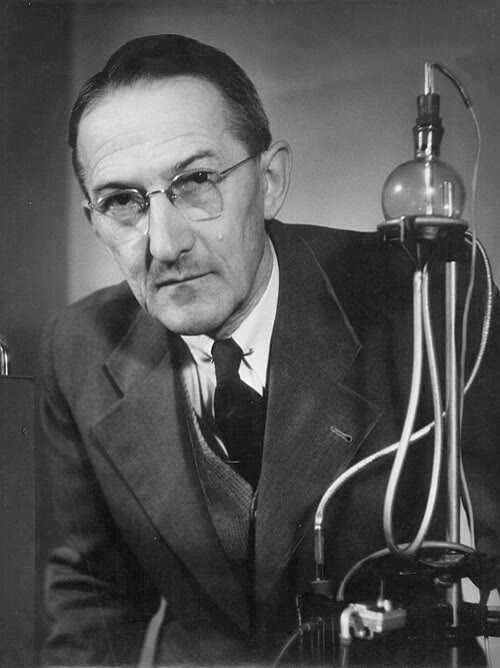
In 1922 Jaroslav Heyrovský recorded the current through a mercury electrode that formed drop after drop at the tip of a capillary, while the potential was swept: each reducible species gave a step whose position identified it and whose height measured its concentration. The renewed drop kept the surface fresh, and the high overpotential of hydrogen on mercury opened a wide cathodic window. Polarography earned him the Nobel Prize in Chemistry in 1959 and founded electroanalytical chemistry; the photograph shows him with a dropping-mercury electrode. (Photograph: archive of the J. Heyrovský Institute of Physical Chemistry, CC BY-SA 3.0, Wikimedia Commons.)
10.6 Exercises
Exercise 10.1 ★
In a Daniell cell delivering a current, give the sign of the current at the zinc electrode and at the copper electrode, with the conventions of this chapter.
Solution
Solution of Exercise 10.1.
Zinc is oxidised: anodic current, positive. Copper ions are reduced at the copper electrode: cathodic current, negative. The two currents are equal in magnitude, as the same charge flows through the circuit.
Exercise 10.2 ★
Compute the limiting current of the reduction of (, ) on with (model values).
Solution
Solution of Exercise 10.2.
, that is .
Exercise 10.3 ★
On the model curves of the chapter, how do you recognise a fast and a slow system? Give one example of each on platinum.
Solution
Solution of Exercise 10.3.
A fast system crosses the potential axis steeply at its Nernst potential; a slow system shows a flat stretch of zero current around it, its branches starting only after an overpotential. On platinum: / (fast); / (slow).
Exercise 10.4 ★
A solution contains only . At what potential does its anodic current reach half its plateau, if the two forms diffuse alike ()?
Solution
Solution of Exercise 10.4.
At the half-wave potential, equal to when the two forms diffuse alike.
Exercise 10.5 ★★
A platinum electrode in a solution of and (equal concentrations, = 0.77 and ) is swept towards negative potentials. Describe the curve: waves, plateaus, their heights, and the cathodic wall.
Solution
Solution of Exercise 10.5.
Near a cathodic wave of (fast), reaching a plateau proportional to its concentration. Near a second wave, copper being deposited; its plateau adds to the first, about twice as high for an equal concentration and similar diffusion coefficients, since . Then, near at pH 0 on platinum (lower once the electrode is coated with copper), the steep wall of the reduction of .
Exercise 10.6 ★★
In the solution of Exercise 10.5, the potential of the electrode is held at , then at . What happens in each case?
Solution
Solution of Exercise 10.6.
At : only is reduced to , at its limiting current. At : is reduced and copper is deposited at the same time, each at its limiting current; the total is the sum of the two plateaus.
Exercise 10.7 ★★
Give the Nernst potentials of the two couples of water at pH 0 and pH 14, and sketch how the window on platinum moves with pH.
Solution
Solution of Exercise 10.7.
pH 0: and ; pH 14: and . On platinum the window keeps its width and moves down by per pH unit, each wall following its couple, the anodic one still shifted up by the oxygen overpotential.
Exercise 10.8 ★★
is titrated by while a platinum electrode held at records the current. Sketch the current against the volume added and explain how it locates the equivalence (/: ).
Solution
Solution of Exercise 10.8.
At , is oxidised on its plateau (anodic current proportional to ) and any is reduced on its plateau (cathodic current proportional to ). Before the equivalence the anodic current falls linearly with the volume added; after it the cathodic current grows linearly. The two straight lines cross zero at the equivalence.
Exercise 10.9 ★★
Doubling the stirring speed halves the thickness of the diffusion layer. What happens to the plateaus, the half-wave potential and the zero-current potential of a fast system?
Solution
Solution of Exercise 10.9.
The plateaus double (). The half-wave potential does not change, the layer being the same for both forms; nor does the zero-current potential of a fast system, which is the Nernst potential.
Exercise 10.10 ★★★
Derive the equation of the wave of a fast system with only Red present, and show that a plot of against is a straight line of slope volt at .
Solution
Solution of Exercise 10.10.
As in the chapter with : . In decimal logarithms, , a straight line of slope volt at , which crosses the axis at .
Exercise 10.11 ★★★
A piece of zinc dipped into acid dissolves only slowly, while the same piece touching a platinum wire dissolves fast, with hydrogen bubbling on the platinum. Explain with current–potential curves.
Solution
Solution of Exercise 10.11.
Alone, the zinc settles at the potential where its anodic current (fast oxidation of zinc) equals the cathodic current of reduction on zinc, which is small because that reduction is slow on zinc: the dissolution is slow. Touching platinum, the electrons released by the zinc can reduce on the platinum, where the reduction is fast: the cathodic current at a given potential is much larger, the balance is reached at a higher current, and the zinc dissolves faster while hydrogen forms on the platinum.
Exercise 10.12 ★★★
To oxidise a species whose wave lies at at pH 0, would you choose a platinum electrode or one with a high oxygen overpotential? Explain, and say what would be formed otherwise.
Solution
Solution of Exercise 10.12.
On platinum the oxidation of water starts near at pH 0: before the current would be spent making dioxygen. An electrode on which the oxidation of water needs a larger overpotential pushes the wall beyond , so that the species can be oxidised inside the window.
10.7 Problem: An Oxygen Probe for a River
Problem 10.1
Weekend problem — the cathode of an amperometric oxygen sensor, the limiting current through its membrane, the calibration in air-saturated water with Henry’s law, and the oxygen content of a river
An amperometric oxygen probe has a gold cathode and a silver anode in a potassium chloride gel, separated from the sample by a thin gas-permeable membrane. The cathode is held at against the silver–silver chloride anode. Data at : Henry’s law constant of , ; vapour pressure of water ; oxygen in dry air 20.95 % by volume; ; . Membrane (model values): area , thickness , effective diffusion coefficient of across it .
Part I — The cathode.
- Write the reduction of dioxygen in a neutral medium.
- Write the reaction at the silver anode, and the overall reaction.
- Compute the Nernst potential of the / couple at pH 7 with .
- Express the cathode potential, against Ag/AgCl, on the hydrogen scale, taking the chloride activity of the gel as 1.
- Why must the cathode be held far below the Nernst potential of ?
- Why is a potential on the plateau chosen?
- What sets the lower limit of the usable potentials?
Part II — The limiting current.
- Describe the concentration profile of across the membrane when the cathode works on its plateau.
- Write the flux of through the membrane.
- Deduce the current as a function of the concentration of dissolved .
- Why is the membrane thickness used in place of the diffusion layer?
- Why does the reading depend little on the stirring of the river, but a lot on fouling of the membrane?
Part III — Calibration.
- Compute the partial pressure of over water saturated with air at and .
- Compute the concentration of dissolved at saturation, in .
- Express it in .
- Predict the current of the probe in air-saturated water.
- The probe actually reads in air-saturated water (exercise data). Compute its sensitivity in per .
- Why calibrate rather than trust the predicted current?
- What should the probe read in water freed from oxygen?
Part IV — The river.
- In a river sample at , the probe reads . Compute the dissolved oxygen in .
- Express it as a percentage of saturation.
- The water of a river is nearly saturated with oxygen at its source. Suggest a cause for the deficit.
- What amount of does the probe consume in one hour? Does it disturb the sample?
- Why must the calibration be repeated if the river is at ?
- State the dissolved-oxygen concentration of the sample.
Solution
Solution of Problem 10.1.
1. . 2. (four times); overall . 3. . 4. with chloride of activity 1: on the hydrogen scale. 5. The reduction of is a slow system: below its Nernst potential an overpotential of several tenths of a volt is needed before the current grows, and more to reach the plateau. 6. On the plateau the current depends only on the supply of , not on small drifts of the potential: it measures the concentration. 7. The reduction of water to dihydrogen (the cathodic wall), which would add a current unrelated to oxygen. 8. Linear across the membrane, from on the sample side to zero at the cathode. 9. per unit area. 10. (cathodic), . 11. The membrane is the slowest step: diffusion across it is much slower than in the water outside, so the membrane plays the part of the diffusion layer. 12. The concentration gradient lies inside the membrane, whose thickness does not depend on the stirring (provided the water outside is renewed); a deposit on the membrane adds thickness and lowers the current. 13. . 14. (). 15. (). 16. . 17. per . 18. The membrane thickness and its diffusion coefficient are not known precisely and change with age and temperature; a measurement in a known solution includes them all. 19. Zero (in practice a small residual current, subtracted). 20. . 21. of saturation. 22. Oxygen consumed by the decay of organic matter (sewage, dead plants) faster than it is supplied by the air and by photosynthesis. 23. per hour: negligible against the oxygen of even a litre of water (). 24. Both the solubility of (Henry’s constant) and the diffusion across the membrane change with temperature: the sensitivity found at no longer applies. 25. The sample holds of dissolved oxygen.