
All books

Professional

Apps About Coach Log in Start reading

Chemistry · Glossary

What is Dose–response?

Also known as: dose--response relationship · median lethal dose · median effective concentration · no-observed-adverse-effect level · lowest-observed-adverse-effect level

Definition 32.21 University Chemistry — Year 3 · Chapter 32 — Environmental Chemistry and Toxicology

A dose–response relationship links the dose of a substance to the size or frequency of an effect. The median lethal dose LD50\mathrm{LD_{50}} kills half of a test population; the median effective concentration EC50\mathrm{EC_{50}} causes a stated effect in half. The no-observed-adverse-effect level (NOAEL) is the highest tested dose without an adverse effect, the lowest-observed-adverse-effect level (LOAEL) the lowest tested dose with one.
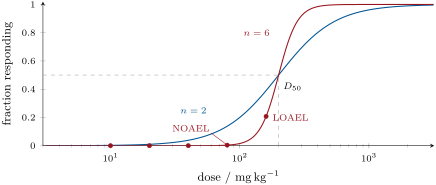
Log-logistic dose–response curves with the same median dose (200\, mg/ kg, model) and two steepnesses. The dots are a study at five doses for the steeper curve: with a 5 % response as the criterion of an adverse effect, the NOAEL is 80\, mg/ kg and the LOAEL 160\, mg/ kg; both depend on the doses chosen.
Log-logistic dose–response curves with the same median dose (200 mg/kg200\,\mathrm{mg}/\mathrm{kg}, model) and two steepnesses. The dots are a study at five doses for the steeper curve: with a 5 % response as the criterion of an adverse effect, the NOAEL is 80 mg/kg80\,\mathrm{mg}/\mathrm{kg} and the LOAEL 160 mg/kg160\,\mathrm{mg}/\mathrm{kg}; both depend on the doses chosen.
Read in context →