 Coach
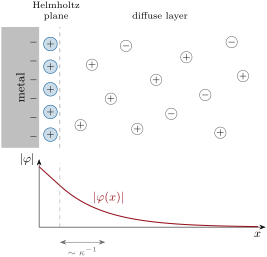
CoachThe electrical double layer is the arrangement of charge at an electrode–solution interface: the charge on the metal and the compensating ionic charge in the solution. Its compact part, the Helmholtz layer, is the layer of ions and solvent molecules in contact with the surface; its diffuse layer is the region beyond, where thermal motion spreads the excess ions over a distance of the order of the Debye length . The double-layer capacitance is the charge stored per unit area per volt of potential across the interface.
Examples
Example 15.3 (The thickness of the double layer)
In water at () with of a 1:1 salt (), ; at , ten times more. A supporting electrolyte compresses the diffuse layer to a few molecular diameters.