All books

Professional

Apps About Coach Log in Start reading

Chemistry · Glossary

What is Ellingham diagram?

Definition 6.1 University Chemistry — Year 2 · Chapter 6 — Ellingham Diagrams and Metallurgy

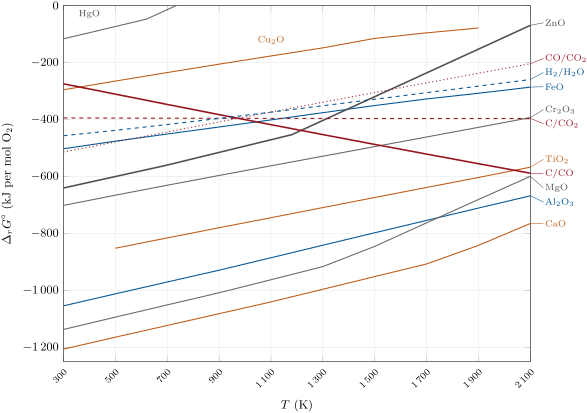
The Ellingham diagram of a family of oxides is the graph, against temperature, of the standard Gibbs energies of their formation reactions written for one mole of dioxygen,

2xy M+OX2⟶2y MxOy,ΔrG∘(T) per mole of OX2.\tfrac{2x}{y}\,\mathrm M + \ce{O2} \longrightarrow \tfrac{2}{y}\,\mathrm{M}_x\mathrm O_y , \qquad \Delta_r G^\circ(T) \ \text{per mole of } \ce{O2} .
The Ellingham diagram: standard Gibbs energy of formation of oxides per mole of O2, against temperature, from tabulated Gibbs energies. The lower a line, the more stable the oxide and the more reducing the metal. Each metal line is labelled by its oxide; C/CO is 2C + O2 -> 2CO, C/CO2 is C + O2 -> CO2, CO/CO2 is 2CO + O2 -> 2CO2 and H2/H2O is 2H2 + O2 -> 2H2O, water as a gas.
The Ellingham diagram: standard Gibbs energy of formation of oxides per mole of OX2\ce{O2}, against temperature, from tabulated Gibbs energies. The lower a line, the more stable the oxide and the more reducing the metal. Each metal line is labelled by its oxide; C\ce{C}/CO\ce{CO} is 2 C+OX2→2 CO\ce{2C + O2 -> 2CO}, C\ce{C}/COX2\ce{CO2} is C+OX2→COX2\ce{C + O2 -> CO2}, CO\ce{CO}/COX2\ce{CO2} is 2 CO+OX2→2 COX2\ce{2CO + O2 -> 2CO2} and HX2\ce{H2}/HX2O\ce{H2O} is 2 HX2+OX2→2 HX2O\ce{2H2 + O2 -> 2H2O}, water as a gas.
Read in context →