University Chemistry — Year 2 · Bachelor Year 2
6Ellingham Diagrams and Metallurgy
A blast furnace turns red rock into liquid iron with coke and hot air, at a rate of thousands of tonnes a day. No furnace of that kind will ever make aluminium, magnesium or titanium, although carbon is just as cheap for them. Most metals are found in the ground as oxides, and winning a metal means taking its oxygen away: which reducing agents can do it, and at what temperature, is a question of standard Gibbs energies. In 1944 Harold Ellingham drew them all on one chart, against temperature, for one mole of dioxygen each. The chart answers at a glance which metal reduces which oxide, why carbon wins at high temperature, and why some metals must be made by electrolysis.
You already know
Chapter 2: and the Ellingham approximation (straight lines in , changes of state excepted). Chapter 4: from , variance, the end of an equilibrium when a phase disappears. The Year 1 volume: oxidation numbers, redox couples, basic and acidic oxides. The school volume: ores.
6.1 The Ellingham diagram
To compare the affinity of different metals for oxygen, the reactions are written so that they all consume the same amount of the common reagent.
Definition 6.1 (Ellingham diagram)
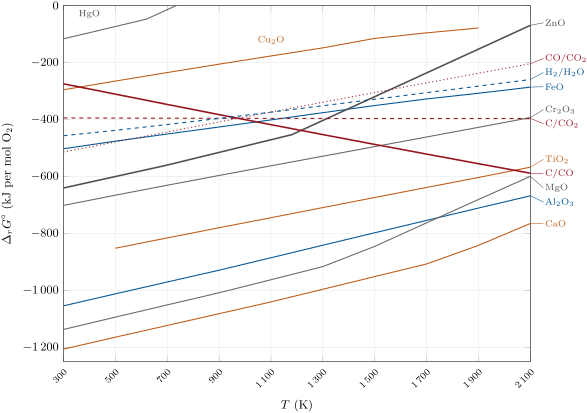
The Ellingham diagram of a family of oxides is the graph, against temperature, of the standard Gibbs energies of their formation reactions written for one mole of dioxygen,
For example , , . The ordinate is in per mole of , always negative for the metals of the chart.
Proposition 6.2 (Straight lines)
In the Ellingham approximation, each line is straight, of slope . For a metal and its oxide, both condensed, is close to minus the entropy of the mole of dioxygen consumed, about : the lines rise with temperature, all with nearly the same slope.
Proof. with constant , . The molar entropies of solids are tens of and largely cancel between metal and oxide, while one mole of gas is consumed, of entropy . For zinc, . ∎
Proposition 6.3 (Breaks in the lines)
At the temperature where the metal melts or boils, the line changes slope: its slope increases by , where is the amount of metal in the reaction and . A change of state of the oxide decreases the slope instead.
Proof. Above the transition the metal reacts from its new phase, whose entropy is higher by : decreases by and the slope increases by as much. itself is continuous, because at both phases have the same chemical potential. For the oxide, the opposite sign. ∎
Melting changes the slope a little; boiling, which turns a condensed reactant into a gas, changes it a lot. Zinc boils at : above that temperature the formation of zinc oxide consumes three moles of gas per two of oxide, and its line climbs steeply. The same happens to magnesium above its boiling point.
6.2 Reading the diagram
Definition 6.4 (Equilibrium oxygen pressure)
The equilibrium oxygen pressure of a metal–oxide pair at temperature is the pressure of dioxygen at which metal and oxide coexist at equilibrium: for the reaction written per mole of .
Theorem 6.5 (Domains of the metal and of the oxide)
In an atmosphere of oxygen pressure at temperature , the metal is oxidised if , and the oxide is reduced to the metal if . On the diagram, the oxide is stable above its line, the metal below.
Proof. With condensed metal and oxide of activity 1, and . The oxidation runs forward when . ∎
Under air (, is at room temperature and at , almost zero on this scale) every metal of the diagram whose line is below the axis is oxidised: at room temperature all of them, even copper. Only the oxides near the top (silver, mercury) decompose on moderate heating.
Example 6.6 (The oxide of mercury)
For , the CODATA key values give with liquid mercury; above the boiling point of mercury the metal is a gas and , . The line crosses zero at : heated above that temperature in air, or under of oxygen, red mercury oxide gives off its oxygen — the way oxygen was first isolated in 1774.
Proposition 6.7 (Which metal reduces which oxide)
At a given temperature, a metal M reduces the oxide of a metal N, under standard conditions, when the line of M lies below that of N. The standard reaction Gibbs energy of the reduction, per mole of transferred, is the difference of the two ordinates.
Proof. The reduction is the formation of M’s oxide minus that of N’s oxide, both per mole of : , negative when M’s line is lower. ∎
Method 6.8 (Reading an Ellingham diagram)
- Find the two lines at the temperature of interest. The lower one is the more stable oxide; its metal reduces the other oxide.
- The vertical gap is per mole of : a gap of or more means a practically complete reduction.
- Where two lines cross, the reduction changes direction: read the crossing temperature.
- Watch the breaks: a metal that boils inside the interval leaves as a vapour, which can be distilled off — or which reoxidises on cooling.
Definition 6.9 (Aluminothermic reduction)
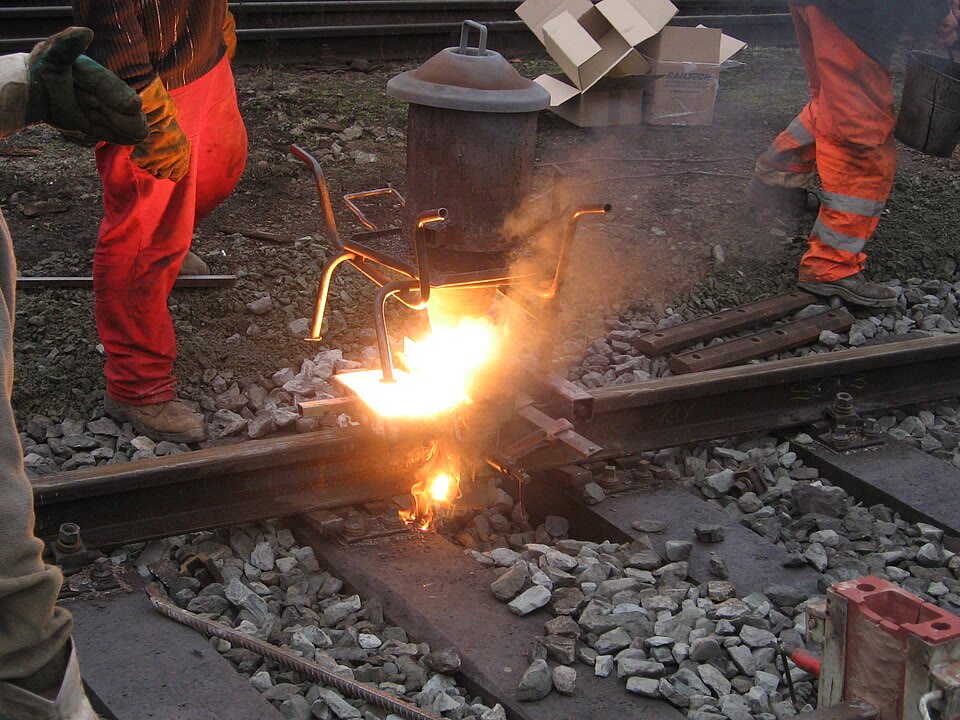
An aluminothermic reduction is the reduction of a metal oxide by aluminium powder, possible for every oxide whose line lies above that of alumina, and so exothermic that the mixture melts: (thermite) welds rails; makes chromium free of carbon.
6.3 Carbon and carbon monoxide
Three lines involve carbon:
- : one mole of gas gives one, , an almost horizontal line near ;
- : one mole of gas gives two, , a line that falls with temperature;
- : three moles of gas give two, a rising line.
Proposition 6.10 (Carbon reduces almost everything when hot)
The line of decreases with temperature and crosses the lines of most metal oxides: above the crossing temperature, carbon reduces the oxide, giving carbon monoxide. The crossing for iron(II) oxide is near , for zinc oxide near ; for titania and magnesia it lies near or above , for alumina higher still, where the metals combine with carbon into carbides or reoxidise as the gas cools.
Proof. The slope of the carbon line is negative (), that of the oxide lines positive: they meet once. The temperatures are read on the computed lines. ∎
Definition 6.11 (Boudouard equilibrium)
The Boudouard equilibrium is , endothermic, between carbon and the two oxides of carbon.
Proposition 6.12 (Composition of the gas over carbon)
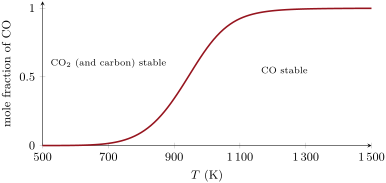
The system carbon + + has variance 2: at a given and total pressure , the mole fraction of carbon monoxide is fixed by . At the gas is almost pure below and almost pure above ; the crossing of the three carbon lines, near , is where .
Proof. Three species, one reaction, two phases: . With and , . At , the standard Gibbs energies of and are equal: the two lines, and so the third, meet. ∎
6.4 The blast furnace
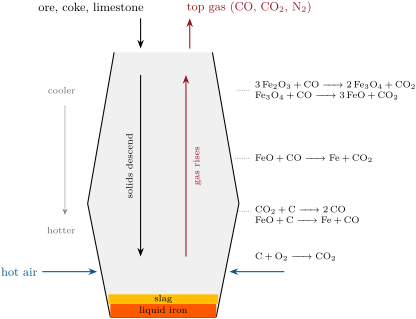
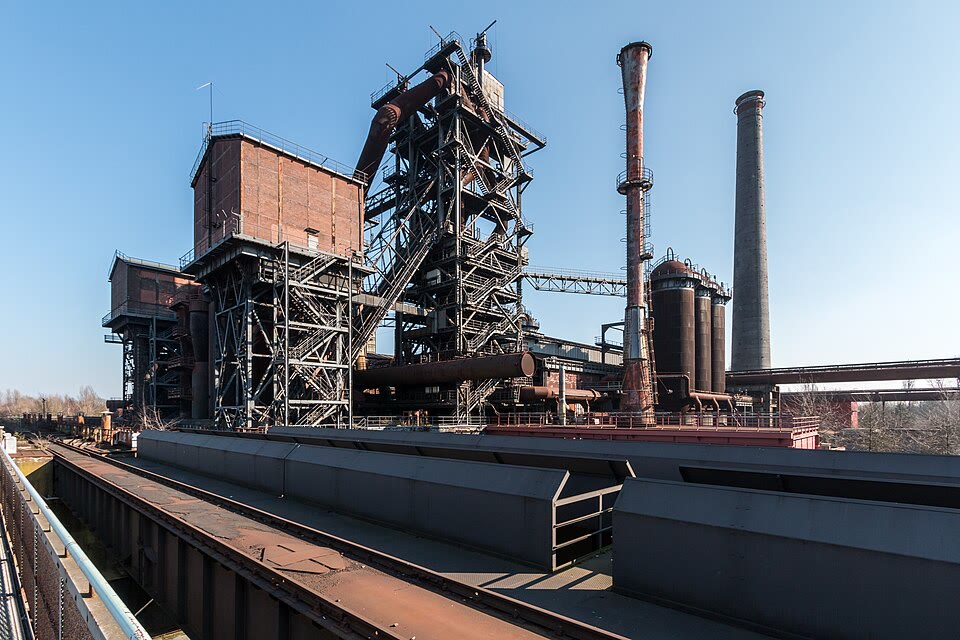
Iron ore (hematite , magnetite ), coke and limestone are charged at the top of a tall shaft; hot air is blown in near the bottom. Going down, the solids meet a hot rising gas; the gas leaves at the top, cooled.
- At the tuyeres, coke burns in the hot air: , and above, with excess carbon, (Boudouard): the gas that rises is mostly carbon monoxide and nitrogen.
- In the upper part, carbon monoxide reduces the iron oxides step by step, , , . The first two steps are easy; for the last, the / line runs a little above the line of : its standard reaction Gibbs energy is slightly positive ( at ), and the reduction needs a gas holding at least three times more than — which the Boudouard equilibrium supplies in the hot zone below.
- Lower and hotter, carbon itself reduces what remains, ; the iron dissolves carbon, melts, and collects at the bottom with a molten slag formed by lime and the silica of the ore.
6.5 Other routes to a metal
Definition 6.13 (Pyrometallurgy and hydrometallurgy)
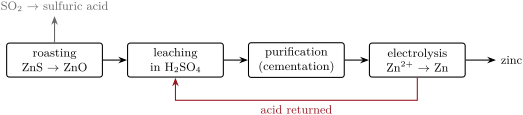
Pyrometallurgy extracts a metal at high temperature, by reduction of its oxide in a furnace. Hydrometallurgy extracts it from an aqueous solution. Their usual steps are roasting (heating a sulfide ore in air to turn it into an oxide, ), leaching (dissolving the metal’s compound, often in sulfuric acid, ), purification of the solution, for instance by cementation (reduction of the ions of a nobler metal by a powder of a less noble one, ), and the recovery of the metal, often by electrolysis.
The diagram explains the division of labour. Iron, zinc, lead, tin are won by carbon in a furnace. Aluminium, whose line lies far below that of carbon at any practicable temperature, is made by electrolysis of its molten oxide (Chapter 11); magnesium by electrolysis or by reduction with silicon under vacuum, which removes the magnesium vapour; titanium by converting the oxide to the chloride, (Exercise 2.12), then reducing the chloride with magnesium (the Kroll process). Most of the world’s zinc is made by roasting, leaching and electrolysis: the hydrometallurgical route gives a purer metal and avoids handling zinc vapour.
6.6 Exercises
Exercise 6.1 ★
Write the reactions represented by the lines of copper(I) oxide, alumina, carbon monoxide and carbon dioxide, each for one mole of .
Solution
Solution of Exercise 6.1.
; ; ; .
Exercise 6.2 ★
From the CODATA key values (, : 43.65, 41.63, ), write of for solid zinc.
Solution
Solution of Exercise 6.2.
; . So (, in ), valid up to the melting point of zinc.
Exercise 6.3 ★
Using the diagram, list the metals that can reduce chromium(III) oxide at , and those that cannot.
Solution
Solution of Exercise 6.3.
At the line of is near . Below it, so able to reduce chromium oxide: silicon, titanium, aluminium, magnesium, calcium. Above it, unable: copper, iron, zinc. Carbon, at , lies just above: it reduces chromium oxide only at a slightly higher temperature, and then gives a chromium loaded with carbide — one reason why chromium for alloys free of carbon is made by aluminothermy.
Exercise 6.4 ★
Explain the sign of the slope of each of the three carbon lines.
Solution
Solution of Exercise 6.4.
The slope is , governed by the change in the amount of gas. : one mole of gas gives one, , horizontal. : one gives two, , the line falls. : three give two, , the line rises, like those of the metals.
Exercise 6.5 ★★
Compute the equilibrium oxygen pressure of mercury(II) oxide at (mercury liquid, , per mole of ). Is mercury oxidised in air at that temperature?
Solution
Solution of Exercise 6.5.
, . Air holds , much more: mercury is oxidised at (slowly — this is how the oxide was first prepared), and the oxide decomposes only above about .
Exercise 6.6 ★★
Compute at of the thermite reaction, , given for and for , and say why the reaction, though very exergonic, does not start at room temperature.
Solution
Solution of Exercise 6.6.
. The reagents are two solids in contact only at the surface of their grains, and the reaction has a high activation energy: it must be ignited locally (a magnesium fuse); then the heat it releases keeps it going.
Exercise 6.7 ★★
Find on the diagram the temperature above which carbon reduces iron(II) oxide to iron with formation of carbon monoxide, and write the reaction.
Solution
Solution of Exercise 6.7.
The line of crosses that of near ; above, has a negative standard reaction Gibbs energy.
Exercise 6.8 ★★
At , and . Compute of the Boudouard equilibrium and the mole fraction of carbon monoxide over carbon at . What happens to the gas, in contact with soot or iron, when it is cooled to ?
Solution
Solution of Exercise 6.8.
, . Then , . On cooling to the equilibrium moves back towards (): carbon monoxide disproportionates, , and soot deposits — slowly, unless a surface such as iron catalyses it.
Exercise 6.9 ★★
Hydrogen is sometimes used to reduce tungsten oxide. Using the line of water, explain why hydrogen is a better reductant than carbon monoxide at high temperature but a worse one at low temperature.
Solution
Solution of Exercise 6.9.
The water line (three moles of gas give two) rises less steeply than the / line, also three for two but with a larger entropy loss. The two cross near : below, the / line is lower and carbon monoxide is the stronger reductant; above, the water line is lower and hydrogen wins. It is the same statement as the shift of the water-gas equilibrium towards the left at high temperature.
Exercise 6.10 ★★★
Magnesium oxide can be reduced by silicon, , though the line of silica lies above that of magnesia at every temperature of the diagram. At , magnesium is a gas and the tables give, per mole of , for magnesia and for silica. Compute of the reduction, then the pressure of magnesium vapour below which it runs forward. How does a vacuum furnace use this?
Solution
Solution of Exercise 6.10.
Per mole of , that is for : . With silicon and silica of activity 1, , negative when . A vacuum furnace pumps the magnesium vapour away as fast as it forms and condenses it on a cold surface, so its pressure never reaches that value; lime added to the charge binds the silica and lowers its activity, which helps further.
Exercise 6.11 ★★★
Compute the variance of the system , , , at equilibrium. What does it mean for the gas leaving the upper part of a blast furnace?
Solution
Solution of Exercise 6.11.
Four species, one reaction, three phases (two solids and the gas): . At given temperature and pressure the ratio is fixed: the gas cannot give up all its carbon monoxide to the iron oxide, and the top gas still contains much of it — which is burnt to preheat the air.
Exercise 6.12 ★★★
Copper is purified from its leach solution by cementation with iron scrap. Using the standard potentials of the Year 1 volume (, ), compute the equilibrium constant of and the residual concentration of copper ions when the solution holds of .
Solution
Solution of Exercise 6.12.
, . With , : the copper is removed completely.
6.7 Problem: Zinc by Fire
Problem 6.1
Weekend problem — the Ellingham lines of zinc oxide and of carbon monoxide, the temperature at which carbon reduces zinc oxide, the variance of the furnace, and the condensation of zinc vapour
Before electrolysis, zinc was made by heating its oxide with carbon in clay retorts. Data (CODATA, and the JANAF table of zinc): ; (): 43.65, 41.63, 205.15; zinc melts at () and boils at under (). For , the tables give at and at .
Part I — The line of zinc oxide.
- Compute and of at .
- Write below the melting point.
- Compute the entropies of fusion and of vaporisation of zinc.
- Write between the melting and the boiling points.
- Write it above the boiling point.
- Compute the three slopes and explain why the last is much steeper.
- Check that the three expressions agree at the transition temperatures.
Part II — The carbon line.
- From the two tabulated values, write the line of in the form between and .
- Deduce its and explain its sign.
- Write the reduction and its as a difference of the two lines (per mole of ).
- Find the temperature where the two lines cross.
- Why is it important that this temperature is above the boiling point of zinc?
Part III — The retort.
- Compute the variance of the system , , , , with zinc and carbon monoxide formed only by the reduction.
- In a retort at under , what are the partial pressures of zinc and carbon monoxide if the reaction is complete?
- Compute of the reduction at and the corresponding .
- Explain why the retort is operated slightly above the crossing temperature and not far above it.
Part IV — The condenser.
- The vapour is led into a cooler condenser. Write the reaction by which zinc vapour can be reoxidised by carbon dioxide.
- Using the diagram, explain why the gas must be kept free of carbon dioxide.
- Why must the zinc be condensed quickly rather than slowly?
- Compute the mass of carbon needed per tonne of zinc, taking the reduction as written.
- Compute the heat absorbed per tonne of zinc by the reduction at about (take from the expressions of Parts I and II).
- State the temperature above which carbon reduces zinc oxide under standard conditions.
Solution
Solution of Problem 6.1.
1. , . 2. (), below . 3. ; . 4. Liquid zinc: , : . 5. Gaseous zinc: , : . 6. Slopes , and . Above the boiling point the reaction consumes three moles of gas instead of one: the entropy loss, hence the slope, doubles. 7. At : ; at : . The lines join, as they must. 8. Slope , : . 9. : one mole of gas gives two. 10. , (). 11. Zero at . 12. Above its boiling point zinc forms as a vapour: the reaction makes gas from solids, its entropy is large and positive, and the vapour leaves the charge, which separates the metal from the ore and the coke by distillation. 13. Four species, one reaction, one particular condition (), three phases: . Fixing the pressure fixes the temperature of equilibrium. 14. One mole of zinc vapour per mole of carbon monoxide: . 15. Per mole of , , ; : the reduction runs. 16. Just above the crossing the reduction is already favoured (with of each gas, from about ); hotter costs fuel, wears the clay retorts and does not make more zinc, since the reaction goes to completion anyway. 17. . 18. The line of zinc oxide lies below the / line ( against at ): zinc vapour reduces carbon dioxide and turns back into oxide. In the retort the hot carbon destroys any (Boudouard); in the cooler condenser nothing does, and — from air leaking in, or from on cooling — spoils the zinc into a grey oxidised powder. 19. Slow cooling leaves the vapour for a long time in the range where it is reoxidised, and gives a fine dust instead of liquid metal; quick condensation to the liquid limits both. 20. of zinc, as many of carbon: (much more in practice, to heat the retorts). 21. per mole of zinc; per tonne, , that is — supplied by burning more coal around the retorts. 22. Carbon reduces zinc oxide under standard conditions above .