All books

Professional

Apps About Coach Log in Start reading

Chemistry · Glossary

What is Ideal mixture, ideal dilute solution?

Also known as: ideal mixture · ideal dilute solution

Definition 3.8 University Chemistry — Year 2 · Chapter 3 — Chemical Potential and Mixtures

A liquid (or solid) mixture is an ideal mixture if, for every constituent and every composition, μi=μi∗(T,p)+RTln⁡xi\mu_i = \mu_i^*(T, p) + RT\ln x_i, where μi∗\mu_i^* is the chemical potential of the pure liquid ii. A solution is an ideal dilute solution if the solvent obeys this law and each solute obeys μj=μj∘(T)+RTln⁡(cj/c∘)\mu_j = \mu_j^\circ(T) + RT\ln(c_j/c^\circ), with a standard state that is a hypothetical solution at c∘=1 mol/Lc^\circ = 1\,\mathrm{mol}/\mathrm{L} behaving as if infinitely dilute.

Vapour pressures over a binary liquid at fixed temperature, in units of p_1* (model mixture). Left, an ideal mixture: straight lines (Raoult). Right, a mixture whose unlike molecules attract each other less than like ones: the pressures lie above the ideal lines. Near x_1 = 1, constituent 1 follows Raoult’s line (dashed); near x_1 = 0, it follows a Henry line (dotted) of a different slope.
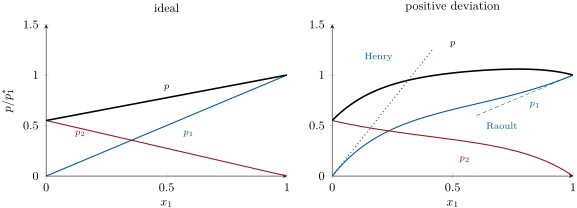
Vapour pressures over a binary liquid at fixed temperature, in units of p1∗p_1^* (model mixture). Left, an ideal mixture: straight lines (Raoult). Right, a mixture whose unlike molecules attract each other less than like ones: the pressures lie above the ideal lines. Near x1=1x_1 = 1, constituent 1 follows Raoult’s line (dashed); near x1=0x_1 = 0, it follows a Henry line (dotted) of a different slope.
Read in context →