
All books

Professional

Apps About Coach Log in Start reading

Chemistry · Glossary

What is Labile and inert complexes?

Also known as: labile complex · kinetically inert complex

Definition 19.1 University Chemistry — Year 3 · Chapter 19 — Reaction Mechanisms of Complexes

A complex is labile if its ligands are replaced quickly, and a kinetically inert complex if they are replaced slowly; following Taube, a complex is called labile when its reactions with a ligand at 0.1 mol/L0.1\,\mathrm{mol}/\mathrm{L} and 25 ∘C25\,{}^{\circ}\mathrm{C} are over within about a minute. Lability is a kinetic property, unrelated to the thermodynamic stability of the complex.
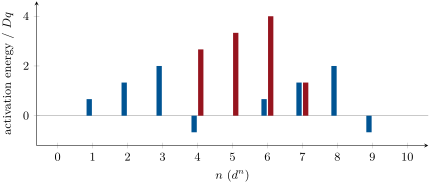
Ligand-field activation energies for a dissociative path through a square pyramid, in the -only model of the proposition (blue: high spin; red: low spin). The largest values, for low-spin d6, d3 and d8, match the inert or slow ions (Co3+, Cr3+, Ni2+); the negative ones, for d4 and d9, the very labile Jahn–Teller ions.
Ligand-field activation energies for a dissociative path through a square pyramid, in the σ\sigma-only model of the proposition (blue: high spin; red: low spin). The largest values, for low-spin d6d^6, d3d^3 and d8d^8, match the inert or slow ions (CoX3+\ce{Co^{3+}}, CrX3+\ce{Cr^{3+}}, NiX2+\ce{Ni^{2+}}); the negative ones, for d4d^4 and d9d^9, the very labile Jahn–Teller ions.
Read in context →