University Chemistry — Year 3 · Bachelor Year 3
19Reaction Mechanisms of Complexes
Dissolve a chromium(III) salt in water labelled with oxygen-18, and days pass before the labelled water has replaced the water molecules bound to the metal; with a copper(II) salt the exchange is complete within the time of mixing. The reaction is the same, one water molecule leaving a metal ion and another taking its place, yet its rate varies enormously from one ion to the next, and the number of electrons predicts much of the variation. The way ligands are replaced decides how platinum anticancer drugs are made and how they act; the way electrons move between metal ions decides the speed of respiration and of every battery. This chapter treats the two families of reactions of complexes: substitution and electron transfer, the latter with the theory of Rudolph Marcus.
You already know
The Year 2 volume described complexes, the denticity of ligands, bridging ligands, and isomers, ligand exchange as an elementary step, and crystal-field stabilisation energies with high- and low-spin configurations; the Year 1 volume, mechanisms with their steady-state and rate-determining-step approximations. Chapter 12 gave the Eyring equation and the meaning of , Chapter 15 electron transfer at an electrode, and Chapter 18 the ligand-field terms and the Jahn–Teller effect.
19.1 Lability and inertness
Definition 19.1 (Labile and inert complexes)
A complex is labile if its ligands are replaced quickly, and a kinetically inert complex if they are replaced slowly; following Taube, a complex is called labile when its reactions with a ligand at and are over within about a minute. Lability is a kinetic property, unrelated to the thermodynamic stability of the complex.
Water exchange, , is the simplest substitution and sets a scale. Ions of the main groups exchange faster when they are larger and less charged. Among transition-metal ions, those with () or low-spin (, , ) configurations are inert, and so are most second- and third-row metals, while () and high-spin (), distorted by the Jahn–Teller effect, are extremely labile.
Proposition 19.2 (Ligand-field activation energy)
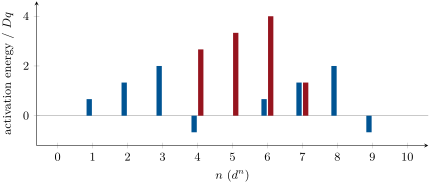
If a substitution goes through a five-coordinate square-pyramidal transition state, the loss of ligand-field stabilisation on going there (the ligand-field activation energy) is, in the simplest -only model, largest for low-spin () and next for and (), zero for , high-spin and , and negative for high-spin and .
Proof. Model each ligand as raising a orbital by times the square of the orbital’s angular amplitude in its direction, normalised to 1 on the lobe axis: an axial ligand gives 1, an equatorial one gives and ; the orbitals point between the ligands and get nothing. The octahedron gives and each (); the square pyramid, without one axial ligand, gives and . The stabilisation of electrons is their energy minus times the sum of the five levels (the barycentre). For low-spin (): in the octahedron, in the pyramid: a loss of . For : ; for (): . For : . ∎
Definition 19.3 (Volume of activation)
The volume of activation of an elementary step is the difference between the partial molar volume of the activated complex and those of the reactants.
Proposition 19.4 (Pressure dependence of a rate constant)
At constant temperature, .
Proof. By the Eyring equation , and , as for any Gibbs energy. ∎
A step in which a ligand leaves has ; one in which a ligand enters has . Measured at a few hundred megapascals, the activation volume is the most direct diagnosis of a substitution mechanism, less blurred by solvation than the entropy of activation.
19.2 Substitution mechanisms
Definition 19.5 (Dissociative, associative and interchange mechanisms)
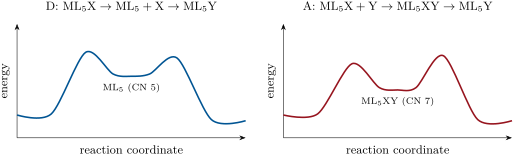
In a dissociative mechanism (D) the leaving ligand departs first, giving an intermediate of lower coordination number; in an associative mechanism (A) the entering ligand binds first, giving an intermediate of higher coordination number; in an interchange mechanism (I) the two ligands exchange in a single step, with a bond-breaking () or bond-making () character.
Proposition 19.6 (Rate laws of D and A mechanisms)
For : a D mechanism (, , ; , ) gives
first order in the complex and independent of at high ; an A mechanism through a seven-coordinate intermediate in a steady state gives , first order in each.
Proof. D: steady state for , , and . At high , . A: (, ), (); the steady state gives . ∎
In water, the entering ligand is usually present at much lower concentration than the solvent, and the true first step is the meeting of the complex and the ligand.
Definition 19.7 (Eigen–Wilkins mechanism)
The Eigen–Wilkins mechanism of substitution of an aqua complex is a fast pre-equilibrium forming an outer-sphere complex, in which the entering ligand sits next to the complex, outside its coordination sphere, followed by the rate-determining interchange of a water molecule for that ligand.
Theorem 19.8 (Eigen–Wilkins rate law)
With the outer-sphere equilibrium constant and the interchange rate constant , the observed pseudo-first-order rate constant at excess is
Proof. The complex is distributed between free and outer-sphere forms, , with total ; the rate is . ∎
At low the reaction is second order with ; , estimated from the charges and the distance of closest approach, is nearly the same for all ligands of the same charge, so that , the water-exchange step, controls the rate: substitution on an aqua ion is nearly independent of the entering ligand, the signature of a dissociative interchange.
Definition 19.9 (Conjugate-base mechanism)
The conjugate-base mechanism of base hydrolysis of an ammine complex, , is the deprotonation of an ammine ligand in a fast pre-equilibrium, followed by the dissociative loss of from the amido conjugate base, whose ligand labilises the complex.
Proposition 19.10 (Rate law of base hydrolysis)
With the deprotonation constant and the dissociation rate constant of the conjugate base, , second order at low .
Proof. As for the Eigen–Wilkins law: the complex is distributed between its acid and conjugate-base forms in the ratio , and only the latter reacts. ∎
The rate law alone does not distinguish this mechanism from a direct attack of ; the evidence is that base hydrolysis needs an N–H proton (complexes without one do not show it) and that the ammine protons exchange with the solvent much faster than the hydrolysis.
Method 19.11 (Diagnosing a substitution mechanism)
- Entering-group dependence: rate independent of Y (or saturating), dissociative; rate proportional to and sensitive to the nature of Y, associative.
- Activation volume: positive, dissociative; negative, associative.
- Entropy of activation: positive for D, negative for A (with caution, since solvation contributes).
- Leaving-group dependence: a rate that follows the strength of the M–X bond points to bond breaking in the transition state.
An octahedral complex that substitutes through a square pyramid generally keeps its configuration ( stays ); one that passes through a trigonal bipyramid, as many cobalt(III) complexes do in base hydrolysis, can give a mixture of and products.
19.3 Square-planar substitution and the trans effect
Square-planar complexes of ions (, , , with strong ligands) are coordinatively unsaturated: an entering ligand can approach along the empty axial direction. Their substitutions are associative, through a five-coordinate trigonal-bipyramidal transition state.
Proposition 19.12 (Two-term rate law)
The substitution in a coordinating solvent S follows at excess Y.
Proof. Two parallel associative paths: direct attack of Y (), and attack of the solvent, present in large excess (pseudo-first-order ), giving , which is then rapidly converted by Y. Parallel first-order paths add. ∎
Definition 19.13 (Trans effect, trans influence)
The trans effect is the acceleration of the substitution of a ligand by the ligand trans to it: a kinetic effect, on the transition state. The trans influence is the weakening, in the ground state, of the bond trans to a ligand, seen in bond lengths and vibrational frequencies: a thermodynamic effect.
The trans effect follows the order , , , , , . Strong donors weaken the trans bond (trans influence); strong acceptors stabilise the five-coordinate transition state by taking electron density from the metal. Both raise the rate.
Method 19.14 (Planning the synthesis of platinum(II) isomers)
- At each step, the ligand replaced is the one trans to the ligand of highest trans effect present.
- Order the additions so that this rule leads to the wanted isomer.
![The trans effect at work (charges omitted). Top: from [PtCl4]2-, the second ammonia replaces a chloride trans to chloride (Cl- has the larger trans effect), giving the cis isomer, cisplatin. Bottom: from [Pt(NH3)4]2+, the second chloride replaces the ammonia trans to the first chloride, giving the trans isomer.](/images/onecourse/chapters/chemistry-4/b3-complex-mechanisms/fig-2ba289e8a7fc.svg)
![The trans effect at work (charges omitted). Top: from [PtCl4]2-, the second ammonia replaces a chloride trans to chloride (Cl- has the larger trans effect), giving the cis isomer, cisplatin. Bottom: from [Pt(NH3)4]2+, the second chloride replaces the ammonia trans to the first chloride, giving the trans isomer.](/images/onecourse/chapters/chemistry-4/b3-complex-mechanisms/fig-93314eebd310.svg)
19.4 Electron transfer
Definition 19.15 (Outer- and inner-sphere electron transfer)
In outer-sphere electron transfer the electron passes between two complexes whose coordination spheres stay intact; in inner-sphere electron transfer it passes through a ligand bridging the two metals in a transient binuclear complex. A self-exchange reaction is an electron transfer between the two oxidation states of the same couple, with no net chemical change, such as .
Henry Taube showed the inner-sphere path in 1953 with a reaction chosen so that the product told its story. Cobalt(III) is inert, cobalt(II) labile; chromium(II) is labile, chromium(III) inert. When is reduced by in acid, all the chromium(III) formed carries the chloride, as , even in the presence of free chloride: the chloride must have bridged the two metals, been bound to the inert chromium(III) as soon as the electron passed, and been released by the labile cobalt(II).
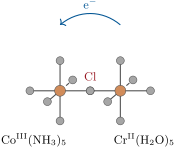
An electron jumps in about s, far faster than nuclei move: by the Franck–Condon principle (Chapter 7), the transfer can only happen at a nuclear configuration where reactants and products have the same energy. For the iron self-exchange, the –O bonds are shorter than the –O bonds; before the electron can move, the two complexes must distort to a common intermediate geometry, at a cost of energy.
19.5 Marcus theory
Definition 19.16 (Reorganisation energy)
The reorganisation energy of an electron transfer is the energy needed to bring the reactants, without transferring the electron, to the nuclear configuration (bond lengths of the complexes and orientations of the surrounding solvent) of the products. It is the sum of an inner part, from the bonds, and an outer part, from the solvent.
Theorem 19.17 (Marcus equation)
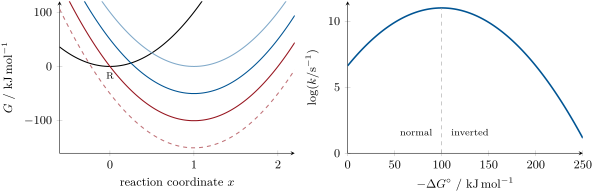
If the Gibbs energies of reactants and products are parabolas of the same curvature in a reaction coordinate (0 at the reactants’ equilibrium, 1 at the products’), the Gibbs energy of activation of an electron transfer with standard reaction Gibbs energy and reorganisation energy is
This is the Marcus equation.
Proof. Write and : the curvature is fixed by , the definition of . The transfer occurs where the curves cross: , so , and . ∎
Corollary 19.18 (Inverted region)
At fixed , the rate increases as the reaction becomes more exergonic until , where ; beyond, it decreases again.
Proof. is a parabola in with its minimum, zero, at ; for it grows again. ∎
Definition 19.19 (Inverted region)
The inverted region of electron transfer is the range of driving forces in which the rate decreases as the reaction becomes more exergonic.
Proposition 19.20 (Outer-sphere reorganisation energy)
For two spherical reactants of radii , at a distance in a solvent of refractive index and relative permittivity , the solvent part of is proportional to .
Proof. Admitted at this level. ∎
Water, very polar ( large) but with an ordinary refractive index, gives a large solvent reorganisation; non-polar solvents a small one. Large reactants reorganise less: this is why electron-transfer proteins bury their metal sites inside the protein.
Theorem 19.21 (Marcus cross relation)
For a cross reaction with equilibrium constant , between couples whose self-exchange rate constants are and ,
with the collision frequency factor; when is not too large. This is the Marcus cross relation.
Partial proof. Assume the reorganisation energy of the cross reaction is the mean of those of the self-exchanges, (each reactant contributes half of its own self-exchange reorganisation), and all rate constants . Then . The first term gives (since ), the second (with ), the third the factor . ∎
Method 19.22 (A cross-reaction rate from self-exchange data)
- Find the self-exchange constants , of the two couples.
- Compute from the standard potentials: .
- (with if is very large). Agreement within a factor of a few with the measured value indicates an outer-sphere mechanism.
Marcus published the theory in 1956; the inverted region, at first doubted, was observed in 1984 by Gerhard Closs and John Miller in molecules where donor and acceptor are held at a fixed distance by a rigid spacer, so that diffusion cannot hide it.
In the lab — Water exchange by oxygen-17 NMR
The oxygen-17 resonance of water bound to a paramagnetic ion and that of bulk water are broadened by the exchange between them. Recording the linewidth of the bulk water signal against temperature, in a solution of the metal perchlorate enriched in , gives the exchange rate constant and, in a high-pressure probe, its activation volume.
Safety


Potassium tetrachloroplatinate(II): toxic if swallowed, causes serious eye damage, a respiratory and skin sensitiser. Platinum complexes are handled with gloves in a fume hood; cisplatin and its analogues are cytotoxic drugs and are handled as such.
History — Taube and Marcus
Henry Taube classified complexes as labile or inert in 1952, and with his chromium–cobalt experiment of 1953 established the inner-sphere mechanism; he received the 1983 Nobel Prize in Chemistry. Rudolph Marcus derived from 1956 the theory of electron transfer that bears his name, and received the 1992 Nobel Prize in Chemistry.
19.6 Exercises
Exercise 19.1 ★
Classify as labile or inert, with a reason: , , , , .
Solution
Solution of Exercise 19.1.
Inert: () and (low-spin ), large ligand-field activation energies. Labile: (high-spin ) and (), Jahn–Teller distorted with long, weak axial bonds; (), no ligand-field barrier.
Exercise 19.2 ★
Show that the D rate law reduces to at high and to when .
Solution
Solution of Exercise 19.2.
When the denominator is and ; when it is and the second form follows (a pre-equilibrium inhibited by the leaving ligand).
Exercise 19.3 ★
Predict the signs of and for a D and an A substitution.
Solution
Solution of Exercise 19.3.
D: and (a ligand leaves). A: both negative (a ligand is bound in the transition state).
Exercise 19.4 ★
Give the products of with two , and of with two .
Exercise 19.5 ★★
For a substitution on an aqua ion, and (data of the exercise). Compute at and , and its limit.
Solution
Solution of Exercise 19.5.
; at , ; limit .
Exercise 19.6 ★★
A rate constant doubles when the pressure rises from 0.1 to at . Compute and conclude.
Solution
Solution of Exercise 19.6.
: associative.
Exercise 19.7 ★★
In the Pt–Cl bond trans to is and the two others (data of the exercise). Interpret, and predict which chloride is replaced first.
Solution
Solution of Exercise 19.7.
The phosphine, a strong donor and acceptor, weakens the bond trans to it (trans influence, longer bond) and labilises it (trans effect): that chloride is replaced first.
Exercise 19.8 ★★
List the experimental evidence that would show an electron transfer to be inner sphere.
Solution
Solution of Exercise 19.8.
The bridging ligand ends up transferred to the oxidised metal; the rate depends strongly on the nature of the potential bridge; a binuclear intermediate is detected; and the rate cannot exceed that of the substitution needed to form the bridge on the labile partner.
Exercise 19.9 ★★
For , compute for , , and .
Exercise 19.10 ★★★
Two couples have self-exchange constants and , and their cross reaction has (data of the exercise). Estimate ().
Solution
Solution of Exercise 19.10.
.
Exercise 19.11 ★★★
Using the -only model, compute the ligand-field activation energies of high-spin , and ions and rank , and by expected water-exchange rate.
Solution
Solution of Exercise 19.11.
High-spin : 0; : ; : . Expected water-exchange rates: , the order observed.
Exercise 19.12 ★★★
Why is the inverted region hard to observe for reactions between ions that diffuse together in solution, and how did rigid donor–acceptor molecules reveal it?
Solution
Solution of Exercise 19.12.
For very exergonic reactions the intrinsic rate exceeds the rate at which the ions meet: the observed constant stays at the diffusion limit and the decrease is hidden. With donor and acceptor fixed at a set distance in one molecule, there is no diffusion step, and a series of acceptors of increasing driving force showed the rate rising, passing a maximum and falling.
19.7 Problem: Making Cisplatin, Not Transplatin
Problem 19.1
Weekend problem — making cisplatin, not transplatin: the square-planar platinum(II) ion, a synthesis planned with the trans effect, the aquation of the drug, and why it is activated inside cells
Cisplatin, -, is made from . Data of the problem: at the first aquation, , has the rate constant and the equilibrium constant ; the chloride concentration is about in blood plasma and inside cells.
Part I — Platinum(II).
- Give the -electron count of .
- Why are its complexes square planar and diamagnetic?
- Why are their substitutions associative?
- Write the two-term rate law and explain its two terms.
- Is the drug labile or inert on the time scale of a day?
Part II — The synthesis.
- What does give with two ? Why?
- That direct route gives impure product. Dhara’s route first converts into with excess KI. Why is iodide useful?
- Adding gives -. Explain the stereochemistry.
- The iodides are then removed with silver nitrate in water. What forms?
- Adding KCl gives cisplatin. Why does the configuration not change?
- How would you make transplatin instead?
- Why is transplatin of no use as a drug, although it reacts too?
Part III — Aquation.
- Compute the half-life of the first aquation.
- Compute the fraction aquated after in a chloride-free solution.
- Why is the aqua complex the reactive form towards DNA?
- Is the aquation dissociative or associative? What would its activation volume be?
- Why is a drug solution for injection made up in saline?
Part IV — Plasma and cell.
- Write the equilibrium fraction of the aqua complex as a function of .
- Compute it in plasma.
- Compute it inside a cell.
- Compute the ratio.
- Why does the drug therefore act mostly inside cells?
- What other ligands inside a cell can bind platinum and deactivate the drug?
- Why do the two ammine ligands stay bound throughout?
- State the result: the ratio of the aqua-complex fraction inside a cell to that in plasma.
Solution
Solution of Problem 19.1.
1. . 2. The strong field of a ion makes the orbital, pointing at four ligands, very high: eight electrons pair in the four lower orbitals. 3. The complex has 16 valence electrons and an open axial site: the entering ligand binds first, through a five-coordinate transition state. 4. : a solvent path (solvent attack, then fast replacement by Y) and a direct path. 5. Substitution takes hours (part III): inert on the scale of minutes, not of a day. 6. Cisplatin, because the second replaces a chloride trans to chloride (trans effect ); side products form as well. 7. Iodide has a larger trans effect than chloride, which makes the directing effect cleaner and faster. 8. In the iodide trans to iodide is labilised, not the one trans to : the second ammonia enters cis to the first. 9. Silver iodide precipitates and - remains in solution. 10. Chloride replaces the two water molecules at their own positions; the ammines are not touched. 11. From and two chlorides. 12. Its two reactive positions are opposite each other: it cannot bind two neighbouring bases of the same DNA strand, the lesion through which cisplatin acts. 13. . 14. . 15. Water is a much better leaving group than chloride: the aqua complex is replaced quickly by the nitrogen of a DNA base. 16. Associative, as for all platinum(II) substitutions: negative activation volume. 17. The high chloride concentration pushes the equilibrium back towards the dichloro form, keeping the drug intact until it reaches the cells. 18. . 19. . 20. . 21. 15. 22. Only inside cells does an appreciable fraction exist as the reactive aqua complex. 23. Sulfur ligands, such as glutathione and the cysteine and methionine of proteins, which bind the soft platinum strongly. 24. Ammonia binds platinum strongly and lies trans to chloride, a ligand of small trans effect: the ammine bonds are not labilised. 25. About 15 times more of the drug is in the reactive aqua form inside a cell than in plasma.