All books

Professional

Apps About Coach Log in Start reading

Chemistry · Glossary

What is Langmuir–Hinshelwood and Eley–Rideal mechanisms?

Also known as: Langmuir--Hinshelwood mechanism · Eley--Rideal mechanism

Definition 16.12 University Chemistry — Year 3 · Chapter 16 — Surfaces, Adsorption and Heterogeneous Catalysis

In the Langmuir–Hinshelwood mechanism both reactants are adsorbed and react on the surface; in the Eley–Rideal mechanism an adsorbed reactant reacts with a molecule arriving from the gas.
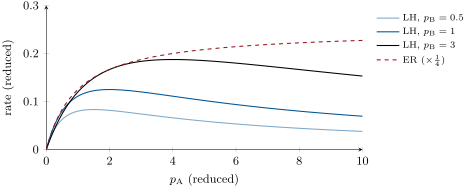

Rates of a bimolecular surface reaction against the pressure of A (reduced units, K_ A = K_ B = 1). Langmuir–Hinshelwood: each curve peaks at K_ Ap_ A = 1 + K_ Bp_ B, then falls as A displaces B. Eley–Rideal (dashed, scaled): a plateau.
Rates of a bimolecular surface reaction against the pressure of A (reduced units, KA=KB=1K_{\mathrm A} = K_{\mathrm B} = 1). Langmuir–Hinshelwood: each curve peaks at KApA=1+KBpBK_{\mathrm A}p_{\mathrm A} = 1 + K_{\mathrm B}p_{\mathrm B}, then falls as A displaces B. Eley–Rideal (dashed, scaled): a plateau.
Read in context →