University Chemistry — Year 3 · Bachelor Year 3
16Surfaces, Adsorption and Heterogeneous Catalysis
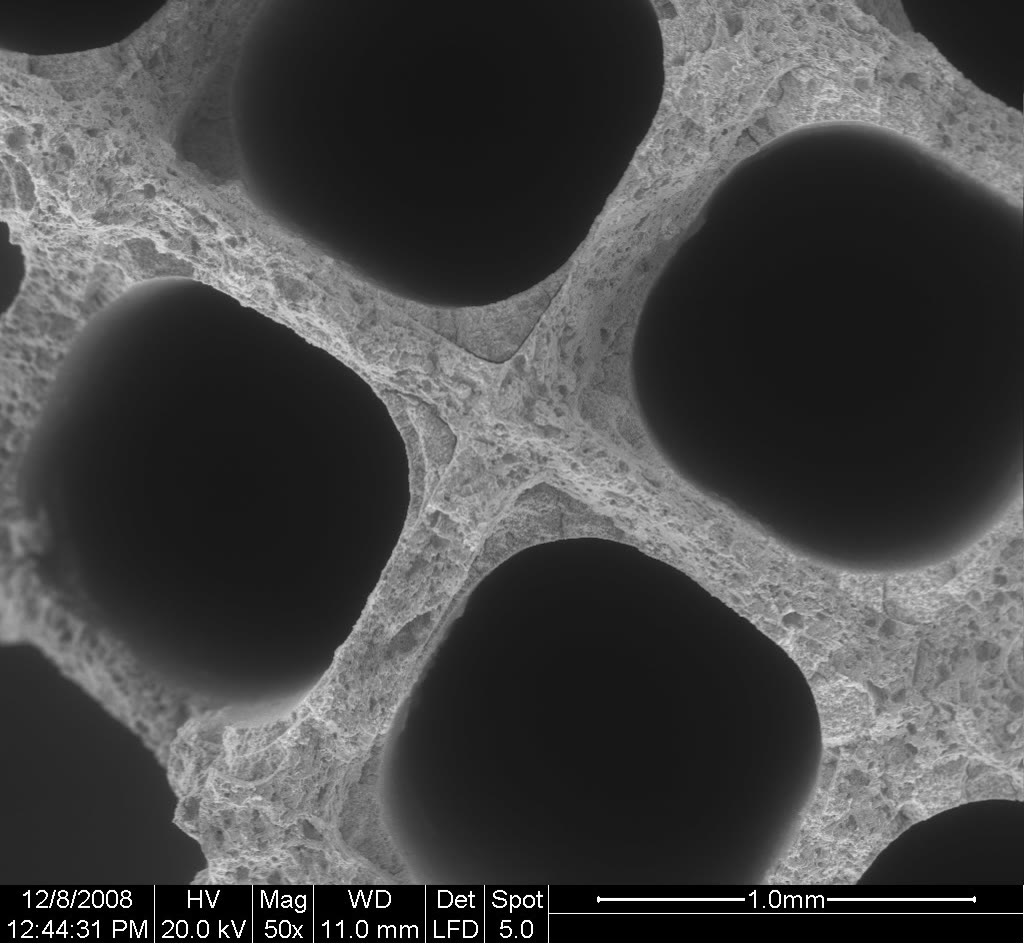
Under a car, inside a steel can, sits a ceramic honeycomb whose thousands of channels are coated with a porous oxide holding a few grams of platinum, palladium and rhodium. In a fraction of a second, the exhaust gases flowing through it lose most of their carbon monoxide, unburnt hydrocarbons and nitrogen oxides. Nothing happens in the gas: every one of these reactions takes place on the surface of the metal particles, a few nanometres across. Most of the chemical industry runs the same way, from the ammonia of fertilisers to the cracking of petroleum. This chapter describes how molecules stick to surfaces, how much of a surface they cover, how surface reactions proceed, and how a solid catalyst is made, measured and looked at.
You already know
The Year 1 volume defined catalysts and the difference between homogeneous and heterogeneous catalysis, and described the face-centred cubic packing of metals. The Year 2 volume defined the conversion, the selectivity and the turnover frequency of a catalyst, and Le Chatelier’s principle. Chapter 9 introduced Miller indices, Chapter 12 the Eyring equation and Chapter 10 the statistics of distributions.
16.1 Adsorption
Definition 16.1 (Adsorption)
Adsorption is the accumulation of molecules of a gas or a solute on the surface of a solid or a liquid. The molecule that adsorbs is the adsorbate, the solid the adsorbent; the reverse process is desorption.
Definition 16.2 (Physisorption, chemisorption)
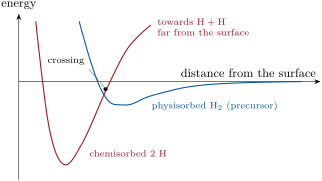
Physisorption is adsorption by van der Waals forces, with enthalpies of adsorption of a few tens of kilojoules per mole at most, comparable to enthalpies of condensation, and no change of the molecule. Chemisorption forms chemical bonds with the surface, with enthalpies of about 40 to several hundred kilojoules per mole; it can break the molecule (dissociative chemisorption) and stops at one layer.
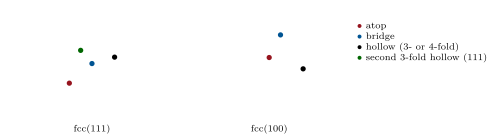
The surfaces of metal particles expose mostly the densest faces of the fcc lattice, (111) and (100). On them an adsorbate can sit on top of one atom (atop), between two (bridge) or in a hollow between three or four, and the binding energy differs from site to site.
Definition 16.3 (Fractional coverage, monolayer)
The fractional coverage of a surface is the fraction of its adsorption sites that are occupied. A monolayer is a single complete layer of adsorbate, .
16.2 Isotherms
Theorem 16.4 (Langmuir isotherm)
If a surface has identical, independent sites, each holding one molecule, the coverage at equilibrium with a gas at pressure is
where , the adsorption equilibrium constant, depends only on the temperature. This is the Langmuir isotherm.
Proof. Kinetic proof. Molecules adsorb on the free sites at the rate ( sites) and desorb at the rate . At equilibrium the two are equal: , which rearranges to the result with .
Statistical proof. molecules on sites can be arranged in ways, each adsorbed molecule having an internal partition function (its vibrations against the surface and its binding energy). With Stirling’s formula the chemical potential of the adsorbed molecules is ; that of the ideal gas is . Equilibrium, , gives : the same law, with written in terms of partition functions. ∎
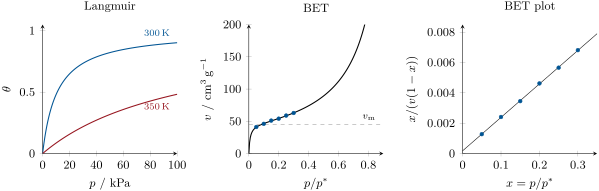
At low pressure (Henry’s regime); at high pressure . The coverage is one half at .
Proposition 16.5 (Dissociative adsorption)
For a diatomic gas that dissociates on two sites, (: a free site),
so that at low pressure.
Proof. Adsorption needs two free sites, at the rate ; desorption needs two adsorbed atoms to recombine, at the rate . Equality gives . ∎
Proposition 16.6 (Competitive adsorption)
Two gases A and B competing for the same sites cover them with
Proof. For each gas, and likewise for B. Hence and with the free fraction; adding, . ∎
Definition 16.7 (Isosteric enthalpy of adsorption)
The isosteric enthalpy of adsorption is the molar enthalpy of adsorption at a fixed coverage, obtained from the pressures that give the same coverage at different temperatures.
Proposition 16.8 (Isosteric enthalpy)
At constant coverage,
Proof. At constant , is constant (for a Langmuir surface; in general the same argument holds with the equilibrium constant at that coverage), so . By the van ’t Hoff equation, (with referred to a standard pressure). ∎
Since adsorption is exothermic, higher temperatures need higher pressures for the same coverage: the isotherms of the figure fall as rises.
Theorem 16.9 (BET isotherm)
If molecules adsorb in successive layers, the first with a binding constant characteristic of the surface and the others with the condensation equilibrium of the liquid, the amount adsorbed at relative pressure (: vapour pressure of the liquid adsorbate) is
where is the amount in a monolayer and a constant related to the difference between the enthalpies of adsorption in the first layer and of condensation. This is the BET isotherm (Brunauer, Emmett and Teller).
Proof. Let be the fraction of the surface covered by exactly layers. The balance of each layer, as in the Langmuir proof, gives and for , so . The amount adsorbed is . With and :
∎
Rearranged, : a straight line whose slope and intercept give and , usually valid for .
Definition 16.10 (Specific surface area)
The specific surface area of a solid is its surface area per unit mass, including the walls of its pores.
Method 16.11 (Specific surface area from a nitrogen isotherm)
- Degas the sample under vacuum while heating; cool it in liquid nitrogen ().
- Measure the volume of nitrogen adsorbed (reduced to standard conditions) at relative pressures between 0.05 and 0.30.
- Plot against ; from slope and intercept, and .
- Area , with the amount in the monolayer and the conventional area of an adsorbed nitrogen molecule.
16.3 Kinetics of surface reactions
Definition 16.12 (Langmuir–Hinshelwood and Eley–Rideal mechanisms)
In the Langmuir–Hinshelwood mechanism both reactants are adsorbed and react on the surface; in the Eley–Rideal mechanism an adsorbed reactant reacts with a molecule arriving from the gas.
Proposition 16.13 (Langmuir–Hinshelwood rate)
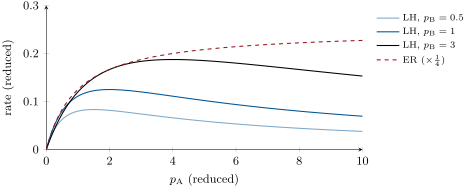
If adsorption equilibria are fast and the surface reaction of adsorbed A and B is rate-determining,
which, at fixed , is largest when and then falls as A crowds B off the surface.
Proof. The coverages are those of Proposition 16.6. With and , , whose derivative vanishes at . ∎
Proposition 16.14 (Eley–Rideal rate)
If adsorbed A reacts with gaseous B,
which grows with to a plateau, without a maximum.
Proof. B does not compete for the sites: is the Langmuir coverage of A alone, and the rate is proportional to it and to the collision rate of B with the surface, proportional to . ∎
Method 16.15 (LH or ER from the pressure dependence)
- Measure the rate against the pressure of each reactant, the other held fixed.
- A maximum, then a decline (negative order at high pressure): Langmuir–Hinshelwood, the reactant inhibiting by occupying the sites.
- A rise to a plateau in one reactant and first order in the other at all pressures: Eley–Rideal.
- Confirm with isotope labelling or surface spectroscopy; most catalytic reactions turn out to be of the Langmuir–Hinshelwood type.
Proposition 16.16 (Apparent activation energy)
For a unimolecular surface reaction with Langmuir adsorption, . At low coverage the measured activation energy is ; at high coverage it is .
Proof. At low coverage , so . At high coverage and . ∎
Since , a reaction on a sparsely covered surface looks easier than its true barrier: raising the temperature speeds up the surface step but empties the surface.
Definition 16.17 (Sabatier principle, volcano plot)
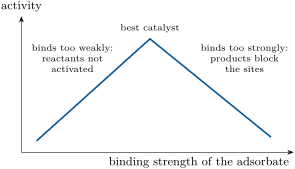
The Sabatier principle states that the best catalyst binds the reactants neither too weakly (they do not adsorb or activate) nor too strongly (the products do not leave and block the sites). A volcano plot of the activity of a series of catalysts against a binding energy has a maximum at intermediate binding.
16.4 Industrial catalysts
Definition 16.18 (Catalyst design)
A catalyst support is a porous, high-area solid (alumina, silica, carbon) that carries small particles of the active phase. A promoter is an additive, inactive alone, that raises the activity, selectivity or stability. A catalyst poison is a substance that binds strongly to the active sites and blocks them. The metal dispersion is the fraction of the metal atoms that lie on the surface. Sintering is the growth of the particles at high temperature, which lowers the dispersion.
Method 16.19 (Dispersion and particle size from hydrogen chemisorption)
- Reduce the catalyst in hydrogen, evacuate, and measure the volume of chemisorbed (reduced to standard conditions) on the metal; the support adsorbs none.
- Assume one H atom per surface metal atom: .
- For spheres of diameter , , with the volume per atom in the bulk and the area per surface atom; hence .
Ammonia synthesis, , runs at about 400 to and 100 to over iron promoted with potassium oxide and alumina: the alumina keeps the iron crystallites from sintering, the potassium raises the activity. The rate-determining step is the dissociative chemisorption of , whose triple bond is the hardest to break. Some 150 million tonnes of nitrogen a year are fixed in this way.
The oxidation of to , on vanadium(V) oxide promoted with potassium sulfate, is the key step of sulfuric acid manufacture.
The three-way converter of petrol engines oxidises CO and hydrocarbons and reduces nitrogen oxides at the same time, on platinum and palladium (oxidation) and rhodium (reduction of NO), dispersed on alumina with cerium oxide, which stores and releases oxygen. It works only in a narrow window around the stoichiometric air–fuel ratio: with excess air the NO is not reduced, with excess fuel the CO is not oxidised; an oxygen sensor in the exhaust keeps the engine in the window. Lead from leaded fuel poisons the metal, which is one reason leaded petrol disappeared. Zeolites, crystalline aluminosilicates with pores of molecular size and acidic sites, crack the large molecules of heavy oil fractions into petrol and admit only molecules that fit their channels.
16.5 Looking at surfaces
Definition 16.20 (Thermal desorption spectroscopy)
Thermal desorption spectroscopy heats a surface carrying an adsorbate at a constant rate and records the desorbing gas with a mass spectrometer; each binding state gives a peak, whose temperature increases with its desorption activation energy.
The position of a desorption peak gives the desorption energy (for first-order desorption, with the heating rate and , admitted), its area the amount adsorbed. Photoelectron spectroscopy with X-rays (XPS) measures the binding energies of core electrons of the surface atoms, which identify the elements and their oxidation states in the first few nanometres. The scanning tunnelling microscope moves a sharp tip a few tenths of a nanometre above a conducting surface; the tunnelling current (Chapter 1) falls by about an order of magnitude for each of extra distance, so that keeping it constant while scanning maps the surface atom by atom.
In the lab — A BET measurement
About of sample is weighed into a glass tube with a bulb, degassed for hours under vacuum at 150 to , weighed again, and mounted on the instrument, the bulb immersed in a dewar of liquid nitrogen. The instrument admits nitrogen in small doses and measures the equilibrium pressure after each, deducing the amount adsorbed from the gas balance; the dead volume of the tube is measured with helium, which does not adsorb.
Safety


Reduced metal catalysts (finely divided nickel, palladium or platinum on a support, freshly reduced in hydrogen) can ignite on contact with air: they are handled under inert gas and passivated before storage. Nickel is a skin sensitiser and a suspected carcinogen; vanadium(V) oxide is toxic if inhaled and swallowed and may cause cancer. Catalyst powders are weighed in a ventilated enclosure.
History — Langmuir and the ammonia catalyst
Irving Langmuir, working on light bulbs in an industrial laboratory, derived his isotherm in 1916–1918 from the idea that adsorbed gases form a layer one molecule thick, and received the 1932 Nobel Prize in Chemistry for his surface chemistry. A few years earlier, Alwin Mittasch had organised the search for a practical ammonia catalyst: thousands of compositions were tested in small high-pressure reactors before the promoted iron catalyst, still in use, was chosen. It was one of the first systematic catalyst screenings.
16.6 Exercises
Exercise 16.1 ★
A gas covers 40 % of a Langmuir surface at . Compute and the coverage at .
Solution
Solution of Exercise 16.1.
; at , .
Exercise 16.2 ★
Two adsorption enthalpies are measured on a metal: and . Which is physisorption, which chemisorption? Which could be dissociative?
Solution
Solution of Exercise 16.2.
: physisorption (the order of a condensation enthalpy); : chemisorption, which alone can be dissociative.
Exercise 16.3 ★
Count, per surface atom, the atop, bridge and hollow sites of a (100) face and of a (111) face of an fcc metal.
Solution
Solution of Exercise 16.3.
(100): one atop, two bridge (four bonds shared by two atoms each), one four-fold hollow (four hollows shared by four atoms). (111): one atop, three bridge, two three-fold hollows (six triangles around each atom, each shared by three).
Exercise 16.4 ★
A catalyst converts of reactant per gram per second and carries of surface sites per gram. Compute the turnover frequency.
Solution
Solution of Exercise 16.4.
.
Exercise 16.5 ★★
Hydrogen adsorbs dissociatively with at . Compute at .
Solution
Solution of Exercise 16.5.
: at , doubled at : , so .
Exercise 16.6 ★★
CO () and (, non-dissociative in this simple model) compete for the sites of a platinum surface at 1.0 and . Compute the two coverages and comment on the CO oxidation rate.
Solution
Solution of Exercise 16.6.
Denominator : , , free sites 0.07. The Langmuir–Hinshelwood rate, proportional to , is limited by the scarcity of oxygen on a surface crowded with CO.
Exercise 16.7 ★★
A coverage reached at at needs at . Compute the isosteric enthalpy of adsorption.
Solution
Solution of Exercise 16.7.
.
Exercise 16.8 ★★
An activated carbon has (standard conditions, 273.15 K and ). Compute its BET area.
Solution
Solution of Exercise 16.8.
; area .
Exercise 16.9 ★★
The rate of on platinum rises, passes a maximum and falls as increases at fixed . Which mechanism does this indicate, and why does CO inhibit the reaction?
Solution
Solution of Exercise 16.9.
Langmuir–Hinshelwood: both reactants must be adsorbed on neighbouring sites; CO binds strongly and, at high pressure, leaves no room for oxygen.
Exercise 16.10 ★★★
A surface reaction has a true activation energy of ; the reactant has . What activation energy is measured at low and at high coverage? Sketch against over a wide range.
Solution
Solution of Exercise 16.10.
Low coverage: ; high coverage: . The plot of against is steep (slope ) at low temperature, where the surface is full, and flatter (slope ) at high temperature, where it empties: a curve bending between the two.
Exercise 16.11 ★★★
Sulfur adsorbs on a nickel catalyst with a coverage of 0.10 (sulfur atoms per surface Ni), each sulfur atom blocking four sites. What fraction of the activity remains for a reaction needing one free site? Two adjacent free sites (assume randomly placed blocked sites)?
Solution
Solution of Exercise 16.11.
of the sites are blocked: 60 % of the activity remains for one site, about for two adjacent free sites.
Exercise 16.12 ★★★
For ammonia synthesis, three metals bind atomic nitrogen with enthalpies of , and (data of the exercise). Using the Sabatier principle, which is likely the best catalyst, and what limits the other two?
Solution
Solution of Exercise 16.12.
The middle one (): the first binds nitrogen too weakly to break readily, the third too strongly, so that nitrogen atoms stay on the surface and block it.
16.7 Problem: Measuring a Catalyst
Problem 16.1
Weekend problem — measuring a catalyst: the BET area of a supported platinum catalyst, its metal dispersion and particle size from hydrogen chemisorption, and the turnover frequency of a hydrogenation
A catalyst contains 1.00 % by mass of platinum on alumina. Data of the problem: nitrogen isotherm at (volumes at standard conditions, 273.15 K and , per gram):
| 0.05 | 0.10 | 0.15 | 0.20 | 0.25 | 0.30 | |
| / | 41.2 | 46.1 | 51.1 | 54.1 | 58.9 | 62.9 |
chemisorbed on the platinum: per gram of catalyst. A hydrogenation runs at per gram of catalyst per second. Platinum: , fcc, ; molar volume of a gas at standard conditions ; .
Part I — The BET plot.
- Why is the isotherm measured at ?
- Why are only relative pressures between 0.05 and 0.30 used?
- Compute for each point.
- The least-squares line has slope and intercept (in ). Deduce .
- Deduce . What does a large mean?
- Why is the intercept so poorly determined, and does it matter for ?
Part II — The area.
- Compute the amount of nitrogen in the monolayer per gram.
- Compute the specific surface area.
- Which part of the solid provides almost all of this area?
- Why does the BET method fail for microporous solids such as zeolites?
Part III — Dispersion and particle size.
- Compute the amount of H atoms chemisorbed per gram.
- Compute the amount of platinum per gram.
- Deduce the dispersion.
- Compute the volume per Pt atom in the bulk.
- The area per surface atom, averaged over the (111), (100) and (110) faces, is . Check the (111) value, .
- Show that for spheres .
- Compute the mean particle diameter.
- Which assumptions limit this result?
Part IV — Activity.
- Compute the turnover frequency per surface Pt atom.
- Compute the rate per gram of platinum.
- If the particles sintered to at constant turnover frequency, by what factor would the rate per gram fall?
- What would a turnover frequency that changes with particle size reveal?
- Why are catalysts compared by turnover frequency rather than rate per gram?
- State the result: the mean diameter of the platinum particles.
Solution
Solution of Problem 16.1.
1. Nitrogen condenses near at atmospheric pressure: a full range of relative pressures is reached, and multilayers form. 2. Below 0.05 the surface heterogeneity, above 0.30 condensation in the pores, violate the BET assumptions. 3. , , , , , . 4. . 5. : the first layer binds much more strongly than the liquid does. 6. It is tiny compared with the slope times , so its relative error is large; but depends on the sum of slope and intercept, dominated by the slope. 7. . 8. . 9. The alumina support: the exposed platinum (part III) has about . 10. Pores of molecular width fill completely at very low pressure, not layer by layer, so no monolayer can be identified. 11. . 12. . 13. . 14. . 15. , the densest face; (100) and (110) give 0.0770 and , and the mean of the three site densities gives . 16. A sphere holds atoms, of which are on the surface: . 17. . 18. One H per surface Pt; spherical particles of one size (the result is a surface-weighted mean); all the platinum reduced and accessible; no hydrogen spilling over onto the support. 19. . 20. per gram of platinum. 21. instead of 0.357: a factor 3.2. 22. That the reaction is structure-sensitive: its active sites (edges, corners, particular faces) are not a constant fraction of the surface. 23. It counts the events per active site, removing the effect of how much metal is exposed. 24. Mean platinum particle diameter .