All books

Professional

Apps About Coach Log in Start reading

Chemistry · Glossary

What is Ligand field theory?

Definition 19.13 University Chemistry — Year 2 · Chapter 19 — Ligand Field Theory and Colour

Ligand field theory describes a complex with molecular orbitals built from the valence orbitals of the metal (its nine nnd, (n+1)(n+1)s and (n+1)(n+1)p orbitals) and the donor orbitals of the ligands.
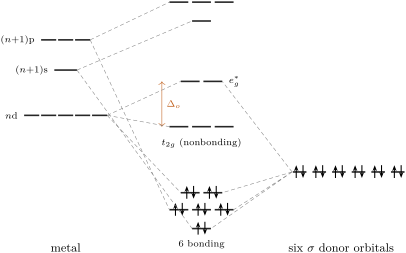
Molecular orbitals of an octahedral complex with six  donors, schematic. The ligands’ twelve electrons fill the six bonding orbitals; the metal’s d electrons occupy the nonbonding t_2g and the antibonding e_g* levels, separated by _o — the crystal-field picture recovered. Up to 18 electrons fill the bonding and nonbonding levels.
Molecular orbitals of an octahedral complex with six σ\sigma donors, schematic. The ligands’ twelve electrons fill the six bonding orbitals; the metal’s d electrons occupy the nonbonding t2gt_{2g} and the antibonding eg∗e_g^* levels, separated by Δo\Delta_o — the crystal-field picture recovered. Up to 18 electrons fill the bonding and nonbonding levels.
Read in context →
