University Chemistry — Year 2 · Bachelor Year 2
19Ligand Field Theory and Colour
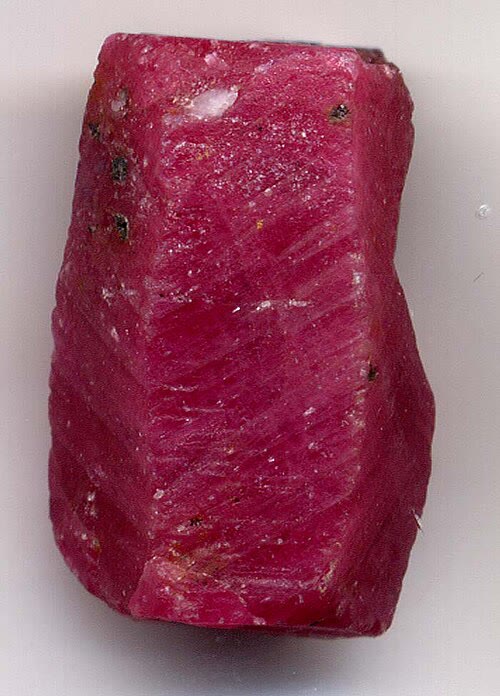
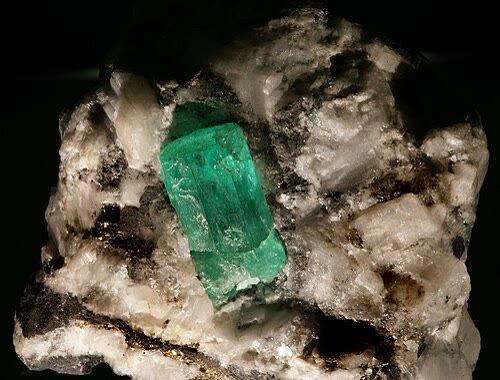
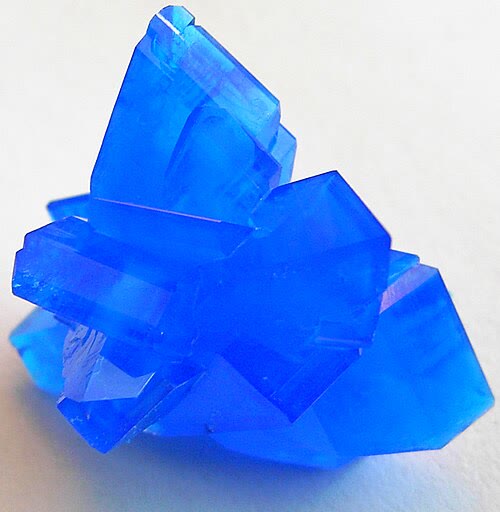
Ruby is red and emerald is green, yet both owe their colour to the same ion, , a few of which replace aluminium in corundum, , or in beryl. Copper sulfate crystals are deep blue, but the powder left after heating them is white. In each case the colour comes from electrons jumping between d orbitals whose energies the surrounding atoms have pulled apart — by an amount that depends on which atoms surround the ion and how. This chapter computes that splitting, first with point charges, then with molecular orbitals; it explains colours, magnetism, and the 18-electron rule of the previous chapter.
You already know
Chapter 18: configurations, geometries, electron counts. Chapter 13: the shapes of the five d orbitals. Chapter 15: fragment orbitals. The Year 1 volume: absorbance, complementary colours, unpaired electrons, Hund’s rule.
19.1 The crystal-field model
Definition 19.1 (Crystal field)
The crystal-field model treats the ligands of a complex as negative point charges (or the negative ends of dipoles) around the metal ion, and computes how they change the energies of its d orbitals. In an octahedral field, the d orbitals split into two sets separated by the crystal-field splitting .
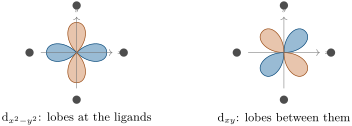
Place the six ligands on the axes. The and orbitals point their lobes straight at ligands: an electron in them is repelled more and they rise. The , , orbitals point between the ligands and rise less. The first pair is called , the second set of three (names from group theory, in the Year 3 volume).
Theorem 19.2 (Barycentre)
In an octahedral field, measured from the average energy of the d orbitals, the pair lies at and the set at .
Proof. The field raises the average of the five d energies but does not change it by splitting (the barycentre rule, admitted: the sum of the shifts of a full set of orbitals is fixed by the total charge, not by its arrangement). With at and at , the condition gives . ∎
19.2 High spin and low spin
Definition 19.3 (Spin states)
The pairing energy is the energy needed to put a second electron into an occupied orbital rather than into an empty one of the same energy. A complex is high spin when its electrons occupy the orbitals before pairing in , low spin when they pair in first.
Proposition 19.4 (Choice of the spin state)
For to octahedral ions, the complex is low spin if and high spin if . For – and – only one configuration exists.
Proof. From (), the fourth electron either enters (cost above ) or pairs in (cost ). The cheaper wins; the same comparison holds for each electron up to . For – there is room in without pairing; for –, is full and must be used anyway. ∎
Definition 19.5 (Crystal-field stabilisation energy)
The crystal-field stabilisation energy (CFSE) of a configuration is , the energy of the d electrons relative to the barycentre (the pairing energies counted separately).
Proposition 19.6 (CFSE along the series)
High spin, the CFSE is , , , , , , , , , , (in ) for to : it vanishes for , , . Low spin it reaches for .
Proof. Fill the configurations and apply the definition; the values are those of the figure, computed. ∎
![Left: crystal-field stabilisation energy along the d series (computed), high spin (solid) and low spin (dashed). Right: the two configurations of a d6 ion: four unpaired electrons when _o < P (as [Fe(H2O)6]2+), none when _o > P (as [Fe(CN)6]4-).](/images/onecourse/chapters/chemistry-3/b2-ligand-field/fig-ab9e59c36ee1.svg)
![Left: crystal-field stabilisation energy along the d series (computed), high spin (solid) and low spin (dashed). Right: the two configurations of a d6 ion: four unpaired electrons when _o < P (as [Fe(H2O)6]2+), none when _o > P (as [Fe(CN)6]4-).](/images/onecourse/chapters/chemistry-3/b2-ligand-field/fig-9f4bc9de3d4e.svg)
Method 19.7 (Spin state, CFSE and unpaired electrons)
- Find from the oxidation state ().
- For –, compare and (or place the ligand in the spectrochemical series): strong field, low spin; weak field, high spin.
- Fill and accordingly; CFSE .
- Count the unpaired electrons; any unpaired electron makes the complex paramagnetic.
19.3 Other geometries
Proposition 19.8 (Tetrahedral and square-planar fields)
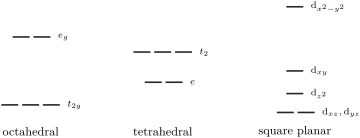
In a tetrahedral field the order is inverted: two orbitals () below three (), with a splitting for the same metal and ligands; tetrahedral complexes are high spin. In a square-planar field the orbital lies far above the others: a ion fills the four lower orbitals and leaves it empty.
Proof. Admitted at this level. ∎
The factor comes from the geometry of the point charges; with only four ligands, none pointing along the axes, the splitting is too small to overcome the pairing energy. Removing the two ligands on the axis of an octahedron lowers the orbitals with a component and raises nothing: this explains the square-planar complexes of the previous chapter, whose eight electrons all find room below the empty .
19.4 Colour and the spectrochemical series
Definition 19.9 (d–d transition)
A d–d transition is the promotion of an electron from a lower to a higher d level of a complex by absorption of light; for a ion, from to , at the energy .
Proposition 19.10 (Splitting from colour)
If a complex absorbs most strongly at the wavelength by a d–d transition of energy , then per mole, or in wavenumbers; the colour seen is the complement of the colour absorbed.
Proof. A photon of wavelength carries ; one mole of photons, . White light minus the absorbed band appears in the complementary colour. ∎
Method 19.11 (From an absorption band to a colour)
- Convert to () and to (): .
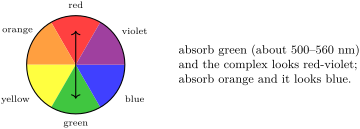
- Find the colour absorbed (violet 400–430, blue 430–490, green 490–560, yellow 560–590, orange 590–620, red 620–700 nm, approximately).
- The colour seen is opposite on the colour wheel.
Definition 19.12 (Spectrochemical series)
The spectrochemical series orders ligands by the splitting they produce for a given metal ion:
For a given ligand, also grows with the charge of the metal ion and down a group (4d and 5d complexes, larger than 3d, are almost always low spin).
The halides are at the weak end and and at the strong end, which the crystal-field model cannot explain: it would put the charged above the neutral . The explanation needs orbitals.
19.5 The ligand field
Definition 19.13 (Ligand field theory)
Ligand field theory describes a complex with molecular orbitals built from the valence orbitals of the metal (its nine d, s and p orbitals) and the donor orbitals of the ligands.
Proposition 19.14 ( bonding in an octahedral complex)
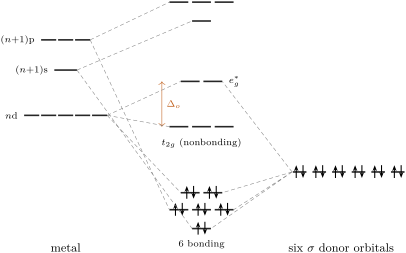
With six ligands each giving one donor orbital, six bonding molecular orbitals form from the metal’s s, three p and the two d orbitals; the three orbitals, which point between the ligands, stay nonbonding; above them lie the antibonding orbitals. The ligand electrons fill the six bonding orbitals; the metal’s d electrons go into and , separated by . Bonding plus nonbonding orbitals can hold electrons.
Argument. By the fragment method of Chapter 15, each metal orbital interacts with the combination of ligand orbitals of the same symmetry: s with the totally symmetric one, each p with a pair of opposite ligands, and with the combinations pointing along their lobes; no combination matches the orbitals (their overlap with any donor pointing along an axis is zero by symmetry). The names of the combinations come from group theory, admitted. Filling all the bonding and nonbonding orbitals, and none of the antibonding ones, takes 18 electrons — the 18-electron rule. ∎
Definition 19.15 (-donor and -acceptor ligands)
A -donor ligand has filled orbitals of symmetry with respect to the metal–ligand bond (lone pairs of , ); a -acceptor ligand has empty ones of low energy (the orbitals of and ). The transfer of electron density from filled metal d orbitals into the empty orbitals of a -acceptor ligand is called back-donation.
Proposition 19.16 ( effects on the splitting)
-donor ligands decrease ; -acceptor ligands increase it.
Proof. The orbitals have the right symmetry to overlap with ligand orbitals. A filled ligand orbital lies below : by Theorem 17.1 the interaction pushes up, towards , and shrinks. An empty orbital lies above : the interaction pushes down, and grows. The second case transfers metal d density into the ligand’s : back-donation. ∎
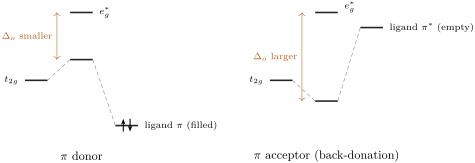
This places and , strong donors and acceptors, at the top of the spectrochemical series, and the halides, donors, at the bottom. Metal carbonyls have their orbitals stabilised and filled: the 18-electron complexes of Chapter 18.
19.6 Exercises
Exercise 19.1 ★
Give the octahedral configuration and CFSE of a ion and of a ion.
Solution
Solution of Exercise 19.1.
: , CFSE . : , CFSE .
Exercise 19.2 ★
How many unpaired electrons do (high spin) and (low spin) have?
Exercise 19.3 ★
A complex absorbs most strongly at . What colour does it look?
Solution
Solution of Exercise 19.3.
600 nm is orange light; the complex looks blue (greenish blue).
Exercise 19.4 ★
Order , , , by the splitting they produce.
Solution
Solution of Exercise 19.4.
.
Exercise 19.5 ★★
For a ion, with water and with cyanide, and (exercise data). Predict both spin states and the unpaired electrons.
Exercise 19.6 ★★
is pink, deep blue. Explain the change of colour from the change of geometry and ligand.
Solution
Solution of Exercise 19.6.
In the tetrahedral the splitting is about of an octahedral one, and chloride is a weaker ligand than water: the d–d band moves to longer wavelengths (orange to red), and the complex looks blue. Tetrahedral complexes also absorb more strongly, hence the deep colour.
Exercise 19.7 ★★
Show that square-planar is diamagnetic, while tetrahedral has two unpaired electrons.
Solution
Solution of Exercise 19.7.
is . Square planar: four lower orbitals hold the eight electrons in pairs, stays empty: diamagnetic. Tetrahedral: , two unpaired electrons in the set.
Exercise 19.8 ★★
A complex absorbs at (exercise data). Compute in and .
Solution
Solution of Exercise 19.8.
; , .
Exercise 19.9 ★★
Why are compounds of and colourless?
Solution
Solution of Exercise 19.9.
is and : no d–d transition is possible (no empty d level for , no d electron for ), so no absorption in the visible.
Exercise 19.10 ★★★
Count the electrons in the molecular orbitals of : which levels are filled, and is the complex diamagnetic?
Solution
Solution of Exercise 19.10.
Co(III) + six ammonia lone pairs: 18 electrons. Twelve fill the six bonding orbitals, six fill the nonbonding (ammonia gives a field strong enough for low spin with cobalt(III)); is empty. All electrons are paired: diamagnetic.
Exercise 19.11 ★★★
Explain why , a neutral and weakly basic molecule, produces a larger splitting than the fluoride ion.
Solution
Solution of Exercise 19.11.
is a good donor and, above all, a acceptor: its empty orbitals lower the level by back-donation, widening . is a donor, which raises and narrows . The point-charge model sees only the charge and gets the order wrong.
Exercise 19.12 ★★★
The hydration enthalpies of the ions from to , plotted against , form two humps above a straight line through , and . Explain the shape with the high-spin CFSE.
Solution
Solution of Exercise 19.12.
Without a field, the hydration enthalpies would follow a smooth line (ions shrinking along the series). Water gives high-spin aqua complexes whose CFSE is zero for , , and largest for and : the extra stabilisation adds two humps, peaking near and , above the line through , , .
19.7 Problem: Red Ruby, Green Emerald
Problem 19.1
Weekend problem — chromium(III) in an octahedral field, the absorption bands of ruby and the colour they leave, the weaker field of emerald, and hydrated and anhydrous copper sulfate
Data stated for the problem (rounded, illustrative): ruby ( in ) absorbs in two bands, near and ; in emerald ( in beryl) the first band lies near . For a ion the first band corresponds to . .
Part I — Chromium(III).
- Give the configuration of .
- How is it distributed in an octahedral field?
- Is there a choice between high and low spin?
- Compute its CFSE.
- How many unpaired electrons does it have?
- Why are chromium(III) complexes kinetically inert (slow to exchange ligands)?
Part II — Ruby.
- What surrounds a ion substituted for in corundum?
- Convert the first band to wavenumber.
- Deduce in .
- Which colours are absorbed by the two bands?
- What remains to be seen?
- Why are there two bands for a single splitting? (A qualitative answer.)
Part III — Emerald.
- Convert the emerald band to .
- Compare with ruby: which crystal gives the stronger field?
- Where does the absorbed colour move, and what colour is transmitted?
- Suggest a structural reason for the weaker field in beryl.
- Would the number of unpaired electrons change?
Part IV — Copper sulfate.
- What is the configuration of ?
- In , copper is surrounded by water molecules. Why is the solid blue?
- What happens to the colour when the water is driven off, and why?
- Why does a drop of water turn the white powder blue again?
- Would absorb at shorter or longer wavelength than the aqua ion?
- Can a ion be high or low spin?
- Is paramagnetic?
- State of in ruby from its first absorption band.
Solution
Solution of Problem 19.1.
1. . 2. , one electron in each of the three orbitals, parallel spins. 3. No: three electrons fit in without pairing. 4. . 5. Three. 6. The CFSE is large and the orbitals, which point at the ligands, are empty: removing or adding a ligand costs much of that stabilisation. 7. Six oxide ions at the corners of a slightly distorted octahedron. 8. , about . 9. : . 10. Yellow-green (556 nm) and violet (405 nm). 11. Red, with a little blue: the deep red of ruby. 12. A ion has more than one excited configuration with an electron in ; electron repulsion gives them different energies, hence several bands (treated in the Year 3 volume). 13. , (). 14. Ruby: its splitting is larger. 15. To orange-red: red is now absorbed, and green (with some blue) is transmitted. 16. In beryl the chromium sites are slightly larger and the oxide ions farther, and the surroundings differ: a weaker field. 17. No: a ion keeps three unpaired electrons in any octahedral field. 18. . 19. The aqua complex absorbs in the red and orange by a d–d transition: the transmitted light is blue. 20. It turns white: without water ligands around copper (sulfate takes their place), the field is weaker and the band moves into the infrared. 21. Water binds to copper again and the blue aqua complex forms. 22. At shorter wavelength: ammonia, above water in the series, gives a larger splitting (the deep blue-violet of the ammine complex). 23. No: is the only configuration. 24. Yes: one unpaired electron. 25. , about .